
The launch of NVIDIA’s flagship GeForce RTX 5090 has been met with both awe at its performance and a familiar sense of trepidation regarding its power requirements. As the most powerful consumer graphics card on the market, the RTX 5090 continues the trend of high-wattage hardware that pushes the limits of modern power delivery standards. Central to this discussion is the 12VHPWR connector, a component that has remained under intense scrutiny since its introduction with the previous generation of hardware. While NVIDIA and its partners have made iterative improvements to the connector’s design to prevent the melting issues that plagued some early RTX 40-series cards, the enthusiast community remains vigilant. This vigilance was recently highlighted by a novel solution shared on social media, where a custom hardware modification aims to bypass the thermal bottlenecks of the standard power interface.
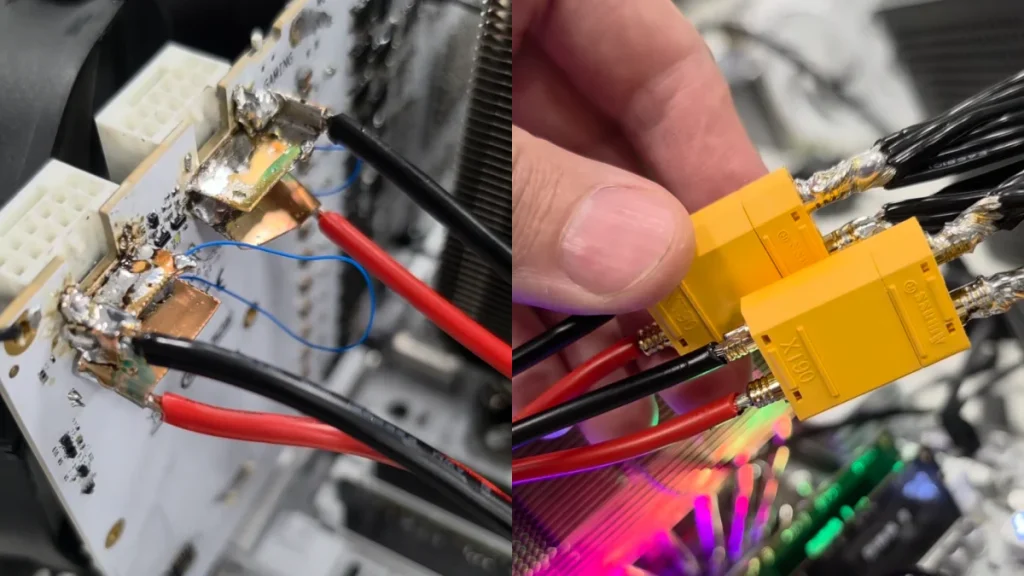
Reddit user u/DallasGrave, a figure within the PC enthusiast community, recently shared a provocative fix for his RTX 5090. According to the user, the card’s 12VHPWR connector was experiencing significant overheating during operation. To combat this, he showcased a custom-engineered module securely screwed onto the rear of the graphics card’s PCB. This module functions as a specialized power distributor, a hardware-level modification designed to fundamentally alter how current is delivered to the GPU’s hungry silicon. The primary objective of the device is to split the massive electrical load across a larger number of wires and contact points than the standard connector allows. By increasing the number of paths for the current to travel, the mod effectively reduces the electrical resistance at any single point, thereby lowering the operating temperatures of the power delivery system.
The visual evidence provided by u/DallasGrave shows a sophisticated piece of hardware that integrates directly with the card’s architecture. Unlike simple cable extensions or 90-degree adapters that have been popular—and sometimes problematic—in the past, this module appears to be a more permanent and integrated solution. The creator of the mod is not merely a hobbyist; u/DallasGrave is associated with GRAVEPC.com, a boutique firm that specializes in bespoke cooling solutions and hardware modifications, particularly for small form-factor (SFF) PCs. In the world of SFF builds, where airflow is limited and components are packed into tight quarters, thermal management is the most significant hurdle to performance. A high-wattage card like the RTX 5090 presents a unique challenge in such environments, where even a slight increase in connector temperature can lead to catastrophic failure.
The emergence of this mod has sparked a significant conversation regarding the role of third-party interventions in high-end hardware maintenance. When questioned by community members about the implications such a modification might have on the manufacturer’s warranty, u/DallasGrave offered an optimistic outlook. He claimed that his firm is currently a PNY partner and suggested that consumers might soon be able to bypass the risks of DIY modification altogether. According to his statements, GRAVEPC intends to offer PNY-branded RTX 5090 cards pre-fitted with this custom power distribution module. Crucially, he asserted that these modified cards would be sold directly through his platform and would come with a full warranty, theoretically providing peace of mind to enthusiasts who are wary of the 12VHPWR connector’s reliability.
However, the claim of a "full warranty" for a modified high-end GPU is one that industry analysts and veteran builders are approaching with caution. While GRAVEPC.com is known for its specialized cooling work, the modification in question is not yet listed as a standard product on their official website. Furthermore, the history of warranty claims involving the 12VHPWR connector is fraught with complications. Manufacturers have historically been very protective of their hardware specifications, often citing any deviation from the provided power cables as a violation of warranty terms. PNY, in particular, has a documented history of being stringent when it comes to honoring warranty claims related to power connector failures, especially when third-party components are involved.
This skepticism is rooted in recent reports involving prebuilt systems and the 12VHPWR interface. In one notable instance, a consumer who purchased a high-end gaming PC valued at over $5,000 found themselves in a difficult position after their RTX 5090 connectors melted. The system, which had reportedly sat unused for a period, suffered a failure that the manufacturer, Digital Storm, and the card partner, PNY, declined to cover. The denials were based on a combination of expired coverage and the use of third-party power cables. Such incidents highlight the precarious nature of high-end PC ownership; even when a user invests a small fortune into their hardware, the fine print of a warranty agreement can leave them with a very expensive, non-functional component if the power delivery fails.
The technical necessity for a mod like the one presented by u/DallasGrave stems from the sheer amount of energy the RTX 5090 requires. As NVIDIA pushes the boundaries of what is possible with consumer-grade graphics processing, the power draw has climbed toward the 600-watt mark. Delivering this much power through a single, relatively small connector requires a high degree of precision. Any slight misalignment, dust ingress, or insufficient seating of the cable can increase resistance. According to the laws of physics, increased resistance at high current leads to localized heat—a phenomenon known as Joule heating. If this heat exceeds the melting point of the plastic housing or the solder joints, the connector fails. By splitting the load across more wires, the GRAVEPC module aims to ensure that no single wire or pin is pushed to its thermal limit, creating a wider safety margin for the user.
Despite the logical appeal of the mod, the broader PC gaming community remains divided on whether such solutions should be necessary in the first place. The 12VHPWR standard was intended to simplify cable management and provide a unified path for high-wattage delivery, but its implementation has been one of the most controversial topics in hardware circles for years. The transition from multiple 8-pin connectors to a single 16-pin interface was meant to usher in the future of the ATX 3.0 standard, yet the frequency of reported issues has led some to believe the design is fundamentally overextended for the power levels required by cards like the RTX 5090.
The involvement of a custom shop like GRAVEPC suggests that there is a market for "hardened" versions of these flagship cards. For professional users and extreme enthusiasts who cannot afford downtime, a card that has been modified at the factory or by an authorized partner to include superior power distribution might be worth the premium. If the partnership with PNY is as robust as u/DallasGrave claims, it could represent a new business model where boutique firms act as specialized "tuners" for high-end silicon, much like how performance shops modify high-end sports cars with the blessing of the original manufacturer.
Until these modified cards become a retail reality with clearly defined legal protections, consumers are advised to remain cautious. The claim that a third-party modification will be fully supported by a major manufacturer like PNY is a significant one, and it remains to be seen how the official RMA departments will handle such hardware if it eventually fails for reasons unrelated to the power module. For now, the mod serves as a fascinating proof of concept and a testament to the ingenuity of the PC building community. It highlights the lengths to which enthusiasts will go to protect their investments and optimize their hardware performance.
As the RTX 5090 continues its lifecycle, the industry will be watching closely to see if other partners or third-party manufacturers adopt similar power distribution strategies. If overheating remains a persistent concern for the 12VHPWR standard, the " DallasGrave fix" might transition from a niche Reddit post to an industry-standard approach for ultra-high-performance GPUs. For the time being, however, most users will likely stick to the standard cables provided by their power supply manufacturers, ensuring they are fully seated and following all safety guidelines provided by NVIDIA and its partners to avoid the risk of a denied warranty claim. The evolution of PC power delivery is clearly still in a state of flux, and the community-led innovations emerging today may well dictate the design standards of tomorrow.
 Hardware Reviews & PC Building
Used Hardware Purchase Leads to Unexpected Valorant Ban for German Gamer as Riot’s Vanguard Flags Secondhand CPU
The secondary market for PC components has long been a haven for...
 Hardware Reviews & PC Building
Amazon Prime Day 2026: Final 24 Hours of Big Deal Days Feature Massive Savings on RTX 5070 Systems, Ryzen 9800X3D, and Premium Gaming Peripherals
As the clock winds down on the 2026 iteration of Amazon’s Big...
 Hardware Reviews & PC Building
Intel Shifts Strategic Focus to Trust Domain Extensions as Software Guard Extensions Era Nears its Conclusion
In a significant realignment of its long-term data center security roadmap, Intel...







