

CoreWeave, the specialized cloud provider that has effectively crowned itself the king of the "neoclouds" by focusing almost exclusively on high-end artificial intelligence processing, continues to be a polarizing figure in the technology and finance sectors. As the company navigates the turbulent waters of the generative AI boom, it remains a focal point for both bullish investors who see it as the backbone of the next industrial revolution and bearish critics who worry about its aggressive leverage. The company’s recently released financial results for the third quarter of 2026 provide a complex picture of a business that is simultaneously scaling at a breakneck pace, exercising immense pricing power, and grappling with the massive costs of its own rapid expansion.
The central narrative of CoreWeave’s current fiscal health is one of supply and demand. In a world where the hunger for Graphics Processing Units (GPUs) far outstrips the available supply, CoreWeave occupies a privileged position. This persistent undersupply has allowed the company to do something rarely seen in the maturing cloud computing market: significantly raise prices on aging hardware. As organizations scramble to secure the compute power necessary to train increasingly massive large language models (LLMs) and run inference workloads at scale, the market value of even "vintage" GPUs in the CoreWeave fleet has seen a dramatic upward trajectory.
During a detailed review of the company’s performance for the quarter ending in September 2026, CoreWeave co-founder and chief executive officer Michael Intrator highlighted how the company is capitalizing on these favorable market dynamics. Intrator revealed that in July, CoreWeave implemented a broad-based price increase of approximately 25 percent across its various stock-keeping units (SKUs). This was not a one-time adjustment; the company followed up with another 10 percent increase later in the same quarter. According to Intrator, this upward momentum in pricing has carried over into the fourth quarter, more than offsetting the rising operational costs associated with running a global network of high-density datacenters.
The economics of CoreWeave’s fleet management are particularly revealing. The company is currently operating a two-tiered strategy to maximize returns. On one hand, it is allocating a significant portion of its capacity to short-term, opportunistic contracts where the extreme demand allows for premium pricing. In these scenarios, CoreWeave is commanding prices in excess of $40 million per megawatt annually. On the other hand, the company continues to sign four- and five-year long-term contracts for new infrastructure, which are currently pricing in the range of $20 million to $25 million per megawatt.
While the long-term commitments provide the financial visibility and predictability necessary to support CoreWeave’s massive capital expenditure (capex) program, the short-term contracts allow the company to act as a high-frequency trader of compute power, capturing the "spread" created by immediate supply crunches. Intrator noted that the company carefully weighs the trade-off of every contract, assessing the full lifecycle economics of the investment, from the cost of financing the hardware to the long-term revenue potential and the immediate operational overhead.
One of the most surprising aspects of the Q3 2026 report is the continued profitability of older hardware. Intrator pointed out that rental prices for Nvidia’s "Ampere" A100 GPUs rose by 30 percent sequentially during the third quarter. Even more impressively, rental prices for the "Hopper" H100 and H200 GPUs surged by 50 percent in the same period. To put this in perspective, the A100 GPUs are now roughly six and a half years old, having first hit the market in mid-2020. The H100s are now four years old. In the traditional world of enterprise IT, hardware of this age is typically considered legacy and is often being phased out.
However, in the context of the AI boom, these chips remain highly functional workhorses for many types of model training and the vast majority of inference tasks. From a financial standpoint, this is a windfall for CoreWeave. By most estimates, the A100 fleet has been completely written down on the company’s balance sheet, and the H100 fleet is likely to be fully depreciated by next year. When a piece of hardware is fully written down, the revenue it generates—minus the cost of power, cooling, and maintenance—becomes almost pure profit. This allows CoreWeave to generate exceptional margins on its "vintage" fleet even as it takes on massive debt to acquire the next generation of silicon.
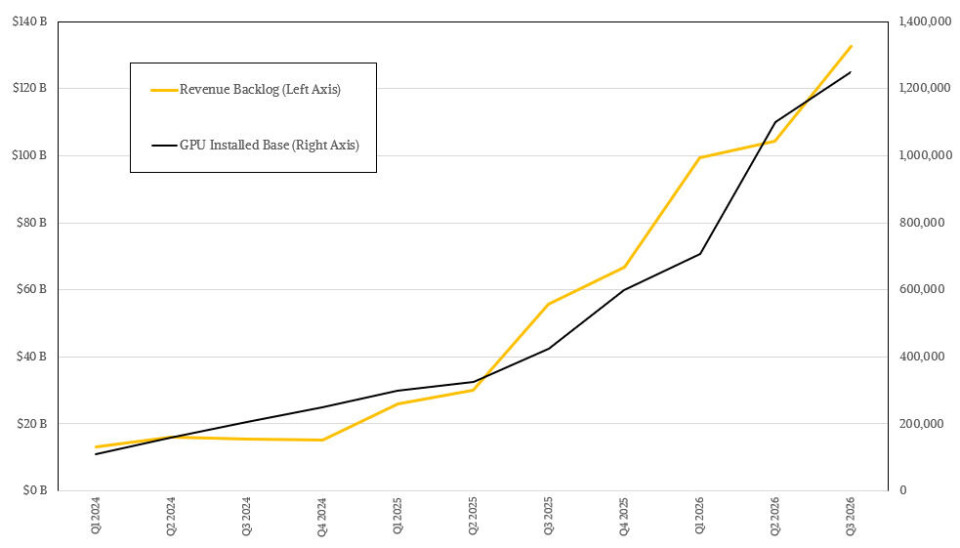
The scale of CoreWeave’s operation is becoming difficult to overstate. Based on active power consumption, it is estimated that the company currently has approximately 1.25 million GPUs installed and operational. While this is a massive footprint, a significant portion of this fleet is currently locked into older, lower-priced contracts. As these contracts expire, CoreWeave is poised to realize a massive jump in revenue. Intrator noted that approximately 130,000 GPUs are scheduled to come off contract in 2027, with another 170,000 up for renewal in 2028.
The math behind these renewals is staggering. Intrator projected that the 2027 renewals alone would generate an incremental $4 billion in annualized revenue based on current market rates. When the 2028 renewals are factored in, that figure is expected to grow by an additional $10 billion in incremental annualized revenue. This creates a "built-in" growth engine for the company that is somewhat independent of new hardware acquisitions, provided that demand for GPU compute remains high.
The CEO also addressed the potential risks of a slowdown in datacenter construction across the broader industry. Paradoxically, such a slowdown might actually benefit CoreWeave in the short to medium term. If the build-out of new physical datacenter space stalls, existing compute capacity becomes even scarcer, potentially keeping GPU rental prices higher for a longer duration. Because CoreWeave was early to the market and has a massive installed base that is already paid for, it stands to benefit from a "first-mover" advantage in a supply-constrained environment.
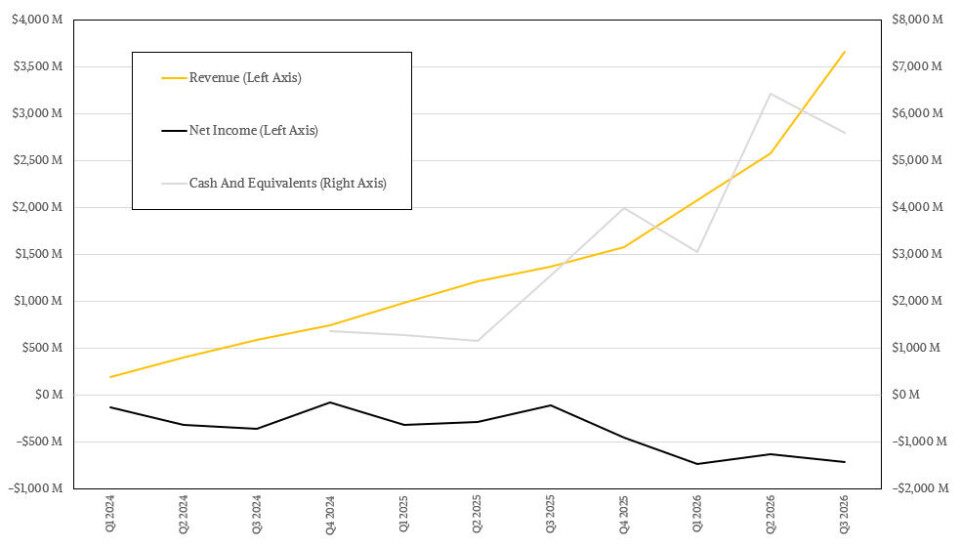
However, the company’s financial health is not without its stressors. The aggressive expansion has required an unprecedented amount of capital. CoreWeave’s debt load is now estimated to be approximately $48 billion. This debt is the engine that funds the expansion of the company’s datacenter footprint and the acquisition of new server fleets, but it comes with a high cost of service. In the third quarter of 2026, CoreWeave reported $3.66 billion in revenue, representing a 2.7-fold increase year-over-year and a 42.2 percent increase from the second quarter. Operating income also trended positively, reaching $207 million compared to $52 million in the same quarter a year ago.
The "bottom line," however, tells a different story. Due to the massive interest payments required to service its $48 billion debt, CoreWeave’s net loss expanded significantly, reaching $709 million for the quarter—a 6.4-fold increase compared to previous periods. This means that, for the moment, net losses are outpacing revenue growth. The company’s strategy for rectifying this imbalance relies on its ability to transition from debt-funded expansion to "success-based capex," where the proceeds from price increases and prepayments from major customers are used to fund further growth.
The current backlog of revenue suggests that the demand is there to support this transition. CoreWeave exited the third quarter with a staggering revenue backlog of $132.5 billion, which is 2.4 times higher than it was a year ago. This backlog represents contracted future revenue that provides a degree of safety against market volatility. Furthermore, the company maintains a significant cash cushion, exiting the quarter with just under $5.6 billion in cash and equivalents.
The pace of investment remains relentless. In the third quarter alone, CoreWeave spent $14.5 billion on capital expenses. For the first nine months of 2026, the company’s total spend on datacenter gear and facilities reached $30.7 billion. This level of spending is essential for the company to maintain its lead in the neocloud space, but it also means the business must operate like a shark—it must keep moving and expanding to stay alive.
There is a clear and strong correlation between the size of the CoreWeave GPU fleet and the revenue backlog it is able to secure. As long as the company can continue to find the power and the physical space to house its growing fleet, the revenue numbers are likely to continue their upward climb. However, the broader industry faces a looming challenge: the availability of electrical power. While capacity seems relatively secure through 2027 and into 2028, largely due to the high volume of prepaid capacity and existing infrastructure projects, the outlook for 2029 and 2030 is more uncertain. Finding the massive amounts of power required for the next phase of IT sector expansion will be a significant hurdle for all major cloud providers, CoreWeave included.
For now, CoreWeave is successfully navigating a high-stakes game of scale. The company is betting that the "GenAI bubble"—if it is indeed a bubble—will not burst before its massive investments begin to pay off and its debt load stabilizes relative to its income. The current strategy of using price increases on fully depreciated hardware to help fund the next generation of infrastructure is a sophisticated financial maneuver that, if successful, could see CoreWeave emerge as a permanent and highly profitable fixture of the global computing landscape.
The results from the third quarter of 2026 suggest that while the company is still deep in the "investment phase" of its lifecycle, the fundamental economics of the AI boom are currently working in its favor. The ability to command premium prices for both new and old silicon, combined with a record-breaking revenue backlog, provides CoreWeave with a path toward long-term sustainability, provided it can manage the crushing weight of its interest payments in the interim. As the industry watches closely, CoreWeave continues to double down on its specialized vision of the cloud, betting that in the age of AI, compute is the most valuable currency in the world.
 Enterprise Tech & Infrastructure
Navigating the Shift to Software-Defined Storage: Essential Strategies for Modern Enterprise Data Management
The landscape of enterprise data management is undergoing a fundamental transformation as...
 Enterprise Tech & Infrastructure
Mastering Amazon S3 Cost Control: Why the Per-Gigabyte Rate Is Only the Beginning of the Bill
In the landscape of enterprise cloud infrastructure, the Amazon S3 storage bucket...
 Enterprise Tech & Infrastructure
Decoding the Total Cost of Ownership: A Strategic Approach to Amazon S3 Storage Optimization
For the modern enterprise, the Amazon S3 bill is frequently a source...







