
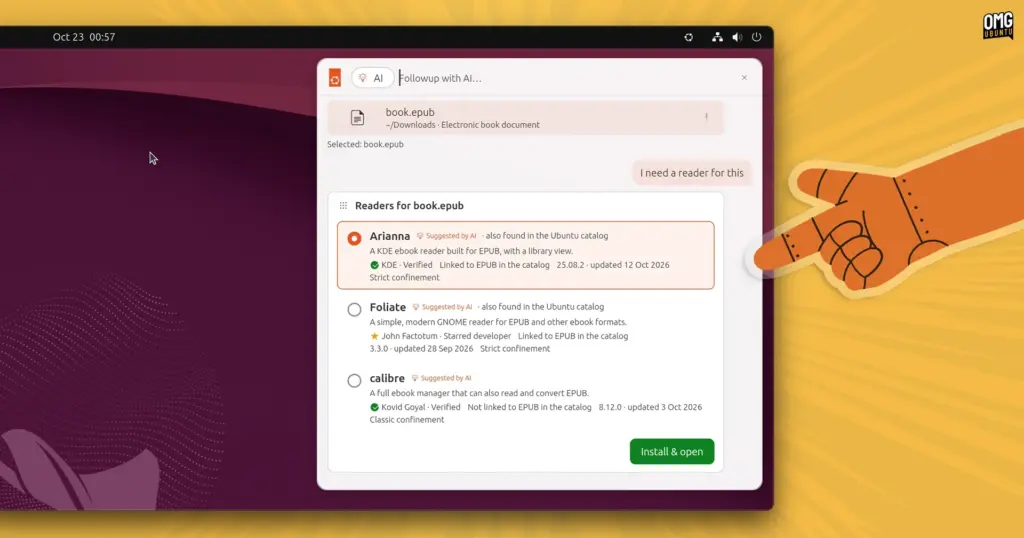
Another routine showcases how natural language support could modernize software discovery and package management. When a user queries a non-standard file type—in this case, an ePub digital book—the launcher provides a contextual option titled "Followup with AI…". Selecting this prompt initiates a search to locate an appropriate application capable of opening the file. Rather than directing the user to a standalone browser window or launching the full Ubuntu Software interface, suitable software package matches are pulled directly from the Snap Store and embedded into the launcher view. The results feature functional installation triggers, allowing the required software to be installed on the spot without breaking workflow.
Perhaps the most sophisticated scenario demonstrated by the prototype addresses productivity and personal schedule management. In this simulation, the local model is tasked with parsing a collection of fragmented snippets stored in the operating system’s clipboard history. The AI interprets the varied dates, times, and event descriptions from the clipboard and aggregates them into a coherent, structured calendar itinerary. Once processed, the resulting schedule entries are presented with an immediate option to add them directly to the user’s primary calendar application.
Beyond these automated, generative tasks, the prototype demonstrates capabilities intended for conventional desktop launcher duties. The interface accounts for everyday utilities such as opening installed software, locating local documents, searching and inserting emoji, reviewing clipboard logs, tracking down active browser tabs across multiple open windows, and reviewing recent user activities and tasks.
Throughout the various scripted simulations, the launcher avoids acting merely as a passive search utility. Retrieved results appear accompanied by dynamic, contextual action icons that allow users to actively manipulate files, trigger background operations, or dispatch instructions directly from the launcher interface itself.

In this regard, the conceptual design mirrors the evolution seen in platform utilities such as Apple’s Spotlight on modern iterations of macOS, which has gradually transitioned from a basic indexing tool into an active, centralized operational hub. The prototype suggests that an integrated Ubuntu equivalent could go even further, moving beyond basic find-and-retrieve mechanisms toward proactive desktop automation.
The initiative arrives at a time when Canonical has publicly signaled its ambition to ramp up AI capabilities across the Ubuntu ecosystem. The company has already begun rolling out exploratory tooling, recently releasing a technology preview of Myna, an on-device AI dictation system. Furthermore, Canonical engineering teams increasingly utilize large language models and agentic software development frameworks to optimize internal development, testing, and infrastructure management pipelines.
 Linux & Open Source Solutions
KDE Plasma 6.8 Released on Project’s 30th Anniversary, Dropping X11 Sessions and Expanding Core Features
The KDE community has officially released KDE Plasma 6.8, marking a historic...
 Linux & Open Source Solutions
Ubuntu 26.10 Flavours Arrive with Updated Desktops, System Modernization, and the Return of Ubuntu MATE
The launch of the Ubuntu 26.10 operating system cycle extends well beyond...
 Linux & Open Source Solutions
NexPhone Multi-OS Smartphone Delayed to March 2027 as Hardware Challenges and Price Adjustments Emerge
The NexPhone, an ambitious multi-operating system smartphone designed to bridge the divide...







