
While forecasting is not destiny, these figures underscore a fundamental truth: AMD cannot secure enough HBM to truly dent Nvidia’s datacenter GPU dominance. Consequently, AMD is focusing on a sensible alternative: maximizing profit on what it can actually manufacture. In a market where demand for AI compute far outstrips supply, the lack of traditional competition grants significant pricing power to all viable vendors. This undersupply is also the primary reason why hyperscalers and cloud builders are increasingly designing their own specialized, cheaper compute engines to supplement their purchases from external vendors.
Financial Performance in Q3 2026
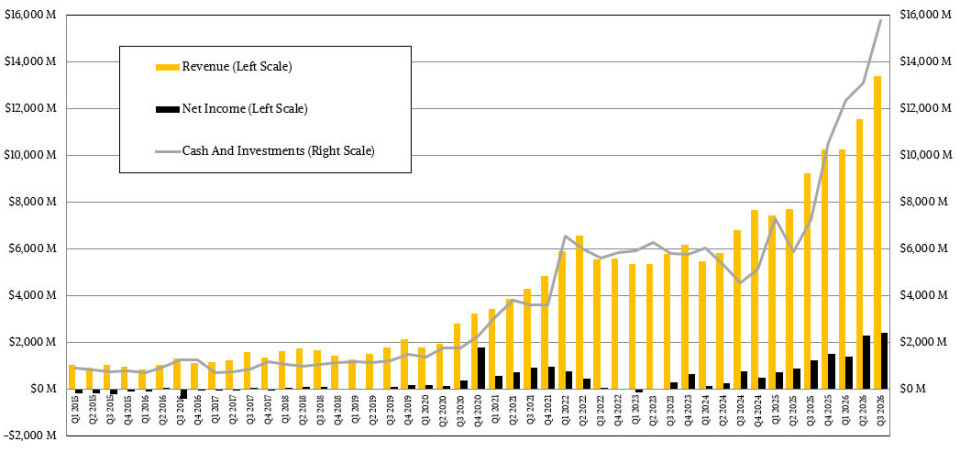
It is against this backdrop that AMD reported its financial results for the third quarter of 2026. This period was defined by the production ramp-up of the "Helios" AI rackscale systems. These systems come in two primary configurations: one optimized with CPUs for "agentic" AI sandboxes, and another featuring a dense mix of Epyc CPUs and Instinct GPUs designed for large-scale AI training and inference workloads.
AMD’s total revenue for the quarter rose 44.7 percent year-over-year to $13.38 billion. More impressively, operating income jumped by a factor of 2.2X to reach $2.83 billion. This profitability surge was aided by the fact that many development costs for the Helios platform were absorbed in previous quarters, allowing the company to reap the rewards as sales of high-margin components to OEMs and ODMs began to scale. Net income for the quarter rose 95.3 percent to $2.43 billion, representing 18.2 percent of revenue. While AMD historically operates with thinner margins than Nvidia, these figures represent a remarkably healthy level of profitability for the company.
The company’s balance sheet has also never looked stronger. AMD’s cash reserves more than doubled over the past year to $15.78 billion, meaning the company now holds more than a full quarter’s worth of revenue in the bank. This provides a level of financial security that is rare in the high-stakes, high-cost world of semiconductor manufacturing.
Datacenter Dominance and Segment Results
The transformation of AMD into a datacenter-first company is now complete. In the third quarter, two-thirds of the company’s total revenue was derived from datacenter products, a category that includes Epyc CPUs, Instinct GPUs, Pensando DPUs, and the ROCm software stack.
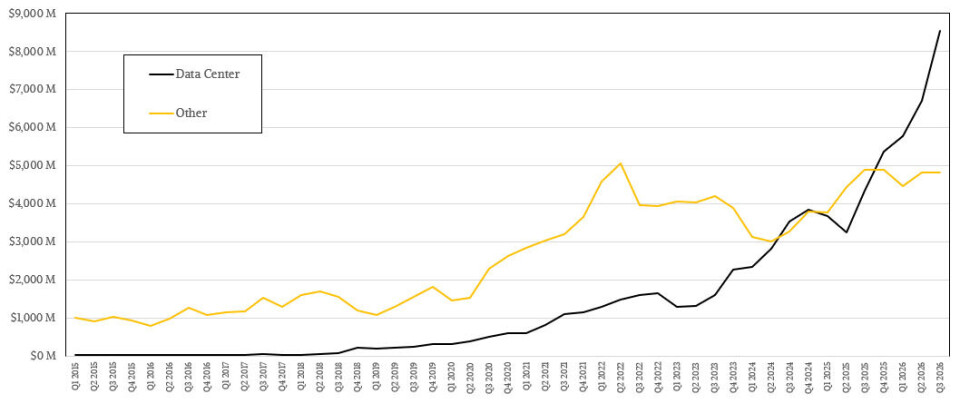
The Data Center group alone generated $8.55 billion in revenue, a 96.9 percent increase that exceeded the company’s own aggressive growth targets. Operating income for this segment rose 2.7X to $2.88 billion, accounting for 33.7 percent of the segment’s revenue.
 Enterprise Tech & Infrastructure
Securing the Data Core: Evaluating the Security Architectures of DAS and NAS in the Enterprise
In the modern enterprise landscape, data is frequently described as the new...
 Enterprise Tech & Infrastructure
The Hidden Architecture of Amazon S3 Costs: Why the Per-Gigabyte Rate is Only the Tip of the Iceberg
For many enterprise IT leaders, the initial appeal of Amazon S3 lies...
 Enterprise Tech & Infrastructure
Understanding the Architecture of Modern Storage: Decoding the Relationship Between Flash Technology and Solid-State Drives
In the rapidly evolving landscape of data storage, the terminology used to...







