

In the volatile ecosystem of global technology, capitalism thrives on the friction of competition. The relentless clash of vendors and the constant cycle of economic and technical substitution are not merely market trends; they are fundamental laws of economics that drive innovation. For years, the industry has watched the meteoric rise of GPU computing at Nvidia, while simultaneously observing Advanced Micro Devices (AMD) navigate a complex path of recovery. After years of stumbling, AMD has successfully re-established itself as a credible force in datacenter CPUs for the second time in its history and has finally carved out a significant position in the datacenter GPU accelerator market, beginning with the Instinct MI200 series.
However, a cold assessment of the current market dynamics reveals a nuanced reality. While AMD is significantly impacting Intel’s standing—taking advantage of a rival that currently lacks a competitive datacenter GPU or a dedicated AI accelerator of note—it is finding it much harder to bridge the chasm separating it from Nvidia. This disparity is not necessarily due to a lack of architectural ingenuity, but rather a consequence of brutal supply chain realities. AMD’s inability to capture more of the market is largely dictated by its inability to secure sufficient HBM (High Bandwidth Memory) allocations from the triumvirate of Samsung, SK Hynix, and Micron. Furthermore, AMD has made a strategic choice to equip its Instinct MI400 series with substantially more HBM than Nvidia’s Blackwell or Rubin architectures. This pursuit of a more balanced ratio between compute capacity and memory capacity is a noble engineering goal, but it inherently limits the number of units AMD can produce given the global scarcity of high-end DRAM.
To gain a true architectural advantage, one could argue that future iterations, such as a hypothetical Instinct MI500 series, should move toward a more radical design. By utilizing optical interposers and disaggregated, composable HBM memory housed on trays adjacent to the GPU accelerators, AMD could allow memory to be recycled and conserved even as GPU engines are swapped out for newer generations. Such a shift would counter Nvidia’s current strategy of shipping static configurations that are arguably "under-memoried" to maximize volume. While the industry does not currently expect such a leap toward composability, it would address the insane costs associated with modern DRAM. A similar approach for the future "Florence" Zen7 series of Epyc datacenter CPUs—separating CPU trays from DRAM banks—could revolutionize the lifecycle of datacenter hardware.
The Widening Revenue Gap
Despite AMD’s technical prowess, the financial distance between it and Nvidia is expanding rather than contracting. To understand the scale of this divergence, one must look at top-line revenue across all product segments. While this includes AMD’s healthy client CPU and GPU businesses, it highlights the sheer velocity of Nvidia’s growth in the age of generative AI.
In 2021, a year before the emergence of ChatGPT triggered the current AI gold rush, Nvidia reported $26.9 billion in sales compared to AMD’s $16.4 billion—a gap of roughly 1.64X. By 2023, as AI training became the primary driver of datacenter spending, Nvidia’s revenue surged to nearly $60.9 billion, while AMD, bolstered by a pandemic-era PC boom, reached $22.7 billion. This widened the gap to 2.69X.
Fast forward to the current fiscal year of 2026, and the disparity has reached a staggering new level. Nvidia is projected to bring in approximately $354 billion in sales, fueled by its ownership of the most lucrative parts of the AI networking stack—including scale-across, scale-out, and scale-up technologies. In contrast, AMD is expected to generate $52.2 billion. This represents a 6.79X gap. Looking even further ahead to 2029, consensus estimates suggest Nvidia could rake in over $1 trillion in annual revenue, maintaining a nearly 7X lead over AMD’s projected $164 billion.
While forecasting is not destiny, these figures underscore a fundamental truth: AMD cannot secure enough HBM to truly dent Nvidia’s datacenter GPU dominance. Consequently, AMD is focusing on a sensible alternative: maximizing profit on what it can actually manufacture. In a market where demand for AI compute far outstrips supply, the lack of traditional competition grants significant pricing power to all viable vendors. This undersupply is also the primary reason why hyperscalers and cloud builders are increasingly designing their own specialized, cheaper compute engines to supplement their purchases from external vendors.
Financial Performance in Q3 2026
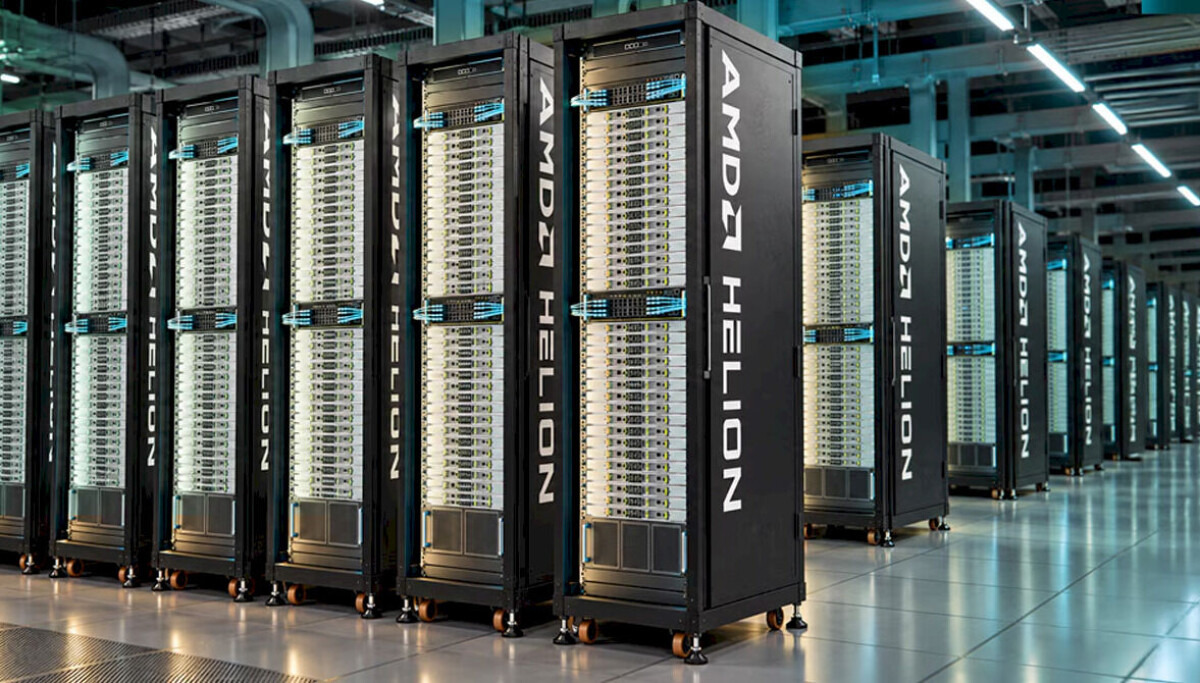
It is against this backdrop that AMD reported its financial results for the third quarter of 2026. This period was defined by the production ramp-up of the "Helios" AI rackscale systems. These systems come in two primary configurations: one optimized with CPUs for "agentic" AI sandboxes, and another featuring a dense mix of Epyc CPUs and Instinct GPUs designed for large-scale AI training and inference workloads.
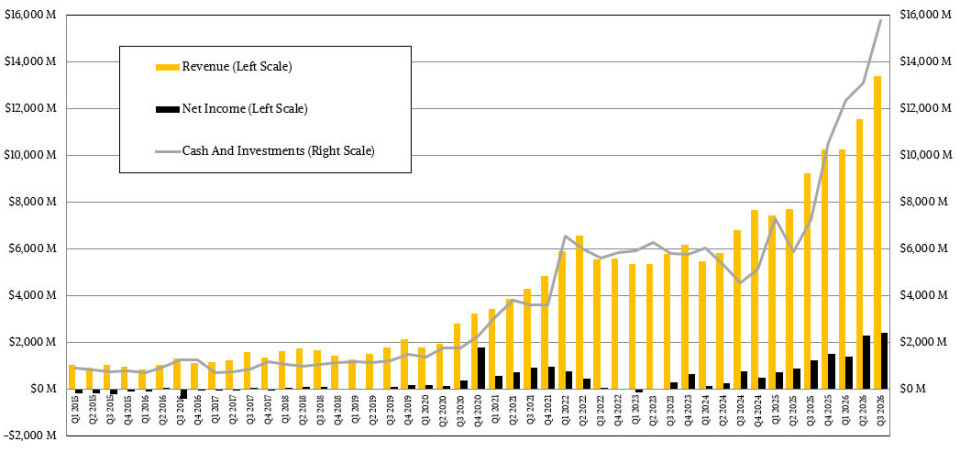
AMD’s total revenue for the quarter rose 44.7 percent year-over-year to $13.38 billion. More impressively, operating income jumped by a factor of 2.2X to reach $2.83 billion. This profitability surge was aided by the fact that many development costs for the Helios platform were absorbed in previous quarters, allowing the company to reap the rewards as sales of high-margin components to OEMs and ODMs began to scale. Net income for the quarter rose 95.3 percent to $2.43 billion, representing 18.2 percent of revenue. While AMD historically operates with thinner margins than Nvidia, these figures represent a remarkably healthy level of profitability for the company.
The company’s balance sheet has also never looked stronger. AMD’s cash reserves more than doubled over the past year to $15.78 billion, meaning the company now holds more than a full quarter’s worth of revenue in the bank. This provides a level of financial security that is rare in the high-stakes, high-cost world of semiconductor manufacturing.
Datacenter Dominance and Segment Results
The transformation of AMD into a datacenter-first company is now complete. In the third quarter, two-thirds of the company’s total revenue was derived from datacenter products, a category that includes Epyc CPUs, Instinct GPUs, Pensando DPUs, and the ROCm software stack.
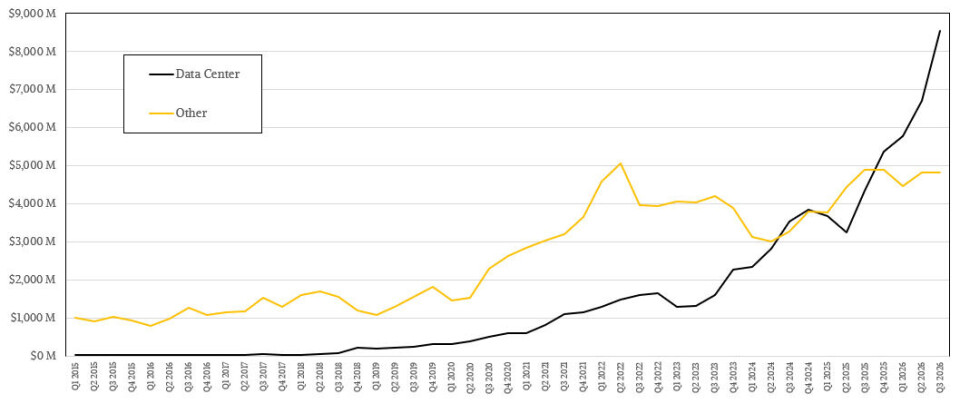
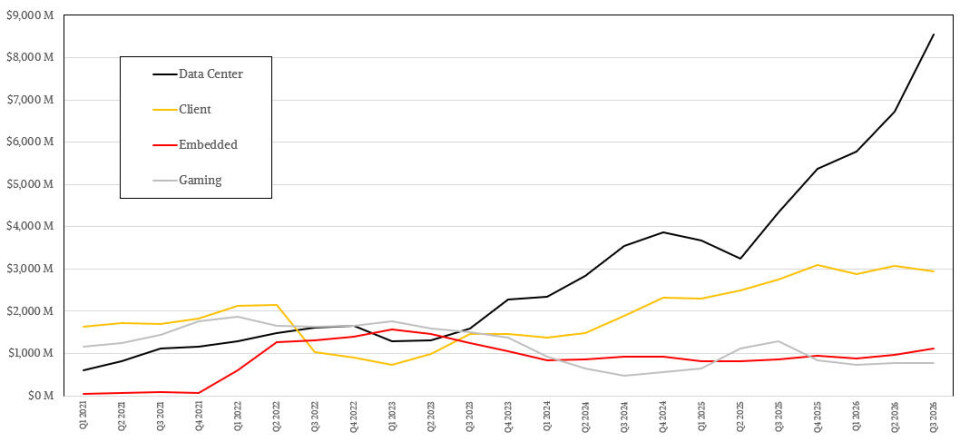
The Data Center group alone generated $8.55 billion in revenue, a 96.9 percent increase that exceeded the company’s own aggressive growth targets. Operating income for this segment rose 2.7X to $2.88 billion, accounting for 33.7 percent of the segment’s revenue.
In contrast, other divisions showed signs of the broader market’s volatility:
- Client Group: Revenue from PC CPUs and GPUs reached $2.95 billion, a modest 7.2 percent increase. However, operating income in this segment fell 18.8 percent to $401 million as competition in the consumer space remained fierce.
- Gaming Group: Once a cornerstone of the company, gaming revenue plummeted 40.4 percent to $773 million. In the current context of AMD’s massive datacenter growth, the gaming business has essentially become "noise" in the financial data. Operating income for gaming fell 53.9 percent to an estimated $172 million.
- Embedded Group: Driven by Xilinx FPGA products, this segment saw a 29.4 percent revenue increase to $1.11 billion. With an operating income of $453 million (up 60.1 percent), the embedded business remains three times more profitable than the PC chip business.
The Rise of the Instinct GPU
For the third consecutive quarter, Epyc CPUs remained the primary revenue driver within the Datacenter group, though the gap is closing. According to AMD CEO Lisa Su, sales of Epyc processors to hyperscalers and cloud builders more than doubled year-over-year. Sales to the enterprise, telecommunications, and academic sectors saw a similarly robust 105 percent increase.
Based on these reports, total Epyc CPU sales are estimated at $4.68 billion for the quarter, up 116 percent. This leaves approximately $3.43 billion in revenue for Instinct GPU sales, representing a 72.3 percent increase. There is little doubt that if AMD had access to five or ten times its current HBM allocation and packaging capacity, it could have sold significantly more. The current revenue figure is less a reflection of market demand and more a reflection of the hard limits of the global supply chain.
Despite these constraints, AMD is moving forward with its next generation of hardware. The "Venice" Zen6 Epyc processors began shipping for revenue during the third quarter, with the first OEM machines expected to hit the market before the end of the year. Design wins for Venice are already 20 percent higher than those for the previous "Turin" generation, with 240 different platforms currently in development. Additionally, Helios racks populated with "Altair" MI455X GPUs have begun shipping to major industry players, including Meta Platforms, Microsoft, OpenAI, and Oracle.
A Bullish Outlook for 2027
Looking toward the end of the year and into 2027, AMD has raised its guidance for the datacenter business. The company now expects 2026 datacenter revenues to be more than double the totals seen in 2025. Crucially, the AI-specific portion of the business—comprising CPUs, GPUs, and DPUs—is projected to grow 50 percent sequentially in the fourth quarter. This surge will likely result in GPU sales surpassing CPU sales for the first time, driven by a major wave of Helios systems entering production.
CEO Lisa Su expressed growing confidence in the company’s long-term trajectory, noting that visibility into 2027 continues to strengthen as customers expand their deployment plans for Epyc and Instinct products. AMD now expects its server revenue to double year-over-year in 2027, with datacenter AI revenue growing even faster than previously projected. If these trends hold, the datacenter segment will account for more than 80 percent of AMD’s total revenue by 2027, serving as the primary engine for the company’s earnings growth for the foreseeable future.
 Enterprise Tech & Infrastructure
Seagate, Western Digital, and Toshiba Lead 2023 Rankings for Enterprise-Grade Storage Solutions
In the rapidly evolving landscape of corporate data infrastructure, the demand for...
 Enterprise Tech & Infrastructure
The Convergence of Storage and Networking: A Deep Dive into Fibre Channel over Ethernet (FCoE) Technology
In the rapidly evolving landscape of enterprise data centers, the demand for...
 Enterprise Tech & Infrastructure
Decoding the Amazon S3 Bill: Why the Per-Gigabyte Rate Is Often the Smallest Part of Cloud Storage Costs
In the world of enterprise cloud infrastructure, the Amazon S3 storage bill...







