
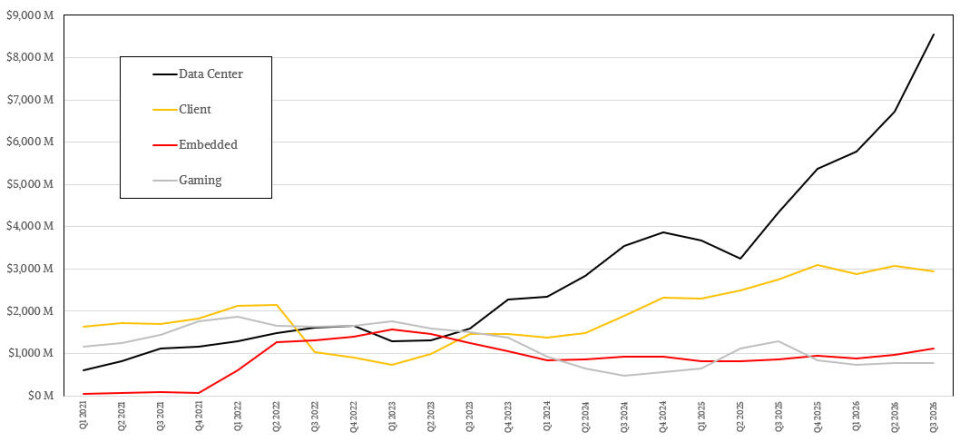
In contrast, other divisions showed signs of the broader market’s volatility:
- Client Group: Revenue from PC CPUs and GPUs reached $2.95 billion, a modest 7.2 percent increase. However, operating income in this segment fell 18.8 percent to $401 million as competition in the consumer space remained fierce.
- Gaming Group: Once a cornerstone of the company, gaming revenue plummeted 40.4 percent to $773 million. In the current context of AMD’s massive datacenter growth, the gaming business has essentially become "noise" in the financial data. Operating income for gaming fell 53.9 percent to an estimated $172 million.
- Embedded Group: Driven by Xilinx FPGA products, this segment saw a 29.4 percent revenue increase to $1.11 billion. With an operating income of $453 million (up 60.1 percent), the embedded business remains three times more profitable than the PC chip business.
The Rise of the Instinct GPU
For the third consecutive quarter, Epyc CPUs remained the primary revenue driver within the Datacenter group, though the gap is closing. According to AMD CEO Lisa Su, sales of Epyc processors to hyperscalers and cloud builders more than doubled year-over-year. Sales to the enterprise, telecommunications, and academic sectors saw a similarly robust 105 percent increase.
Based on these reports, total Epyc CPU sales are estimated at $4.68 billion for the quarter, up 116 percent. This leaves approximately $3.43 billion in revenue for Instinct GPU sales, representing a 72.3 percent increase. There is little doubt that if AMD had access to five or ten times its current HBM allocation and packaging capacity, it could have sold significantly more. The current revenue figure is less a reflection of market demand and more a reflection of the hard limits of the global supply chain.
Despite these constraints, AMD is moving forward with its next generation of hardware. The "Venice" Zen6 Epyc processors began shipping for revenue during the third quarter, with the first OEM machines expected to hit the market before the end of the year. Design wins for Venice are already 20 percent higher than those for the previous "Turin" generation, with 240 different platforms currently in development. Additionally, Helios racks populated with "Altair" MI455X GPUs have begun shipping to major industry players, including Meta Platforms, Microsoft, OpenAI, and Oracle.
A Bullish Outlook for 2027
Looking toward the end of the year and into 2027, AMD has raised its guidance for the datacenter business. The company now expects 2026 datacenter revenues to be more than double the totals seen in 2025. Crucially, the AI-specific portion of the business—comprising CPUs, GPUs, and DPUs—is projected to grow 50 percent sequentially in the fourth quarter. This surge will likely result in GPU sales surpassing CPU sales for the first time, driven by a major wave of Helios systems entering production.
CEO Lisa Su expressed growing confidence in the company’s long-term trajectory, noting that visibility into 2027 continues to strengthen as customers expand their deployment plans for Epyc and Instinct products. AMD now expects its server revenue to double year-over-year in 2027, with datacenter AI revenue growing even faster than previously projected. If these trends hold, the datacenter segment will account for more than 80 percent of AMD’s total revenue by 2027, serving as the primary engine for the company’s earnings growth for the foreseeable future.
 Enterprise Tech & Infrastructure
Cadence Systems Accelerates Chip Design Revolution with Maestro AI and Specialized Super Agents
The landscape of semiconductor engineering is undergoing a fundamental transformation as generative...
 Enterprise Tech & Infrastructure
Decoding the Total Cost of Ownership: A Strategic Approach to Amazon S3 Storage Optimization
For the modern enterprise, the Amazon S3 bill is frequently a source...
 Enterprise Tech & Infrastructure
Optimizing the Modern Data Center: Best Practices for Implementing Software-Defined Storage Architecture
The landscape of enterprise data management is undergoing a fundamental transformation as...







