
When Venice is compared to the "Shanghai" quad-core Opteron processors launched in late 2008—the last competitive Opteron line before Intel’s Nehalem architecture took the lead—the progress is staggering. The flagship Epyc 9996, designed for the SP7 socket, offers approximately 190 times the performance of the top-bin Opteron 2393 SE from the Great Recession era.
The economic story is just as compelling. While the price of a top-bin chip has risen roughly 12.8 times over that period, the cost per unit of performance has plummeted. The Epyc 9996 provides a price-to-performance ratio that is nearly 15 times better than the Shanghai Opteron. This dramatic improvement in "bang for the buck" has been the primary engine driving server consolidation over the last decade, allowing enterprises to replace racks of older equipment with a single Venice-based server.
The performance curve across the Epyc generations—from Naples (7001 series) to Rome, Milan, Genoa, and Turin—has been largely linear. However, the 256-core Venice SP7 parts represent a significant upward inflection point. By doubling down on core count and memory bandwidth, AMD is pushing the throughput of a single socket into territory previously reserved for multi-node clusters.
The Competitive Landscape
AMD’s aggressive positioning with Venice is a direct challenge to Intel’s latest Xeon offerings, but it is also a defensive move against the "Arm collective." Hyperscalers like Amazon, Google, and Microsoft have increasingly turned to their own custom Arm-based silicon to power their internal workloads and cloud instances. By offering a massive 256-core X86 part that maintains software compatibility while matching or exceeding the density of Arm designs, AMD is providing a powerful reason for these cloud giants to remain within the X86 ecosystem.
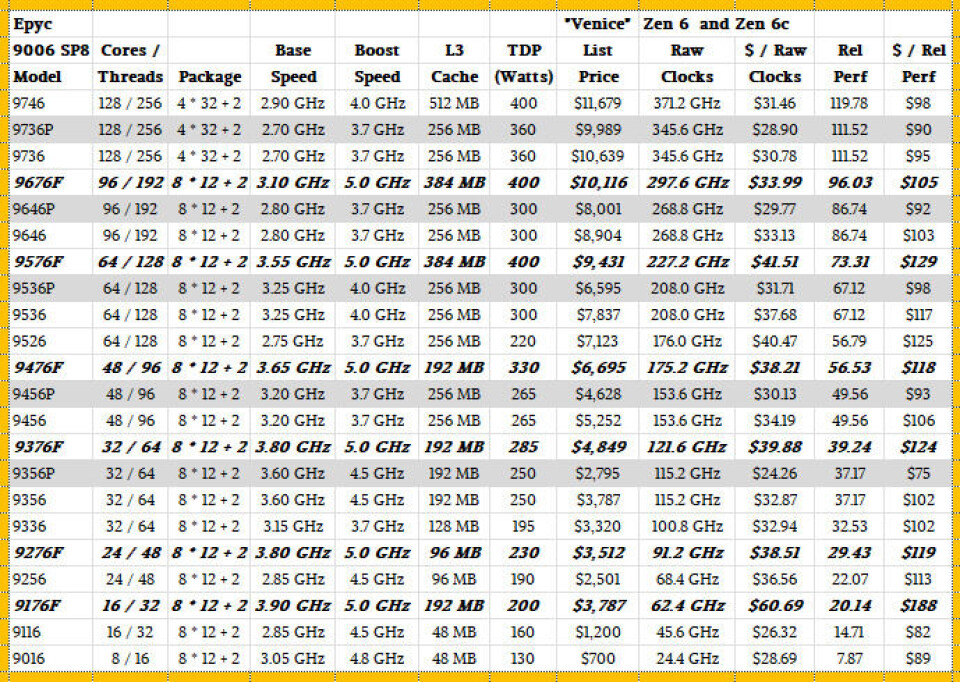
The pricing strategy for Venice reflects this competitive reality. While AMD is charging a premium for the SP8 mainstream versions—which feature fewer cores running at higher clock speeds—the SP7 throughput-oriented parts are priced to maximize value for high-density deployments. This tiered approach ensures that AMD can compete on raw speed for frequency-sensitive enterprise applications while dominating on throughput for the scale-out workloads of the AI era.
As the industry moves toward 2027, the Venice generation of Epyc processors stands as a testament to AMD’s ability to execute a complex, multi-year roadmap. By successfully navigating the transition to 2nm manufacturing and diversifying its platform with the SP7 and SP8 sockets, AMD has ensured that its sixth generation of Epyc will remain the touchstone for datacenter performance for years to come. The heat is not just on Intel; it is rising across the entire semiconductor landscape, and AMD appears more than ready to meet the challenge.
 Enterprise Tech & Infrastructure
The Convergence of Storage and Networking: A Deep Dive into Fibre Channel over Ethernet (FCoE) Technology
In the rapidly evolving landscape of enterprise data centers, the demand for...
 Enterprise Tech & Infrastructure
Navigating the Hidden Complexities of Amazon S3 Cost Management for the Modern Enterprise
The promise of cloud storage has always been centered on its elasticity...
 Enterprise Tech & Infrastructure
The Security Perimeter: Evaluating the Strengths and Vulnerabilities of DAS vs. NAS Storage
In the contemporary digital economy, data has emerged as the most critical...







