
A Tale of Two Sockets: SP7 and SP8
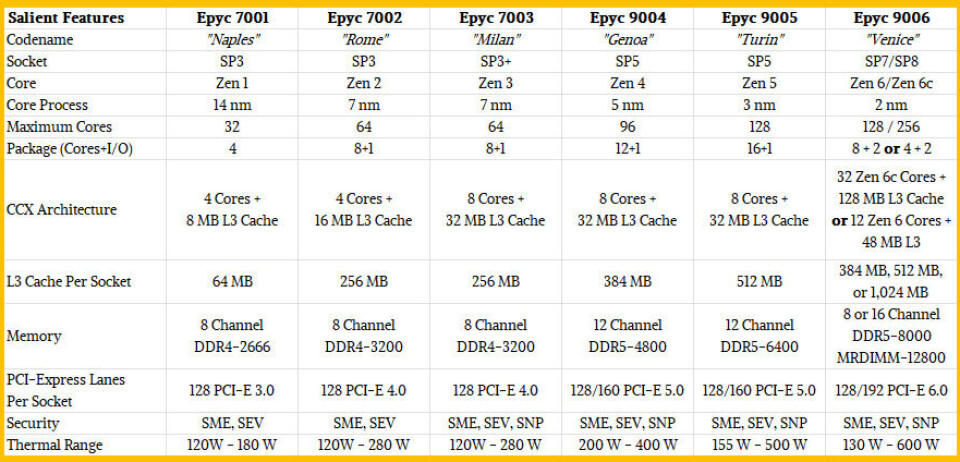
The Venice generation introduces a dual-socket strategy to address different segments of the market. The SP7 socket is the heavyweight of the lineup, designed for the most demanding throughput and AI-centric tasks. It utilizes a pair of I/O dies that support a staggering 16 channels of DDR5 memory. When paired with Multi-Ranked DIMMs (MRDIMMs) running at 12.8 GT/sec, the SP7 platform can deliver up to 1.6 TB/sec of memory bandwidth. Even with standard RDIMMs at 8 GT/sec, the platform provides 1 TB/sec of bandwidth.
Connectivity on the SP7 is equally robust, offering 96 lanes of PCI-Express 6.0 running at 64 Gb/sec, supplemented by eight lanes of PCI-Express 4.0. In dual-socket configurations, the platform exposes 128 PCI-Express 6.0 lanes to the system, with another 64 lanes dedicated to the NUMA (Non-Uniform Memory Access) link that maintains coherency between the two processors.
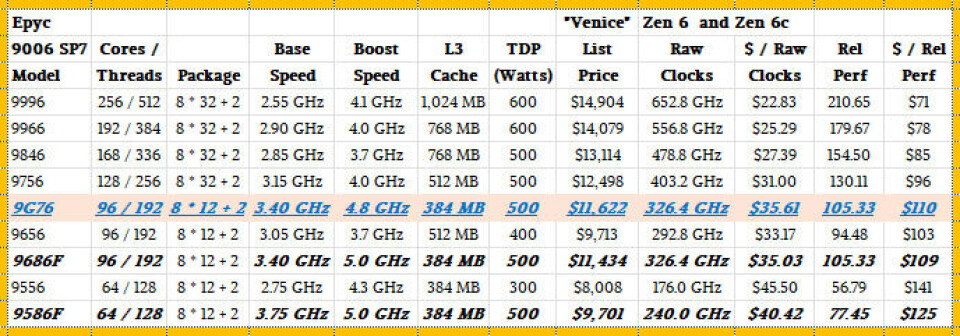
The nine initial Venice chips designed for the SP7 socket include the top-tier 256-core models. Notable among these is the Epyc 9G76, a specialized part designed specifically for Helion AI racks. While similar in architecture to the HPC-focused Epyc 9686F, the 9G76 is positioned for hyperscalers and cloud builders who require massive parallelization for agentic AI workloads.
For the mainstream enterprise market, AMD offers the SP8 socket. These processors are intended for more traditional datacenter roles where extreme core density is less critical than balanced I/O and cost-efficiency. The SP8 socket supports eight DDR5 memory channels per socket and provides 128 PCI-Express 6.0 lanes. Interestingly, while the SP8 has half the memory bandwidth of the SP7, it offers 33 percent more I/O lanes in a single-socket configuration. In a two-socket setup, the SP8 platform can expose 192 PCI-Express 6.0 lanes to the outside world.
The SP8 variants of the Venice line, comprising 22 different SKUs, are scheduled to begin shipping in the first half of 2027. This staggered release allows AMD to prioritize the high-margin, high-demand AI and HPC sectors with the SP7 socket before filling out the rest of the enterprise stack.
Performance Gains and the Historical Perspective
To understand the magnitude of the Venice launch, it is necessary to look back at the history of the Epyc line and its predecessor, the Opteron. AMD’s internal benchmarks and architectural analysis indicate a 20 percent improvement in instructions per clock (IPC) for the Zen 6 core over the Zen 5 core for integer workloads. This is a substantial generational jump, particularly given the already high baseline established by the "Turin" processors.
 Enterprise Tech & Infrastructure
Decoding the Total Cost of Ownership: A Strategic Approach to Amazon S3 Storage Optimization
For the modern enterprise, the Amazon S3 bill is frequently a source...
 Enterprise Tech & Infrastructure
The Security Architecture of Enterprise Storage: Evaluating the Vulnerabilities of DAS and NAS Systems
In the modern enterprise landscape, data is frequently characterized as the lifeblood...
 Enterprise Tech & Infrastructure
Navigating the Hidden Complexities of Amazon S3: Strategies for Mitigating Enterprise Storage Overspend
The financial architecture of cloud storage is often more complex than it...







