
The evolution of modern computing has historically followed a predictable trajectory, moving in successive waves from the emergence of the personal computer to the rise of relational databases and the eventual dominance of the cloud. In each of these eras, technology has tended to reach two groups of professionals before anyone else: developers and finance teams. For those in finance, a technological edge is not a luxury; it is a necessity. The core of the profession involves modeling reality with ever-increasing precision, and for decades, the primary tool for this task has been Microsoft Excel. It is the environment where quarters are closed, forecasts are debated, and every single digit is expected to be traceable back to its original source.
As artificial intelligence begins to permeate the financial sector, it faces a uniquely high bar for entry. Unlike creative or general administrative tasks where a margin of error might be tolerated, financial operations demand absolute transparency and rigor. Microsoft is addressing this challenge by introducing a suite of new capabilities for Copilot in Excel, specifically designed to meet the exacting standards of financial planning and analysis (FP&A), accounting, tax, compliance, and treasury departments.
These updates represent more than just incremental improvements; they signal a shift toward AI that can handle multi-step workflows, connect to trusted third-party data sources, and provide a verifiable audit trail for every calculation it performs.
The Standard of Precision: Internal Testing and the FMI Partnership
The development of these new features did not happen in a vacuum. Microsoft has utilized its own global finance organization as a primary testing ground. Microsoft Finance, a massive operation responsible for the fiscal health of one of the world’s largest corporations, has integrated Copilot in Excel into its daily workflows. By using the tool in real-world scenarios—ranging from hunting for specific data points to rebuilding complex analyses—the team has acted as a feedback loop for the product’s developers.
This "pressure-testing" at the frontier of corporate finance ensures that by the time these features reach the general public, they have already been refined by professionals who demand perfection. The internal teams at Microsoft have pushed the AI to move beyond completing single tasks, forcing it to adapt to the complexity of multi-step financial processes.
To further solidify the tool’s credibility, Microsoft has collaborated with the Financial Modeling Institute (FMI), a premier global body that provides credentials to the industry’s most skilled modelers. The FMI’s extensive library of real-world financial modeling cases has been used as a benchmark to evaluate Copilot’s performance. This partnership ensures that the AI’s logic aligns with the rigorous methodologies used by top-tier financial analysts, ensuring that the outputs are not just mathematically correct but also structurally sound according to industry standards.
Introducing ‘Skills’ for Repeatable Financial Workflows
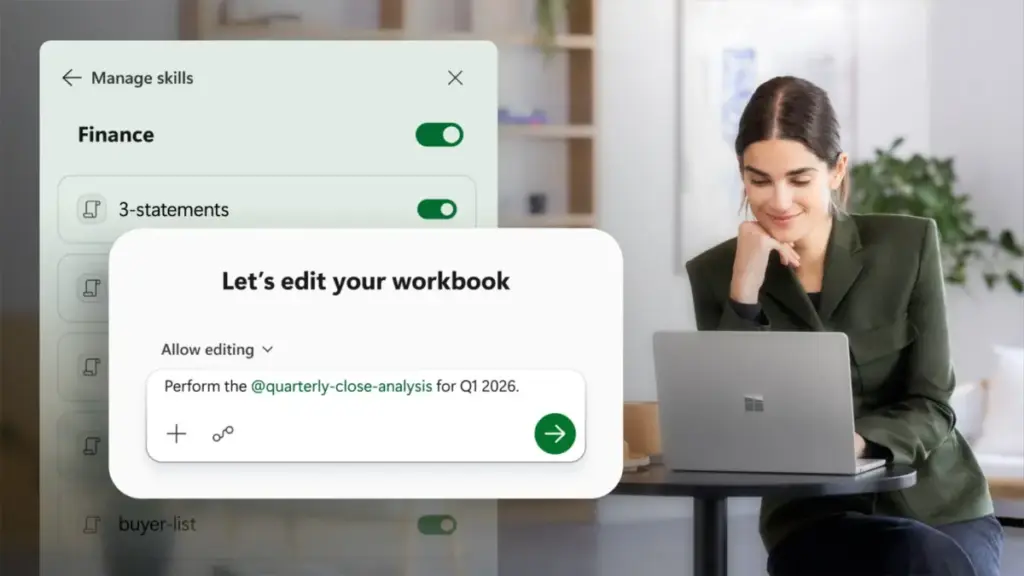
One of the most significant hurdles for AI in a professional setting is the "blank page" problem—the need to repeatedly prompt a tool to perform the same complex task. To solve this, Microsoft is introducing "skills," a feature that allows finance teams to define exactly how Copilot should execute common, repeatable processes.
 Productivity Software & Office Suites
Microsoft Unveils Microsoft 365 G7: A New Frontier for AI-Driven Governance in the Public Sector
In a move designed to redefine how the public sector interacts with...
 Productivity Software & Office Suites
Microsoft Reimagines Copilot as a Central Hub for Autonomous AI and Agentic Work
Microsoft has announced a significant evolution of its AI strategy, unveiling what...
 Productivity Software & Office Suites
Microsoft Unveils Strategic Roadmap for Enterprise AI, Emphasizing Agentic Workflows and Hybrid Pricing Models
In an era defined by a relentless cycle of artificial intelligence breakthroughs...







