
The evolution of enterprise technology has historically followed a predictable trajectory. From the introduction of the first personal computers to the rise of relational databases and the eventual migration to the cloud, innovation typically arrives in waves. These waves almost always break first upon the shores of the developer community before quickly flowing into the finance department. For finance professionals, technology is more than a convenience; it is a competitive edge. The core objective of the role has remained unchanged for decades: to model reality with a level of precision that was impossible the day before.
For the better part of forty years, the primary vehicle for this modeling has been Microsoft Excel. It is the environment where quarterly books are closed, where multi-year forecasts are debated line by line, and where every figure must be traceable to a verifiable source. As artificial intelligence begins to permeate the financial sector, it faces a rigorous set of requirements. To be useful in a professional financial context, AI cannot simply provide an answer; it must show its work, utilize trusted data, and maintain a clear audit trail for every calculation.
Microsoft is addressing these specific demands with a significant expansion of Microsoft 365 Copilot in Excel. The company is introducing a suite of new features designed to meet the high bar of professional finance work, focusing on repeatable workflows, deep data integration, and enhanced transparency. These updates are intended to move AI beyond simple task completion and into the realm of complex, multi-step financial logic.
Built for the Complexity of Finance Work
The challenge of integrating AI into finance lies in the intolerance for error. Unlike creative fields where a "hallucination" might be seen as a spark of inspiration, a misplaced decimal or a faulty logic chain in a financial model can have catastrophic consequences for a corporation. Recognizing this, Microsoft has shifted its development focus toward ensuring that Copilot can handle the inherent complexity of financial workflows rather than just completing isolated tasks.
Before any new Copilot capability is released to the public, it undergoes a rigorous evaluation process. Microsoft utilizes a framework of graded task complexity and benchmarks that are specifically designed to mirror the daily responsibilities of finance teams. This ensures that the AI can manage multi-step processes—such as reconciling disparate data sets or building complex projections—while delivering a result that is both trusted and verifiable.
This commitment to professional standards has led to a strategic partnership with the Financial Modeling Institute (FMI). As the global body responsible for credentialing the industry’s most proficient modelers, the FMI provides a level of domain expertise that is difficult to replicate. By incorporating the FMI’s library of real-world financial modeling cases into its testing protocols, Microsoft has grounded Copilot’s development in the actual rigors of the profession. This collaboration ensures that the AI understands the nuances of financial logic, from the structure of a three-statement model to the intricacies of debt sculpting and sensitivity analysis.
Furthermore, the development of these tools has been "pressure-tested" by Microsoft’s own internal finance organization. Across departments such as Financial Planning and Analysis (FP&A), Accounting, Tax, Compliance, and Treasury, Microsoft Finance has integrated Copilot into its live workflows. By using the tool to hunt for information and rebuild analyses, the internal teams have acted as the first line of feedback, pushing the product to meet the standards required by a global enterprise. This internal "dogfooding" ensures that by the time the technology reaches the broader market, it has already survived the demands of a frontier-level finance operation.
Tuned to Your Standards
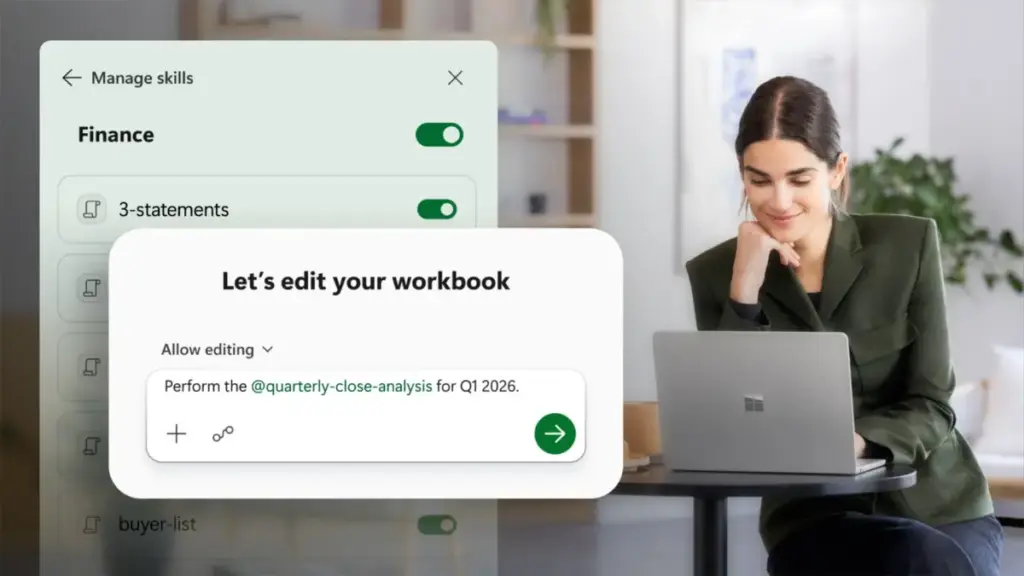
One of the primary hurdles for AI adoption in finance has been the "blank slate" problem. While generative AI is excellent at starting from a prompt, finance professionals often have established methodologies and "house styles" that must be followed. To bridge this gap, Microsoft is introducing "skills"—a feature that allows finance teams to define exactly how Copilot should execute common, repeatable processes.
 Productivity Software & Office Suites
Microsoft 365 Copilot Surpasses 30 Million Paid Seats as Enterprise AI Evolves from Assistant to Autonomous Agent
In a landmark update shared during its most recent earnings call, Microsoft...
 Productivity Software & Office Suites
Microsoft Reimagines Copilot as a Comprehensive AI System for Enterprise Automation and Custom Development
In a significant shift that signals the next phase of the generative...
 Productivity Software & Office Suites
Microsoft Confirmed as Headline Sponsor for ESPC 2026 in Amsterdam as AI Transformation Takes Center Stage
The European Microsoft community is preparing for one of its most significant...







