
The debut of OpenAI’s ChatGPT in the closing months of 2022 did more than just introduce a new consumer tool; it ignited a generational shift in computing that shows few signs of slowing down. This "GenAI era" has moved with a velocity that has redefined the priorities of the modern datacenter, driving an insatiable demand for high-performance silicon. However, as the industry matures, the nature of the artificial intelligence workload is undergoing a fundamental transformation. While the first wave of generative AI was characterized by massive large language models (LLMs) and "chatty" interfaces, the next frontier is defined by agentic AI—autonomous systems capable of reasoning, planning, and executing complex tasks.
This shift comes at a time of significant broader volatility. In the United States, the recent "Blue Wave" in the midterm elections has introduced a new layer of uncertainty for the technology sector. The potential for increased regulation of the AI industry could serve as a drag on the massive datacenter building boom that has swept the country over the last two years. Simultaneously, the latest scandal involving Nvidia co-founder and CEO Jensen Huang has left analysts wondering if the industry leader is facing a temporary "blip" or a more systemic, long-term challenge. Against this backdrop of political and corporate flux, the technological requirements of the datacenter are pivoting, and Advanced Micro Devices (AMD) is positioning itself to be the primary beneficiary of this new architecture.
The emerging agentic AI market is currently the focus of intense speculation and aggressive forecasting. Some analyst firms suggest the sector will expand at a compound annual growth rate of nearly 43 percent between now and 2034. This growth is expected to drive a significant realignment of datacenter infrastructure. For the past four years, the various iterations of generative AI—including reasoning models and Mixture-of-Experts (MoE) architectures—have been an unprecedented boon for GPU manufacturers. Nvidia, in particular, has seen its valuation rocket into the trillions as the industry prioritized raw floating-point performance for model training. During this period, the central processing unit (CPU), which was long the undisputed heart of the server, was often relegated to a supporting role, acting as a traffic controller for the massive arrays of GPUs.
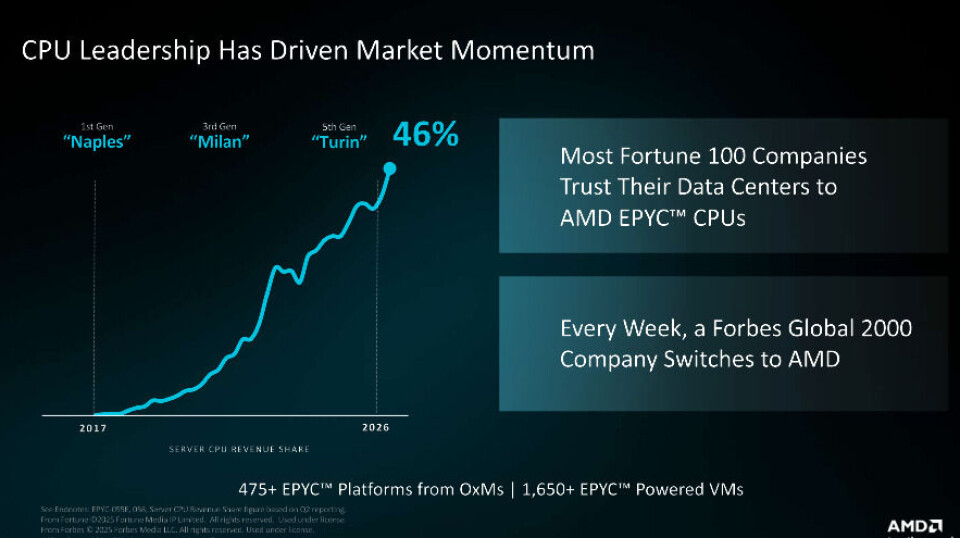
However, the computational demands of agentic AI are distinct from the prompt-and-response patterns of early chatbots. Unlike a standard LLM that generates a string of text based on a single input, an AI agent operates as a persistent, multi-step problem solver. This shift requires the specific capabilities that CPUs bring to the table, particularly in their roles as AI host processors and as the "sandboxes" that run the code generated by AI models.
In the agentic AI era, the shape of the workload changes entirely. Dan McNamara, senior vice president and general manager for compute and enterprise AI at AMD, recently noted that instead of merely answering a single prompt, an agent must break a high-level goal into a series of discrete steps. The agent must decide what to do next, call upon multiple different models, query various databases, and connect with external APIs. It must run enterprise applications, verify permissions, retrieve specific memories, validate its own output, and then loop back through the process to refine its results. This creates an infrastructure profile that is radically different from the "prompt-in, answer-out" workflow of a basic chatbot.
 Enterprise Tech & Infrastructure
AMD Acquires World Labs for $8.2 Billion to Rival Nvidia in the Frontier of World Models
In a massive strategic move designed to reshape its standing in the...
 Enterprise Tech & Infrastructure
Navigating the Hidden Complexities of Amazon S3: Strategies for Mitigating Enterprise Storage Overspend
The financial architecture of cloud storage is often more complex than it...
 Enterprise Tech & Infrastructure
From Theory to Engineering: Quantum Computing Reaches a Commercial Tipping Point as Industry Giants Prepare for a Hybrid Future
The long-anticipated transition of quantum computing from a theoretical pursuit of physics...







