The performance metrics for the Venice Epyc 9006 series are particularly striking. AMD is essentially doubling the throughput from one generation to the next, with Venice delivering 1.9 times the throughput of the prior "Turin" Epyc 9005 processors. The hardware specifications have seen a massive uplift: clock speeds have increased from 5.0 GHz with 64 cores in the Turin generation to 5.3 GHz with up to 96 cores in Venice. Memory bandwidth has also seen a significant leap, moving from 12 channels of DDR5 at 614 GB/sec to 16 channels delivering 1.6 TB/sec. Furthermore, I/O bandwidth has doubled with the transition from PCI-Express Gen 5 to Gen 6.
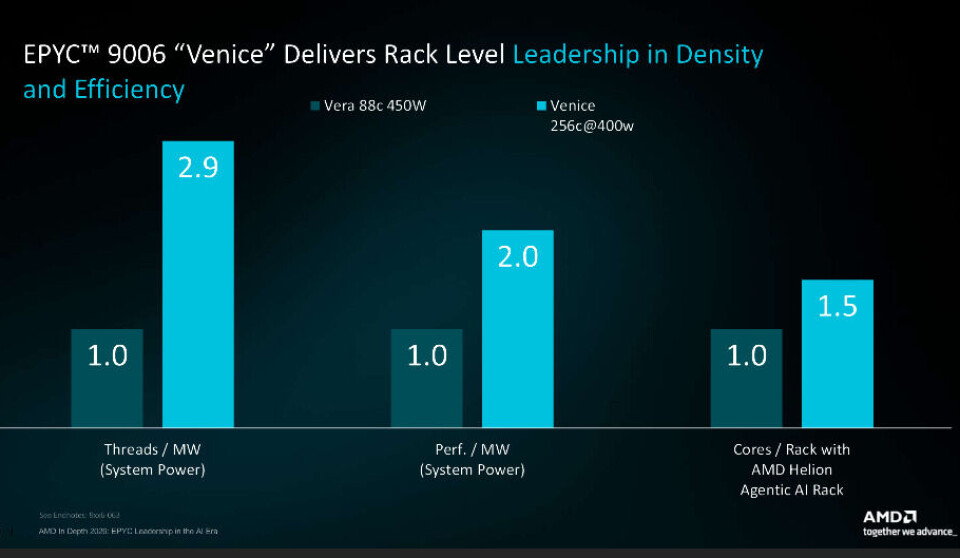
When compared to its competitors, AMD claims that Venice holds a distinct edge. In terms of concurrent agents—an increasingly vital metric for modern enterprises—AMD’s 6th Gen 256-core chip, running at 400 watts, reportedly offers 3.3 times the agents-per-watt of Nvidia’s Vera. It also claims 1.8 times the agents-per-dollar when compared to Intel’s 6th Gen Xeon 6980P and can fit 1.5 times more agents into a Helion AI Rack than a comparable Vera-based setup.
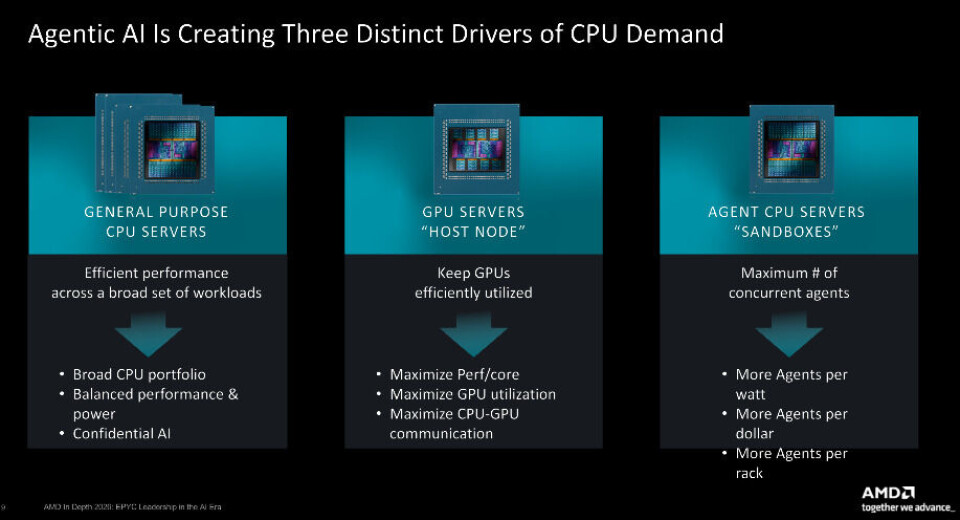
Rangarajan pointed out that agentic AI is driving CPU demand across three distinct networks rather than just general-purpose servers. Agents frequently perform intensive searches in dedicated clusters, execute enterprise tools like CRM and ERP systems, and access massive databases. This multifaceted activity requires a broad and powerful CPU portfolio. One of the most critical areas of performance for Venice involves "ephemeral tools." These are short-lived, isolated runtimes created during an agent’s session to perform a specific task—such as parsing a document or compiling code—and are then automatically destroyed.
According to Rangarajan, ephemeral tools represent the most interesting and challenging part of agentic AI because there is no single, well-defined benchmark for them. They encompass a vast and varied set of workloads. To measure Venice’s efficacy, AMD selected a representative mix of tasks, including group graphs, document parsing, and coding agent compilations. In each of these stages, the Venice architecture showed significant improvements over previous generations and competitor products. The 256-core Epyc 9996 Venice processor, in particular, outperformed both Intel’s 128-core Xeon 6980P and Amazon’s 192-core Graviton5 chips by substantial margins.
As the industry prepares for the next stage of the AI revolution, the focus is shifting from raw power to intelligent orchestration and efficiency. The "Venice" generation of Epyc CPUs appears to be the cornerstone of AMD’s strategy to lead this transition. By focusing on the specific, multi-step requirements of agentic AI, AMD is not just participating in the current boom but is helping to define the hardware standards for the next decade of computing. With further analyses of the Venice SKU stack and deep dives into the forthcoming "Verano" and "Venice-X" CPUs expected next year, the roadmap for the agentic era is becoming increasingly clear.
 Enterprise Tech & Infrastructure
The Hidden Math of Amazon S3: Why Storage Class Rates Are Only the Beginning of Cloud Cost Control
For enterprise IT leaders and cloud architects, the promise of Amazon S3...
 Enterprise Tech & Infrastructure
Advanced Photonics Coalition Sets New Standards to Scale Optical Networking for the AI Era
The global infrastructure supporting the rapid expansion of artificial intelligence reached a...
 Enterprise Tech & Infrastructure
Navigating the Hidden Complexities of Amazon S3 Cost Management for the Enterprise
The financial management of cloud storage has evolved into a discipline that...