
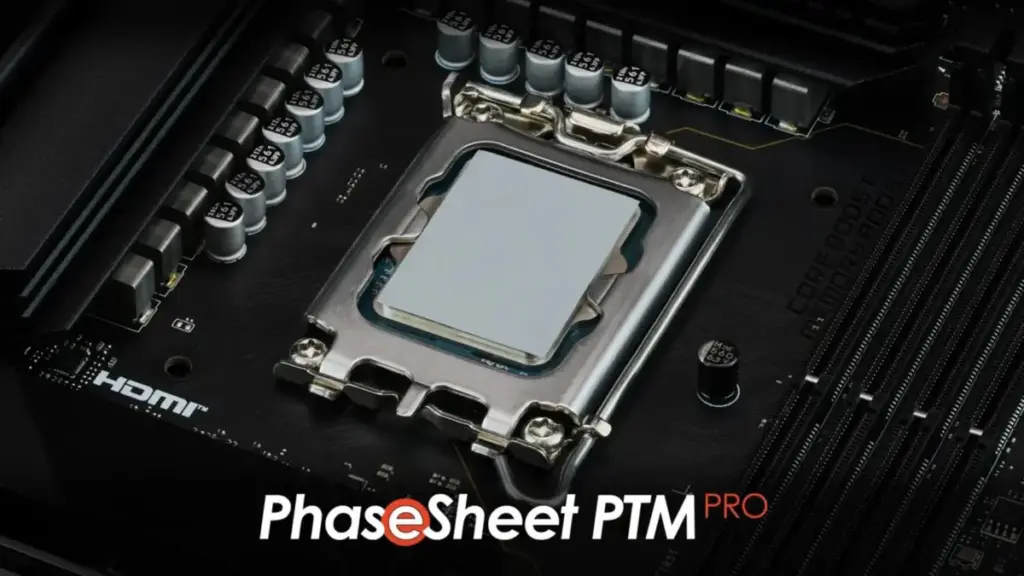
Thermal Grizzly, the German-based manufacturer synonymous with high-performance cooling solutions for PC enthusiasts and overclockers, has officially announced the launch of its latest thermal interface innovation: the PhaseSheet PTM Pro. This new offering represents an evolutionary step forward for the company’s thermal pad lineup, building upon the foundations of its previous phase-changing materials to address both thermal performance and the practical challenges of installation. As modern processors and graphics cards continue to push the boundaries of power density and heat output, the demand for more sophisticated thermal interface materials (TIMs) has grown exponentially, leading manufacturers to look beyond traditional thermal greases toward more stable, long-term solutions like phase-change materials.
The PhaseSheet PTM Pro is positioned as an optimized successor to the brand’s existing phase-changing thermal pads. According to Thermal Grizzly, the primary advancements in the Pro version center on two critical areas: thermal efficiency and physical handling. While thermal conductivity is the headline specification for any cooling product, the ease of application is often a significant pain point for users dealing with phase-change materials, which are notoriously delicate. Thermal Grizzly claims that the PhaseSheet PTM Pro features a higher degree of thermal conductivity than its predecessor, though the specific numerical improvements often vary depending on the pressure and temperature of the environment in which it is deployed. By refining the internal composition of the material, the company aims to provide a solution that can better facilitate the transfer of heat from the silicon die or integrated heat spreader (IHS) to the baseplate of a cooler.
Beyond the raw performance metrics, the most tangible improvement for the end-user is the introduction of a redesigned carrier film. In the world of high-end PC building, phase-change materials (PCMs) are often delivered as incredibly thin, semi-solid sheets protected by plastic liners on both sides. These sheets are frequently as thin as 0.2 millimeters, making them extremely susceptible to tearing, stretching, or folding during the application process. Thermal Grizzly’s new carrier film has been engineered to peel away more easily from both sides of the pad. This change is designed to mitigate the risk of damaging the material before it even makes contact with the hardware. For enthusiasts who have struggled with the "tackiness" of previous generations—where the pad might stick more aggressively to the protective film than to the processor—this structural change represents a significant quality-of-life upgrade.
To understand the significance of the PhaseSheet PTM Pro, one must look at the broader context of the thermal interface market. For decades, traditional thermal paste, or grease, has been the standard. However, thermal paste is subject to a phenomenon known as "pump-out." As a CPU or GPU heats up and cools down, the materials expand and contract. This microscopic mechanical movement can gradually push liquid thermal paste out from the center of the die toward the edges. Over time, this leads to a degradation in thermal performance, often requiring users to repaste their components every year or two to maintain optimal temperatures. Phase-change materials like the PhaseSheet PTM Pro are designed to solve this specific problem. At room temperature, these materials are solid and stable. Once the component reaches a specific transition temperature—usually around 45 to 50 degrees Celsius—the material softens and enters a semi-liquid state. In this phase, it flows into the microscopic imperfections of the metal surfaces, much like a high-quality paste, but it returns to a solid or highly viscous state once the system cools down. This resistance to movement makes PCMs significantly more durable over the long term, often lasting the entire lifespan of the hardware without needing replacement.
 Hardware Reviews & PC Building
The PC gaming ray tracing obsession began with the first RTX 20 graphics cards released on this day in 2018 — the…
The debut of the GeForce 20 series was spearheaded by the release...
 Hardware Reviews & PC Building
Save $250 on this award-winning Elegoo resin 3D printer with an integrated heater and 16K resolution — 39%…
The Saturn 4 Ultra is currently positioned as a flagship offering within...
 Hardware Reviews & PC Building
Unofficial Grand Theft Auto V Browser Port Faces Swift Takedown Following Viral Technical Demonstration
The landscape of modern gaming is often defined by the boundaries of...







