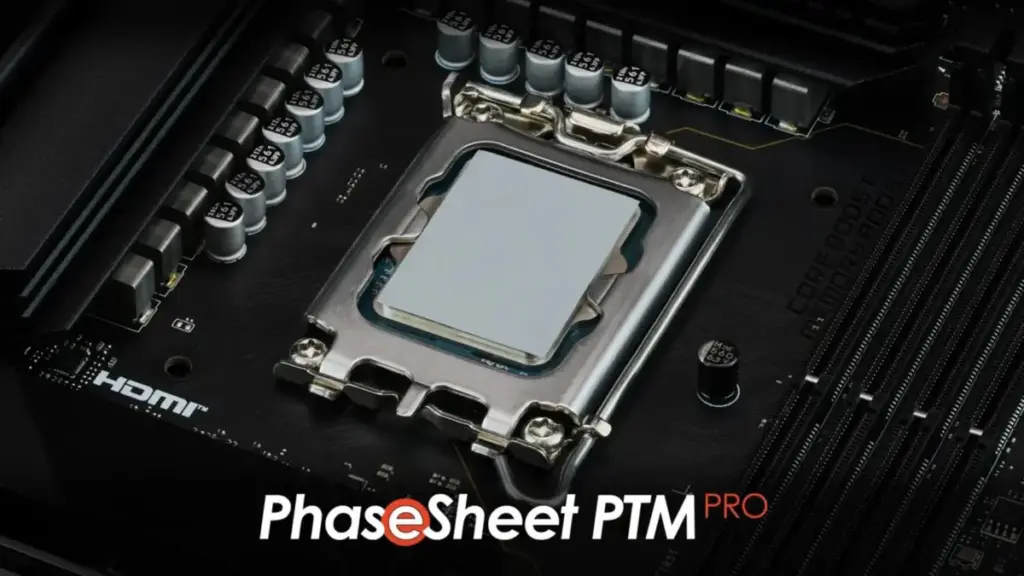
Thermal Grizzly, the German-based manufacturer synonymous with high-performance cooling solutions for PC enthusiasts and overclockers, has officially announced the launch of its latest thermal interface innovation: the PhaseSheet PTM Pro. This new offering represents an evolutionary step forward for the company’s thermal pad lineup, building upon the foundations of its previous phase-changing materials to address both thermal performance and the practical challenges of installation. As modern processors and graphics cards continue to push the boundaries of power density and heat output, the demand for more sophisticated thermal interface materials (TIMs) has grown exponentially, leading manufacturers to look beyond traditional thermal greases toward more stable, long-term solutions like phase-change materials.
The PhaseSheet PTM Pro is positioned as an optimized successor to the brand’s existing phase-changing thermal pads. According to Thermal Grizzly, the primary advancements in the Pro version center on two critical areas: thermal efficiency and physical handling. While thermal conductivity is the headline specification for any cooling product, the ease of application is often a significant pain point for users dealing with phase-change materials, which are notoriously delicate. Thermal Grizzly claims that the PhaseSheet PTM Pro features a higher degree of thermal conductivity than its predecessor, though the specific numerical improvements often vary depending on the pressure and temperature of the environment in which it is deployed. By refining the internal composition of the material, the company aims to provide a solution that can better facilitate the transfer of heat from the silicon die or integrated heat spreader (IHS) to the baseplate of a cooler.
Beyond the raw performance metrics, the most tangible improvement for the end-user is the introduction of a redesigned carrier film. In the world of high-end PC building, phase-change materials (PCMs) are often delivered as incredibly thin, semi-solid sheets protected by plastic liners on both sides. These sheets are frequently as thin as 0.2 millimeters, making them extremely susceptible to tearing, stretching, or folding during the application process. Thermal Grizzly’s new carrier film has been engineered to peel away more easily from both sides of the pad. This change is designed to mitigate the risk of damaging the material before it even makes contact with the hardware. For enthusiasts who have struggled with the "tackiness" of previous generations—where the pad might stick more aggressively to the protective film than to the processor—this structural change represents a significant quality-of-life upgrade.
To understand the significance of the PhaseSheet PTM Pro, one must look at the broader context of the thermal interface market. For decades, traditional thermal paste, or grease, has been the standard. However, thermal paste is subject to a phenomenon known as "pump-out." As a CPU or GPU heats up and cools down, the materials expand and contract. This microscopic mechanical movement can gradually push liquid thermal paste out from the center of the die toward the edges. Over time, this leads to a degradation in thermal performance, often requiring users to repaste their components every year or two to maintain optimal temperatures. Phase-change materials like the PhaseSheet PTM Pro are designed to solve this specific problem. At room temperature, these materials are solid and stable. Once the component reaches a specific transition temperature—usually around 45 to 50 degrees Celsius—the material softens and enters a semi-liquid state. In this phase, it flows into the microscopic imperfections of the metal surfaces, much like a high-quality paste, but it returns to a solid or highly viscous state once the system cools down. This resistance to movement makes PCMs significantly more durable over the long term, often lasting the entire lifespan of the hardware without needing replacement.
The development of the PhaseSheet PTM Pro also reflects Thermal Grizzly’s ongoing commitment to the enthusiast community, often working in tandem with well-known figures in the overclocking scene, such as Roman "der8auer" Hartung. The company’s product catalog, which includes the legendary Kryonaut paste and Conductonaut liquid metal, has always targeted users who demand the lowest possible temperatures. However, liquid metal is electrically conductive and difficult to apply safely, while high-end pastes can be prone to the aforementioned pump-out in high-heat scenarios like those found in modern gaming laptops or high-TDP desktop GPUs. The PhaseSheet PTM Pro occupies a middle ground, offering performance that rivals top-tier pastes while providing the safety and longevity of a solid pad.
The redesigned carrier film mentioned in the announcement is more than just a packaging update; it is a response to the specific mechanical properties of phase-change sheets. Because these materials are designed to be "thixotropic"—meaning they become less viscous under stress or heat—they are inherently fragile when cold. If a user attempts to peel a protective layer and the adhesion between the film and the pad is too strong, the pad will often deform. A deformed pad creates uneven thickness across the die, which can lead to air pockets or poor contact pressure, ultimately defeating the purpose of using a high-performance material. By ensuring the film peels away cleanly, Thermal Grizzly is effectively increasing the "success rate" of installations for amateur and professional builders alike.
This focus on usability is particularly relevant for the GPU repasting market. Unlike CPUs, which are protected by an integrated heat spreader, GPUs are usually "bare die" components. Applying thermal interface material to a bare die requires extreme precision; too little material results in hot spots, while too much can be messy. A pre-cut, phase-change sheet like the PhaseSheet PTM Pro allows for a perfectly uniform layer of material across the entire die surface. This uniformity is critical for maintaining the health of high-end graphics cards, where memory controllers and VRMs are often packed tightly around the main processor.
Thermal Grizzly’s announcement also highlights a trend in the PC component industry toward specialized materials that were once reserved for industrial or enterprise applications. Phase-change materials have been used in industrial power electronics and high-end server environments for years, largely due to their "set-it-and-forget-it" nature. Bringing this technology to the consumer market in a format that is easy to handle—the "Pro" designation in this case—suggests that the company sees a growing market among users who want high performance without the maintenance cycle of traditional greases.
As hardware manufacturers like Intel, AMD, and Nvidia continue to push the thermal envelopes of their flagship products, the margin for error in cooling becomes slimmer. A difference of a few degrees can be the deciding factor in whether a processor maintains its maximum boost clock or begins to thermal throttle. In this environment, the thermal interface material is often the bottleneck. Even the most expensive liquid cooling loop or the largest air cooler is only as effective as the material transferring heat into it. By improving the conductivity of the PhaseSheet PTM Pro, Thermal Grizzly is attempting to widen that bottleneck, allowing heat to move more freely into the cooling solution.
While the company has not released exhaustive benchmarking data comparing the Pro version to the original PhaseSheet in every conceivable scenario, the emphasis on "increased thermal conductivity" suggests a refinement in the polymer-filler matrix. Most phase-change materials consist of a polymer base loaded with thermally conductive ceramic or metallic particles. Balancing the ratio of these particles is a delicate science; too much filler makes the material brittle and hard to apply, while too little reduces its ability to move heat. The "Pro" iteration likely represents a more optimized balance, utilizing advanced manufacturing techniques to pack more conductive material into the sheet without sacrificing the phase-change properties that make it desirable.
The announcement serves as a reminder that in the high-stakes world of PC hardware, even the smallest components—down to the film protecting a thermal pad—can have a meaningful impact on the user experience. For builders who have experienced the frustration of a torn thermal sheet or the gradual performance decline of a pumped-out paste, the PhaseSheet PTM Pro offers a refined alternative. It combines the industrial-grade reliability of phase-change technology with a consumer-centric focus on ease of use.
As the PhaseSheet PTM Pro begins to reach retailers and system integrators, it will likely become a popular choice for those performing "day one" upgrades on gaming laptops, where factory thermal application is often a weak point. It also stands as a viable option for enthusiasts building custom-loop liquid-cooled systems who want to ensure their blocks remain seated and effective for years to come. By addressing the physical handling of the material as much as its thermal properties, Thermal Grizzly has acknowledged that a product’s performance is only as good as its successful application. With the PhaseSheet PTM Pro, the company appears to have smoothed out the path toward achieving those peak thermal results.
 Hardware Reviews & PC Building
Russian Military Targets Ukrainian Data Centers in Widening Campaign Against Digital Infrastructure
The Russian military has initiated a series of targeted strikes against critical...
 Hardware Reviews & PC Building
Used Hardware Purchase Leads to Unexpected Valorant Ban for German Gamer as Riot’s Vanguard Flags Secondhand CPU
The secondary market for PC components has long been a haven for...
 Hardware Reviews & PC Building
US Video Game Hardware Sales Experience Historic Decline as PlayStation and Xbox Reach Multi-Year Lows
The United States video game industry is currently grappling with a significant...