
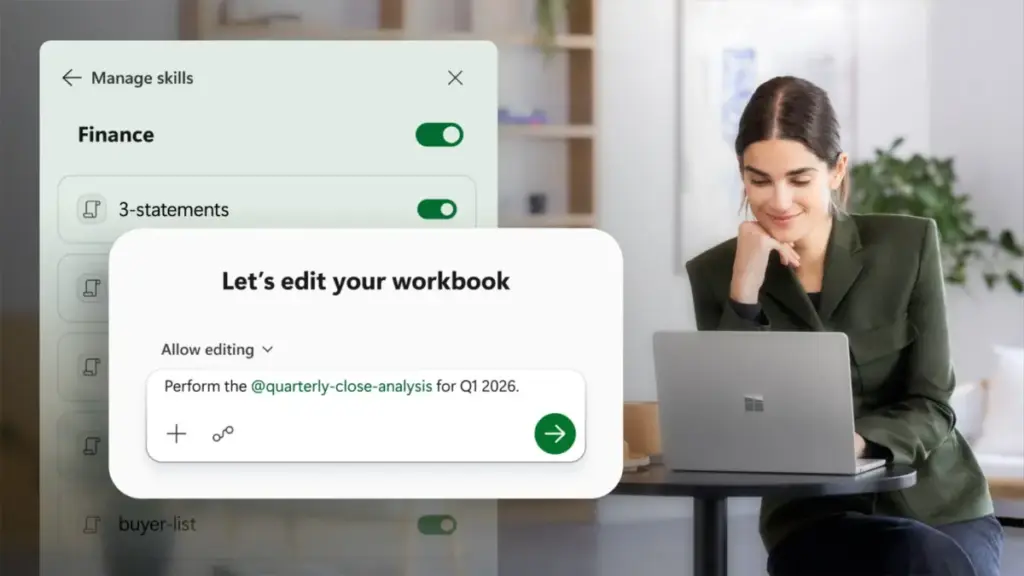
The history of computing has long followed a predictable trajectory: new technology emerges, it is embraced by developers, and then it is immediately adopted by the finance department. From the early days of the personal computer to the rise of relational databases and the eventual migration to the cloud, finance professionals have consistently been the vanguard of technological adoption. For these experts, a more powerful tool represents more than just efficiency; it offers a competitive edge and the ability to model the complexities of reality with ever-increasing precision.
For the better part of four decades, the primary tool for this work has been Microsoft Excel. It is the environment where quarterly earnings are closed, where multi-year forecasts are debated line by line, and where every figure must be traceable to a verifiable source. As artificial intelligence begins to permeate the corporate landscape, the stakes in the finance sector are uniquely high. To be useful in a financial context, AI cannot simply generate an answer; it must show its work, utilize trusted data, and provide a transparent audit trail for every calculation.
Microsoft is addressing these rigorous requirements by introducing a suite of new features for Microsoft 365 Copilot in Excel, specifically engineered for the financial services industry. These updates, which include specialized "skills" for repeatable workflows, new financial data connectors, and improved traceability functions, represent a significant step in moving AI from a general-purpose assistant to a specialized financial analyst.
Built for the Complexity of Finance Work
The introduction of AI into financial workflows requires a level of scrutiny that exceeds standard consumer applications. Financial professionals operate in a world where a single misplaced decimal or an unverified assumption can have catastrophic consequences for a firm’s balance sheet or regulatory standing. Recognizing this, Microsoft has integrated Copilot into its own internal finance operations, allowing the technology to be "pressure-tested" by an organization operating at the frontier of global finance.
Within Microsoft’s own Financial Planning and Analysis (FP&A), Accounting, Tax, Compliance, and Treasury departments, Copilot is already being utilized in real-world workflows. The goal is to reduce the time spent on manual data hunting and the rebuilding of repetitive analyses, thereby freeing teams to focus on the higher-level judgment and decision-making that their roles demand. This internal feedback loop has been essential in shaping the product, with Microsoft’s finance teams acting as the first line of defense, identifying where the AI falls short and pushing the development team to meet the exacting standards of the profession.
To ensure that Copilot can handle the multi-step, complex tasks inherent in finance, Microsoft has developed an evaluation framework that goes beyond simple task completion. Before any new capability is shipped, it is graded against benchmarks that reflect daily financial operations. This ensures the AI can deliver a verifiable result across a series of linked steps, rather than just answering isolated prompts.
Central to this effort is a partnership with the Financial Modeling Institute (FMI), a global body responsible for credentialing the world’s most demanding financial modelers. By utilizing FMI’s library of real-world financial modeling cases, Microsoft has established a foundational set of criteria to evaluate Copilot’s performance. This collaboration ensures that the AI is not just performing math, but is adhering to the structural and logical standards expected of a professional modeler.
Tuned to Your Standards
One of the most significant hurdles in adopting AI for finance has been the "start-from-scratch" problem. Financial workflows are often highly specific to a firm’s internal culture and methodology. To address this, Microsoft is introducing "skills"—a feature that allows finance teams to define exactly how Copilot should execute common, repeatable processes.
 Productivity Software & Office Suites
Microsoft Announces Fifth Annual Power Platform Community Conference in Las Vegas to Address the Future of AI-Driven Business Processes
As modern enterprises continue to navigate an era defined by rapid digital...
 Productivity Software & Office Suites
Microsoft 365 Copilot Surpasses 30 Million Paid Seats as Enterprise AI Shifts from Assistance to Autonomous Agency
In a landmark update during its most recent earnings call, Microsoft announced...
 Productivity Software & Office Suites
Microsoft Unveils Microsoft 365 G7: A New Frontier for AI-Driven Governance in the Public Sector
In a move designed to redefine how the public sector interacts with...







