
The history of computing has long followed a predictable trajectory: new technology emerges, it is embraced by developers, and then it is immediately adopted by the finance department. From the early days of the personal computer to the rise of relational databases and the eventual migration to the cloud, finance professionals have consistently been the vanguard of technological adoption. For these experts, a more powerful tool represents more than just efficiency; it offers a competitive edge and the ability to model the complexities of reality with ever-increasing precision.
For the better part of four decades, the primary tool for this work has been Microsoft Excel. It is the environment where quarterly earnings are closed, where multi-year forecasts are debated line by line, and where every figure must be traceable to a verifiable source. As artificial intelligence begins to permeate the corporate landscape, the stakes in the finance sector are uniquely high. To be useful in a financial context, AI cannot simply generate an answer; it must show its work, utilize trusted data, and provide a transparent audit trail for every calculation.
Microsoft is addressing these rigorous requirements by introducing a suite of new features for Microsoft 365 Copilot in Excel, specifically engineered for the financial services industry. These updates, which include specialized "skills" for repeatable workflows, new financial data connectors, and improved traceability functions, represent a significant step in moving AI from a general-purpose assistant to a specialized financial analyst.
Built for the Complexity of Finance Work
The introduction of AI into financial workflows requires a level of scrutiny that exceeds standard consumer applications. Financial professionals operate in a world where a single misplaced decimal or an unverified assumption can have catastrophic consequences for a firm’s balance sheet or regulatory standing. Recognizing this, Microsoft has integrated Copilot into its own internal finance operations, allowing the technology to be "pressure-tested" by an organization operating at the frontier of global finance.
Within Microsoft’s own Financial Planning and Analysis (FP&A), Accounting, Tax, Compliance, and Treasury departments, Copilot is already being utilized in real-world workflows. The goal is to reduce the time spent on manual data hunting and the rebuilding of repetitive analyses, thereby freeing teams to focus on the higher-level judgment and decision-making that their roles demand. This internal feedback loop has been essential in shaping the product, with Microsoft’s finance teams acting as the first line of defense, identifying where the AI falls short and pushing the development team to meet the exacting standards of the profession.
To ensure that Copilot can handle the multi-step, complex tasks inherent in finance, Microsoft has developed an evaluation framework that goes beyond simple task completion. Before any new capability is shipped, it is graded against benchmarks that reflect daily financial operations. This ensures the AI can deliver a verifiable result across a series of linked steps, rather than just answering isolated prompts.
Central to this effort is a partnership with the Financial Modeling Institute (FMI), a global body responsible for credentialing the world’s most demanding financial modelers. By utilizing FMI’s library of real-world financial modeling cases, Microsoft has established a foundational set of criteria to evaluate Copilot’s performance. This collaboration ensures that the AI is not just performing math, but is adhering to the structural and logical standards expected of a professional modeler.
Tuned to Your Standards
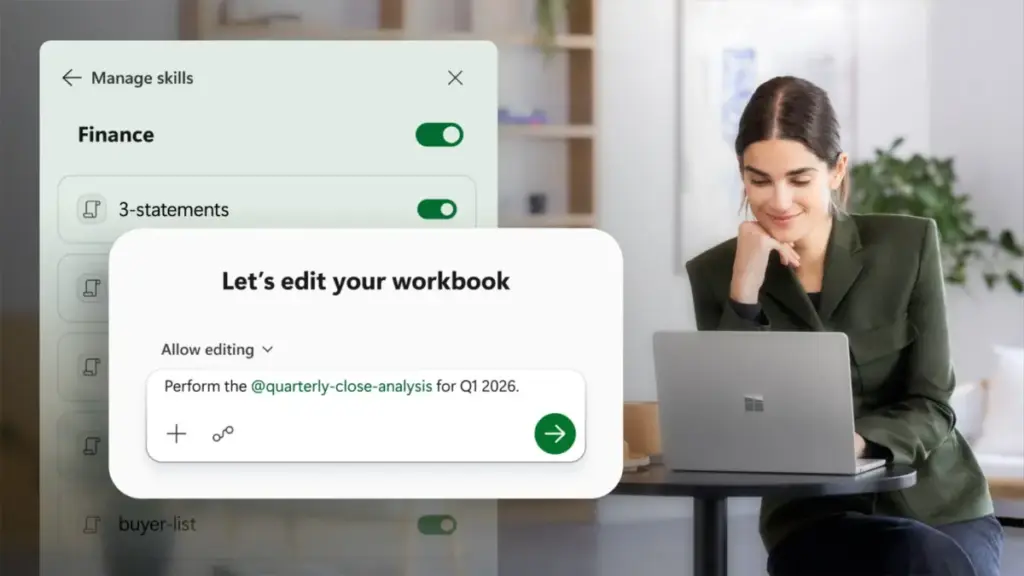
One of the most significant hurdles in adopting AI for finance has been the "start-from-scratch" problem. Financial workflows are often highly specific to a firm’s internal culture and methodology. To address this, Microsoft is introducing "skills"—a feature that allows finance teams to define exactly how Copilot should execute common, repeatable processes.
Whether it is building a discounted cash flow (DCF) model, closing the monthly books, refreshing a reporting model, or conducting a variance analysis, these skills act as a roadmap for the AI. Instead of the user having to provide exhaustive instructions every time, a predefined skill guides Copilot through the necessary steps. This ensures that the output follows the correct structure and formatting, making the final product easier to review, reuse, and trust.
Microsoft has released a library of sample finance skills to get teams started, but the true power of the feature lies in its customization. Users can create their own custom skills using an open-standard markdown file. By saving a file named "SKILL.md" in a OneDrive folder, Copilot can automatically ingest the instructions and apply them to complex tasks, such as generating a three-statement model or a board-ready reporting package. This allows an organization to codify its proprietary "house style" and ensure that the AI adheres to it consistently.
The ecosystem for these skills is also expanding to include third-party developers and partners. Soon, specialized skills will be available through the Microsoft Marketplace and Microsoft 365 Admin Center. Microsoft is already collaborating with a first wave of partners, including major names in the finance and Enterprise Resource Planning (ERP) space such as LSEG, Ramp, Rogo, Samaya AI, Velixo, and Vena. This open approach allows firms to bring their preferred tools and methodologies directly into the Excel environment.

Furthermore, Copilot is becoming more adaptable to individual user preferences. New personalization features allow professionals to set their formatting and logic preferences once, which Copilot then applies consistently across different tasks. Additionally, "workbook rules" have been introduced to capture specific naming conventions, structures, and formula styles as a dedicated sheet within the workbook, ensuring that the logic follows the file regardless of who is opening it.
Grounded in Data You Trust
In the world of finance, an analysis is only as good as the data that feeds it. Historically, this has meant hours of manual data pulls from various terminals and databases—a process prone to human error and version control issues. To solve this, Copilot in Excel is being equipped with direct connectors to the data sources that financial professionals rely on most.
By bringing market data, fundamentals, and research directly into the workbook, Copilot allows the analysis to begin from a foundation of live, trusted data. This follows the release of connectors for LSEG and Moody’s earlier this year. Microsoft is now expanding these options, providing even more avenues for bringing both public and private market data into the Excel environment. FactSet, a staple in the industry, is currently in preview and is scheduled for general availability in July. These connectors ensure that when a professional asks Copilot to compare a company’s performance against its peers or to pull historical volatility data, the information is coming from a verified, professional-grade source.
These data capabilities are further enhanced by "Work IQ," which provides Copilot with the necessary context regarding a user’s specific work environment. When combined with skills and connectors, this allows for highly sophisticated prompts. A user might, for example, ask Copilot to "update the revenue forecast in this sheet based on the latest market trends from the LSEG connector and apply our internal variance analysis skill." The AI then navigates the data, applies the logic, and presents a structured update that is ready for human review.
Controllable by Design
Perhaps the most critical requirement for finance professionals is the ability to audit and control the AI’s output. In a field where "black box" solutions are unacceptable, Microsoft has focused on making Copilot’s actions entirely transparent. A finance team must know not just the final number, but exactly how that number was derived.
To meet this need, Microsoft has introduced "Plan with Copilot." Before the AI takes any action in a spreadsheet, it can now outline its intended path. This includes specifying which cell ranges it will modify, which formulas it will write, and what assumptions it is making. This allows the user to review and course-correct the AI’s logic before any changes are committed.
Once changes are made, the traceability continues. Every edit made by the AI remains linked back to the affected cells. Furthermore, these edits are now explicitly attributed to Copilot in the "Show Changes" pane, appearing alongside the edits made by human collaborators. This level of attribution ensures that the AI functions as a "trusted analyst"—proposing a path, explaining its methodology, and leaving a clear, reviewable trail of its work.
This approach acknowledges that the role of the finance professional is changing. The job is shifting away from the manual construction of models and toward the review and refinement of models generated by AI. By providing these control mechanisms, Microsoft is ensuring that the human remains the final authority in the financial reporting process.
Availability and Rollout
The new suite of features is being rolled out progressively to Microsoft 365 Copilot customers. Currently, personalization, workbook rules, pre-built skills, and the federated Copilot connectors are generally available across Excel for the Web, Windows, and Mac. The "Plan with Copilot" feature and the attribution in the "Show Changes" pane are also now available to general users.
For those looking to build more bespoke solutions, custom skills are available today via the Insiders channel for Windows and Mac, with a full rollout to general availability expected next month. Looking further ahead, the integration of partner-built skills from the broader finance ecosystem is slated for the third quarter of 2026.
As these tools become more deeply integrated into the daily workflows of finance departments worldwide, the expectation is that the "Excel of the future" will be less about the manual entry of data and more about the orchestration of intelligent agents. By grounding these agents in the specific rigors of financial modeling and data integrity, Microsoft is attempting to ensure that the next wave of technology in finance is as transformative as the spreadsheet itself.
 Productivity Software & Office Suites
Microsoft and European Tech Leaders Set Sights on Amsterdam for ESPC 2026: A Deep Dive into the Future of AI-Powered Work
As the global landscape of enterprise technology continues its rapid shift toward...
 Productivity Software & Office Suites
Microsoft to Headline ESPC 2026 in Amsterdam: A Deep Dive into the Future of AI-Powered Work and Agentic Ecosystems
The landscape of enterprise technology is currently undergoing one of its most...
 Productivity Software & Office Suites
Microsoft Unveils Reimagined Copilot with Agentic Capabilities and New "Autopilot" Digital Teammate
Microsoft has announced a sweeping overhaul of its Copilot platform, signaling a...







