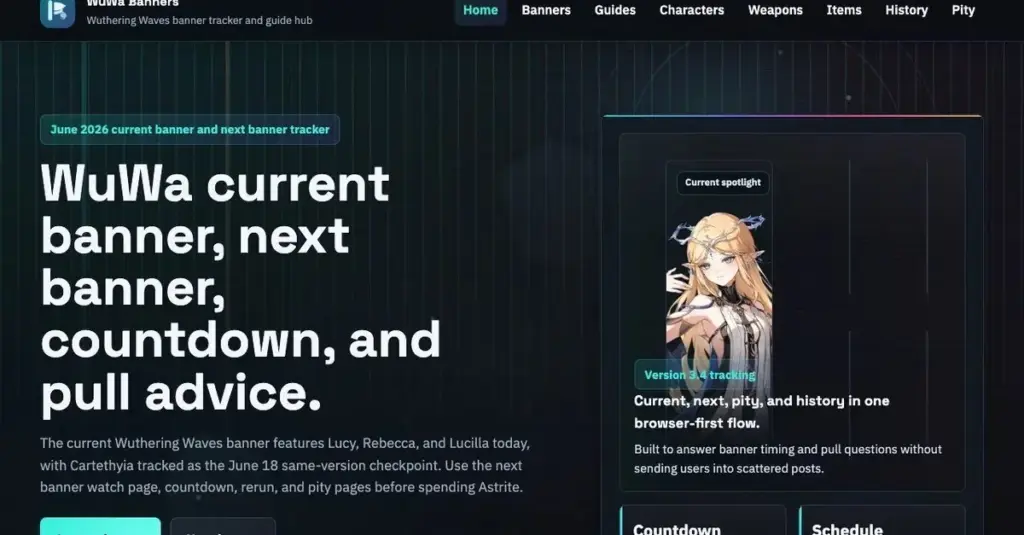
In the rapidly evolving landscape of live-service gaming, information is the most valuable currency for players. Whether navigating the sprawling landscapes of Teyvat in Genshin Impact or the post-apocalyptic reaches of Solaris-3 in Wuthering Waves, players are constantly seeking answers to a specific set of high-stakes questions: Who is on the current banner? Which character is coming next? Exactly when does the current phase end?
However, for the developers and journalists who maintain the guides and trackers that answer these questions, these queries represent a significant data problem. The most frequently searched information is often the most volatile. A confirmed character lineup can be upended by a last-minute developer announcement, and community speculation often becomes indistinguishable from official data in the eyes of search engine algorithms. The traditional model of digital publishing—treating information as a chronological stream of blog posts—is increasingly proving inadequate for the demands of the modern "forever game."
A new approach to this challenge treats the game guide not as a series of articles, but as a state-modeling problem. By prioritizing the structural integrity of data over the mere frequency of updates, developers are finding ways to provide more accurate, reliable, and user-friendly tools for the gaming community. This methodology shifts the focus from "what is being said" to "what is known," creating a framework that can handle the inherent uncertainty of live-service roadmaps.
The Architecture of Explicit Evidence States
The core of the issue lies in how information is categorized before it ever reaches the user’s screen. In a standard content management system, a record for a "character banner"—the limited-time events where players spend currency to acquire new heroes—is typically either published or unpublished. This binary state fails to capture the nuance of the information lifecycle in gaming.
To combat this, the state-modeling approach introduces explicit "evidence states." Under this system, a banner record is never simply "missing" or "live." Instead, it exists within a spectrum of verification. The "confirmed" state is reserved strictly for data supported by official developer notices or direct in-game data. This ensures that when a player sees a countdown timer or a character list, they are looking at information that has been vetted by the primary source.
The "watchlist" state serves as a crucial middle ground. It acknowledges that while a version number might have been mentioned or a community signal has emerged, the specific lineup remains unofficial. By categorizing information this way, developers can prevent a generic mention of a future update from silently morphing into a factual banner page. It allows the platform to remain honest with the user; the page can explicitly state that the next official update is pending rather than inventing characters or dates to fill an empty UI card.
Finally, the "historical" state ensures that once a phase is completed, its data is not discarded but transitioned into a permanent archive. This is essential for players performing "rerun research"—the practice of tracking how long it has been since a specific character was last available—which is a vital component of long-term resource planning in games with "gacha" mechanics.
 Software Development & Scripting for IT
The Streaming Paradox: Resolving the Single-Blob Bottleneck in Next.js Server-Sent Events
In the rapidly evolving landscape of generative artificial intelligence and real-time web...
 Software Development & Scripting for IT
AI-Driven Development Reaches New Milestone as Formal Verification and Statecharts Detect Elusive Edge Cases
In the rapidly evolving landscape of software engineering, the integration of artificial...
 Software Development & Scripting for IT
The Architecture Gap: Why AI Coding Agents Are Generating More Code but Less Software
In the modern landscape of software development, a peculiar paradox has begun...