
In the rapidly evolving landscape of enterprise resource planning and data management, SAP HANA has emerged as more than just a database; it is a foundational platform that has redefined how organizations process, analyze, and leverage their most critical information. At its core, SAP HANA—short for High-Performance Analytic Appliance—is a multi-model, in-memory, column-oriented database management system. Its primary distinction lies in its ability to support both high-volume transactional processing (OLTP) and complex analytical processing (OLAP) within a single, unified system.
When enterprise architects and database administrators (DBAs) discuss SAP HANA architecture, they are typically examining the structural design that allows the platform to bypass the limitations of traditional disk-based systems. This architecture determines how the platform stores vast amounts of data, processes intricate queries, scales to meet global demand, and ensures a rapid recovery in the event of a system failure. By keeping active data in RAM rather than on spinning disks, SAP HANA facilitates real-time insights that were previously impossible under older paradigms.
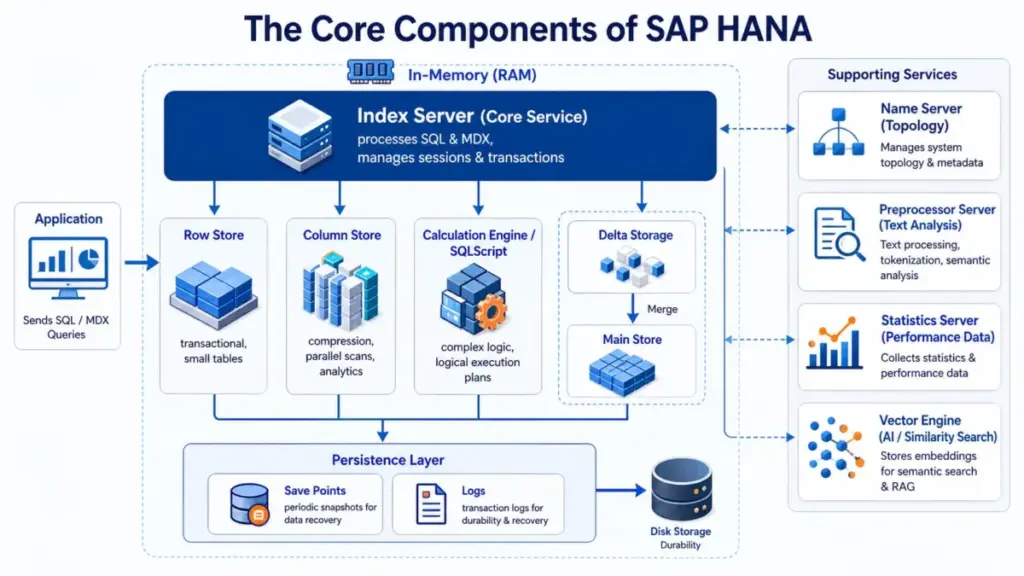
The Core Components of the SAP HANA Index Server
The heartbeat of the SAP HANA environment is the index server. This is the primary service responsible for the heavy lifting within the database. It houses the actual data stores and the engines that process that data. Every time a user or an application interacts with the system, the index server manages the session, handles transaction controls, and coordinates the various engines required to execute the work.
Beyond simple data retrieval, the index server is a sophisticated orchestrator. It processes both SQL (Structured Query Language) for relational data and MDX (Multi-Dimensional eXpressions) for OLAP-style cubes. By managing these requests centrally, the index server ensures that data integrity is maintained through ACID (Atomicity, Consistency, Isolation, Durability) compliance while maximizing the hardware’s throughput.
Balancing Row and Column Stores
A defining characteristic of SAP HANA is its dual-approach storage model. While most traditional databases are either row-oriented or column-oriented, SAP HANA includes both, allowing it to adapt to the specific needs of different workloads.
The column store is where the majority of SAP HANA’s performance reputation is built. By storing data in columns rather than rows, the system can achieve massive compression ratios. This is particularly beneficial for analytical processing, where queries often need to scan a few columns across millions or billions of records. Columnar storage allows for parallel scans and high-speed aggregations, making it the engine of choice for large-scale reporting.
Conversely, the row store remains a vital component of the architecture. It is optimized for highly transactional workloads where the system needs to access all fields of a single record quickly—such as looking up a specific customer’s details or processing a single sales order. It is also the home for many system tables. The architectural brilliance of SAP HANA lies in its ability to let the workload dictate the storage choice, rather than forcing a one-size-fits-all approach.
The Calculation Engine and Advanced Logic Execution
To handle more complex business logic, SAP HANA employs a dedicated calculation engine. This component is essential when simple SQL queries are insufficient to represent the intricacy of modern business rules. Through the use of SQLScript—a collection of extensions to SQL—and calculation models, developers can push complex logic directly into the database layer.
 Helpdesk & IT Service Management (ITSM)
SolarWinds Reveals IT Pro Day 2026 Survey Results: Modern Technology Management Mirrored in High-Stakes Professional Sports
As the global technology community gathers to celebrate IT Pro Day 2026,...
 Helpdesk & IT Service Management (ITSM)
Anthropic and Akamai Ink Landmark $11.6 Billion Compute Partnership to Fuel Long-Term AI Infrastructure Growth
In a move that underscores the staggering capital requirements of the generative...
 Helpdesk & IT Service Management (ITSM)
UK Tech Leaders Demand £20 Billion Investment to Secure National AI Sovereignty
A coalition of the United Kingdom’s most prominent technology leaders has issued...







