
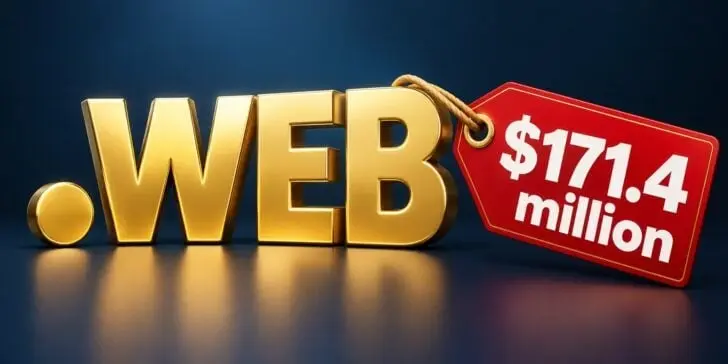
In a detailed disclosure that sheds light on one of the most protracted and expensive battles in the history of the internet’s domain name system, Verisign has finally confirmed the full financial weight of its acquisition of the .web top-level domain (TLD). According to a recent filing with the Securities and Exchange Commission (SEC), the Virginia-based registry giant spent a total of $171.4 million to secure the rights to the extension. The revelation comes as the company prepares for a mid-December launch, marking the end of a nearly decade-long saga defined by legal disputes, proxy bidding, and intense industry speculation.
The $171.4 million figure represents a significant escalation from the initial auction price and underscores the premium Verisign was willing to pay to keep .web under its umbrella. While many of the financial broad strokes had been a matter of public record for years, the new filing provides the first comprehensive look at the "hidden" costs associated with bringing this specific generic TLD to market. For Verisign, which already operates the internet’s most valuable real estate in .com and .net, the successful rollout of .web is no longer just a strategic expansion—it is a high-stakes attempt to recoup a massive capital investment.
The Financial Path to Ownership
The journey to this $171.4 million valuation began in 2016 during a high-profile ICANN (Internet Corporation for Assigned Names and Numbers) auction. At the time, a company called Nu Dot Co won the rights to .web with a staggering $135 million bid, a record-breaking sum that sent shockwaves through the domain industry. It was later revealed that Verisign had provided the funding for Nu Dot Co’s bid, acting through a proxy to secure the extension.
Subsequent filings in 2016 indicated that Verisign had paid $145 million for the asset, suggesting a $10 million premium paid to Nu Dot Co for its role in the acquisition. However, the most recent SEC disclosure clarifies the final tally: Verisign ended up paying $145.2 million to the proxy entity, plus an additional $26.2 million in what the company described as "certain other acquisition costs." While Verisign noted that these individual costs were "not material" on their own, the aggregate $26.2 million represents a substantial overhead that highlights the complexity of the acquisition.
Industry analysts suggest that this $26.2 million likely covers a decade of legal fees, administrative overhead, and potential settlements. A significant portion of this expenditure may be tied to the long-standing legal challenges from competitors like Altanovo (formerly Afilias), which fought the results of the 2016 auction for years. Altanovo argued that the use of a proxy bidder violated ICANN’s auction rules, leading to a series of appeals and Independent Review Process (IRP) proceedings that effectively mothballed .web for eight years. The recent disclosure suggests that Verisign may have finally cleared these hurdles, possibly through a settlement aimed at ending the litigation and clearing the path for a commercial launch.
The Launch Strategy: Leveraging the .Com Monopoly
With the financial cards now on the table, the focus shifts to how Verisign intends to generate a return on its $171.4 million investment. During a recent investor conference call, the company outlined a rollout schedule that begins in mid-December. The launch will follow a traditional phased approach, starting with a 30-day "Sunrise" period. This phase is legally mandated to allow trademark holders to register their brand names before the general public, preventing "cybersquatting" and protecting intellectual property.
The most critical phase for Verisign’s return on investment (ROI), however, will be the "limited registration period" that follows. During this window, Verisign plans to implement a strategy that leverages its dominance in the .com market. The company indicated that registrants who currently own .com domains will be given a preferential opportunity to acquire the matching version of their domain with the .web extension.
This "matching" strategy is a proven revenue driver in the domain industry. By marketing .web as a natural companion to .com, Verisign is tapping into a pre-existing customer base of millions. For business owners, the pitch is often rooted in brand protection: "If you own yourbrand.com, you should also own yourbrand.web to ensure no one else can use it." For Verisign, this creates a massive opportunity for high-margin revenue, as the cost of maintaining a TLD registry remains relatively fixed regardless of whether they have one million or ten million registrations.
Historical Precedents and Market Challenges
The success of such a launch often depends on the cooperation of domain registrars—the retail outlets like GoDaddy, Namecheap, and Network Solutions where consumers actually buy their names. Registrars are highly motivated to push these new extensions because they offer an opportunity to upsell existing customers.
The industry has seen similar "windfall" events in the past. When the .xxx TLD launched, registrars aggressively marketed defensive blocks to corporations and public figures who wanted to ensure their names weren’t associated with adult content. This resulted in a surge of registrations from entities that had no intention of actually using the domains, but paid the fees nonetheless to avoid reputational risk.
However, .web faces a different set of challenges than the niche TLDs of the past. The internet landscape of 2024 is vastly different from that of 2016, when Verisign first placed its bet. In the intervening years, the market has been flooded with hundreds of new generic TLDs, ranging from .app and .dev to .site and .online. This saturation has led to a degree of "TLD fatigue" among both businesses and consumers.
The fundamental question facing Verisign is whether the term "web" still carries enough weight to justify a $171 million price tag. In the early days of the internet, "the web" was synonymous with the online experience. Today, the digital world is increasingly dominated by mobile applications, social media platforms, and specialized ecosystems where the concept of a "web address" is sometimes secondary. There is a risk that the term may feel "passé" to a younger generation of entrepreneurs who might prefer more modern extensions like .ai or .io.
The Pricing Dilemma
As Verisign crunches the numbers for the December launch, pricing will be the most delicate lever they have to pull. The company has not yet announced the specific costs for the limited registration period, but the stakes are high. If Verisign sets the price for a .web match too high, it risks a low adoption rate, as companies decide that the defensive value isn’t worth the annual renewal fee. If they set it too low, they may achieve high registration numbers but fail to make a meaningful dent in the $171.4 million acquisition cost.
For investors, the limited release period will serve as a litmus test for the viability of the .web asset. Verisign’s core business—managing the .com and .net registries—is a highly stable, "utility-like" operation with predictable growth. The .web acquisition represents a rare moment of aggressive capital expenditure and market risk for the company. Shareholders will be looking for evidence that .web can become a "third pillar" for the company, providing a new stream of recurring revenue that isn’t tied to the price caps and regulatory oversight associated with .com.
Looking Ahead to December
As the mid-December sunrise period approaches, the domain industry will be watching closely to see how Verisign markets this new asset. The success of .web will likely depend on whether the company can convince the world that a .web address is a "must-have" rather than a "nice-to-have."
While the $171.4 million investment is a sunk cost, the true value of .web will be determined in the first 90 days of its public availability. If the matching program for .com owners sees high conversion rates, Verisign may well prove that its long, expensive battle for .web was a masterstroke of long-term planning. If the launch meets with apathy, it may serve as a cautionary tale about the diminishing returns of generic domain extensions in an increasingly fragmented digital age.
For now, Verisign is moving forward with a plan that has been nearly a decade in the making. With the legal clouds finally parting and the total costs finally accounted for, the industry is about to see exactly what kind of return a $171 million bet on the "web" can deliver.
 Web Hosting & Domain Management
ICANN Confirms 1,616 Applications for 2026 New gTLD Round as Fees Top $350 Million
The Internet Corporation for Assigned Names and Numbers (ICANN) has officially confirmed...
 Web Hosting & Domain Management
Verisign Discloses $171.4 Million Total Investment in .Web as Long-Awaited Launch Approaches
In a recent regulatory disclosure that sheds new light on one of...
 Web Hosting & Domain Management
Verisign Unveils "Verisign Informed" Security Service and Formally Applies for .pki Top-Level Domain
Verisign, the global leader in domain name registry services and internet infrastructure,...







