

Interestingly, SkyHammer is designed to run UALink over Ethernet (UALoE) and the ESUN memory protocols. This confirms that, beneath its specialized AI features, SkyHammer remains an Ethernet-based ASIC. This choice aligns with a broader industry trend where Ethernet is being optimized to challenge InfiniBand’s long-standing dominance in high-performance environments. While InfiniBand still holds the crown for absolute lowest port-to-port hop latency, the Ultra Ethernet Consortium and companies like Upscale AI are betting that Ethernet’s superior scalability and cost-effectiveness will eventually make it the standard for the vast majority of AI clusters.
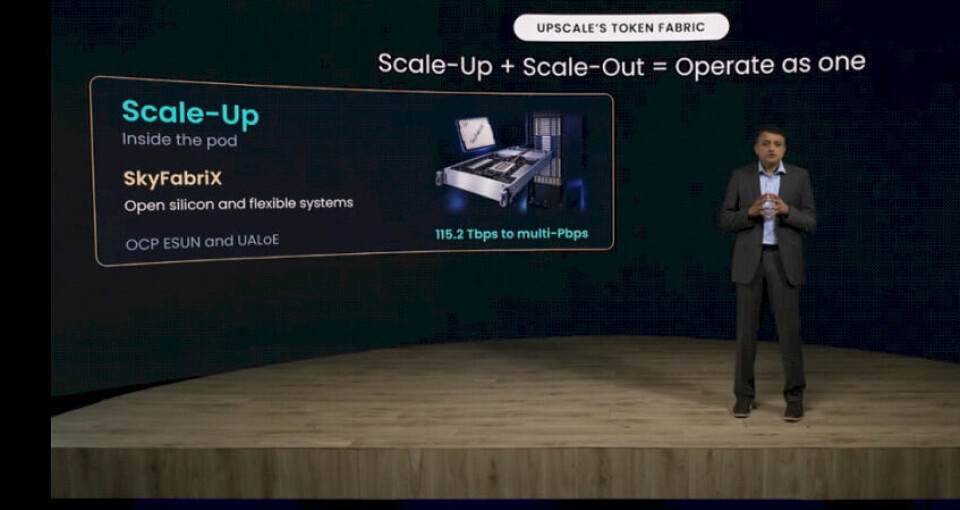
Upscale AI’s strategy also involves a nuanced relationship with Nvidia. The startup has selected Nvidia’s Spectrum-X Ethernet switches as its preferred platform for scale-out fabrics. Upscale AI plans to acquire Spectrum-X ASICs and build its own scale-out switches, porting its SkyOS network operating system to run on them. SkyOS itself is an AI-optimized evolution of SONiC (Software for Open Networking in the Cloud), the open-source operating system originally developed by Microsoft that has become a de facto standard in hyperscale datacenters.
By spanning both scale-up and scale-out networks with a single operating system and orchestration tool (SkyCMD), Upscale AI aims to give customers a unified view of their entire AI infrastructure. This would theoretically allow a datacenter architect to mix and match CPUs, GPUs, and XPUs from different vendors, all managed through a single software stack.
The primary hurdle for this vision remains Nvidia’s closed ecosystem. As of now, there is no path for Nvidia GPUs to participate in a scale-up domain managed by SkyHammer or any other non-Nvidia fabric. Nvidia has every incentive to keep its NVSwitch environment proprietary to maintain its high margins. However, other players in the market, most notably AMD, are likely looking at companies like Upscale AI as essential partners. AMD’s strategy relies on open standards like UALink and ESUN, and some industry observers suggest that AMD might eventually seek to acquire a company like Upscale AI to secure its own scale-up networking intellectual property.
As the industry moves toward the next generation of AI hardware—Nvidia’s Rubin and AMD’s future MI-series accelerators—the battle over the interconnect will only intensify. Nvidia could potentially counter the threat of standardized fabrics by increasing the radix of its NVSwitch ASICs to flatten its networks, though this would likely require a trade-off in per-port bandwidth. Alternatively, if the market for AI inference continues to shift toward standardized protocols, Nvidia might eventually find it more profitable to port its own protocols to high-radix switches like SkyHammer.
For now, Upscale AI is positioning itself as the bridge between the proprietary past and a more open, competitive future for AI infrastructure. With $500 million in the bank and a clean-sheet silicon design, the company is betting that the law of economic substitution will eventually break down even the strongest of proprietary walls.
 Enterprise Tech & Infrastructure
Understanding Fibre Channel over Ethernet: Bridging the Gap Between High-Performance Storage and Ethernet Ubiquity
In the rapidly evolving landscape of data center infrastructure, the quest for...
 Enterprise Tech & Infrastructure
Understanding the Architecture of Modern Storage: Why the ‘Flash vs. SSD’ Debate Misses the Point
In the rapidly evolving landscape of enterprise data management, the terminology used...
 Enterprise Tech & Infrastructure
Navigating the Financial Realities of Enterprise Cloud Storage: A Comprehensive Analysis of Amazon S3 Cost Management
In the rapidly evolving landscape of enterprise cloud infrastructure, the management of...







