

In the landscape of modern enterprise infrastructure, Amazon Simple Storage Service (S3) has long been regarded as the gold standard for scalability and durability. However, as data volumes swell into the petabyte range, many organizations are discovering a jarring disconnect between their projected storage budgets and their actual monthly invoices. The single most significant driver of S3 overspend is the tendency to treat the storage class’s per-gigabyte rate as the totality of the bill. In reality, the true cost of ownership is a complex composite of storage duration, request volumes, transition fees, retrieval charges, and data transfer rates.
Navigating this complexity requires more than a casual understanding of the AWS management console. It demands a rigorous, model-driven approach to data lifecycle management. For data with a predictable aging curve—such as logs that must be retained for compliance but are rarely accessed after thirty days—automated Lifecycle rules are the industry standard. These rules move objects to more cost-effective tiers like S3 Standard-Infrequent Access (Standard-IA) or S3 Glacier on a fixed schedule. Conversely, for workloads where access patterns are erratic or entirely unknown, Amazon recommends S3 Intelligent-Tiering. This class automatically shifts data between tiers based on usage, ostensibly removing the guesswork for administrators.
Yet, neither of these automated solutions is a "set-and-forget" panacea. Their effectiveness is entirely dependent on the specific characteristics of the workload, regional pricing variations, and the date on which the cost model was last validated. Without a granular understanding of these mechanics, an organization’s attempt to save money can inadvertently trigger a cascade of unforeseen fees.
The Multi-Dimensional Equation of S3 Pricing
Enterprise S3 expenditure is never a single line item; it is a sum of several distinct operational variables. Beyond the headline storage rate, administrators must account for request costs, which include PUT, COPY, LIST, and GET operations. Crucially, lifecycle transition requests are also billed on a per-object basis. When moving millions of files between tiers, these transition fees can occasionally eclipse the storage savings they were intended to generate.
Retrieval charges add another layer of complexity, particularly when dealing with the various Glacier tiers. Depending on the urgency of the data request, costs are metered separately for Bulk versus Expedited retrievals, with significant price deltas between the two. Data transfer also represents a major, and often under-emphasized, cost center. AWS tracks outbound transfer to the internet, inbound transfer, and regional transfer to or from EC2 and other resources as distinct usage types.
Optional features further complicate the billing report. Intelligent-Tiering monitoring, S3 Inventory listings, Multi-Region Access Points (MRAP) routing, and S3 Metadata processing each appear as separate line items. According to AWS’s own documentation on understanding billing reports, these "ancillary" costs are frequently where budget overruns hide. For instance, while lifecycle transitions themselves do not carry a data-retrieval charge, every move into a new storage class incurs a per-request ingestion charge. This means that a poorly timed transition strategy can lead to a "double-billing" effect where the organization pays to move the data and then pays a per-request fee for the destination class.
Before committing to a specific storage architecture, experts suggest running a representative model. For example, a bucket containing 10 million objects with an average size of 2 MB, retained for three years with a 5% annual retrieval rate, should be priced using three different scenarios: Standard with a Lifecycle path to Glacier, straight Intelligent-Tiering, and Intelligent-Tiering with Archive Access enabled. Because pricing varies by region, capacity, and support level, any model not updated within the current quarter is considered suspect by financial operations (FinOps) professionals.
Profiling Data Before Implementation
The first step in any cost-control initiative is the rigorous profiling of data. Objects must be segmented by average size, access frequency, and retention requirements before any storage class is selected. A critical, often overlooked update occurred in September 2024: AWS changed the default Lifecycle behavior to prevent objects smaller than 128 KB from transitioning to any storage class automatically. This was a response to the fact that for very small objects, the per-object transition cost frequently outweighs any potential storage savings.
However, organizations operating on legacy configurations built before this date may still be running under the old behavior unless they manually intervene. If an administrator inherited an older environment, it is vital to audit these rules. Tools like S3 Storage Lens or S3 Inventory are essential for identifying how much capacity sits under that 128 KB threshold.
Data profiling must also account for versioned buckets and the use of Object Lock. In buckets where versioning is enabled, simply expiring a current version does not delete the data; it creates a "delete marker." These markers, while seemingly invisible, still count as objects and contribute to both storage and request counts. Without a secondary Lifecycle rule to clean up previous versions and expired delete markers, a bucket can grow indefinitely in cost while appearing "empty" to the casual observer.
Strategic Selection of Storage Destinations
Choosing a destination storage class requires matching the class’s technical limitations with the organization’s operational reality. S3 Standard-IA and S3 One Zone-IA are designed for steady, infrequent access but come with a 30-day minimum storage duration. If data is deleted or moved before that 30-day window closes, AWS charges a prorated fee for the remaining days.
For long-term archives, the Glacier family offers significant savings but introduces "real-time" accessibility trade-offs. Glacier Instant Retrieval provides millisecond access for data that is rarely touched but requires immediate availability. In contrast, Glacier Flexible Retrieval and Deep Archive are intended for data that can wait minutes or hours for a restore. A critical technical detail involves the transition paths: while Flexible Retrieval can eventually move data to Deep Archive, Deep Archive is a "dead end" for Lifecycle rules. It cannot be converted back to a higher-tier class via automation; it must be manually restored, which can be a costly and time-consuming process if the data is suddenly needed for an audit or legal discovery.
Intelligent-Tiering remains a compelling option for unpredictable workloads because it spans three low-latency tiers with no retrieval charges. However, the "small" monthly per-object monitoring and automation fee can become a substantial line item for portfolios containing millions of small objects. This makes the 128 KB profiling step even more important, as the monitoring fee is applied regardless of object size.
The Mechanics of Automation: Lifecycle vs. Monitoring
It is a common misconception that Lifecycle rules and Intelligent-Tiering are competing technologies. In practice, Lifecycle is a scheduling mechanism, while Intelligent-Tiering is a storage class. An organization can use a Lifecycle rule to move aging data from S3 Standard into the Intelligent-Tiering class, effectively combining the benefits of both.
When using Lifecycle rules, timing is everything. Billing changes apply the moment a rule is satisfied, even if the physical movement of data has not been completed by the AWS backend. There are nuances to this: transitions into Glacier tiers start the 40 KB per-object overhead and the minimum-duration clock at the moment the rule is satisfied. This distinction is vital for organizations trying to time an "early exit" from a storage class to avoid penalties.
Furthermore, administrators must be aware of the overhead associated with the Glacier tiers. Every object transitioned to Glacier adds 40 KB of per-object metadata: 8 KB billed at Standard rates and 32 KB at the destination Glacier rate. For a data lake consisting of billions of tiny files, this overhead can effectively double the storage cost, making it more expensive than leaving the data in S3 Standard. In such cases, AWS recommends aggregating small objects into larger archives (like TAR or ZIP files) before applying transition rules.
The "Invisible" Costs: Egress, Encryption, and Governance
Even the most optimized storage-class strategy can be undermined by costs that sit outside the S3 billing bucket. Data transfer is frequently the largest single line item that native cost calculators under-emphasize. Cross-Region replication and internet egress can quickly dwarf the savings gained from moving data from Standard to Glacier.
Similarly, the security architecture of the data impacts the bill. Objects encrypted with AWS Key Management Service (SSE-KMS) remain encrypted through any transition, but every request to access that data triggers a KMS request fee. In high-churn environments or data-heavy analytics pipelines, these cryptographic request costs can become a major secondary expense.
To maintain control over these variables, robust governance is required. Activating cost-allocation tags is the first step toward visibility, though administrators should be aware that it can take up to 48 hours for new tags to propagate through the billing system. While tagging itself does not carry an extra charge beyond standard API rates, the lack of a deliberate tagging taxonomy makes it impossible to attribute spend to specific departments or applications accurately.
For verifying that Lifecycle actions are actually occurring as intended, AWS recommends S3 Storage Lens over CloudWatch. Storage Lens provides a more comprehensive dashboard for tracking daily storage changes and identifying "orphaned" data. Because Lifecycle transitions are asynchronous, there is often a delay between an object becoming "eligible" for a move and the action being executed. Cross-checking with S3 Inventory and server access logs ensures that the organization is not paying for a storage tier it is no longer utilizing.
Ultimately, the path to S3 cost optimization is not found in a single feature, but in the alignment of storage mechanics with business requirements. If an organization understands its aging curve and maintains large object sizes, Lifecycle rules offer the most direct path to savings. If the workload is a "black box" of unpredictable analytics, Intelligent-Tiering provides a necessary safety net. However, in both scenarios, the most effective tool is a proactive, workload-specific model that accounts for the full spectrum of AWS’s metered services. In the world of enterprise cloud storage, the "cheapest" tier is only a bargain if you don’t have to pay a premium to leave it.
 Enterprise Tech & Infrastructure
Navigating the Abstraction Layer: Strategic Best Practices for Software-Defined Storage Deployment
As the modern enterprise grapples with an unprecedented explosion of data, the...
 Enterprise Tech & Infrastructure
The Physical Limits of Artificial Intelligence: Why Infrastructure Constraints Are Throttling the Generative AI Boom
The prevailing narrative surrounding the generative artificial intelligence revolution often focuses on...
 Enterprise Tech & Infrastructure
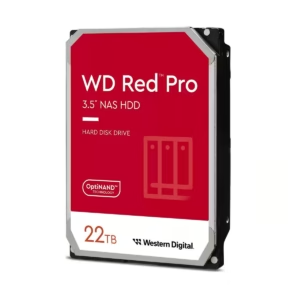
The Pillars of Data Infrastructure: A Comprehensive Evaluation of the Top Enterprise Hard Drives for 2023
In the modern landscape of digital infrastructure, the demand for robust, high-capacity...







