

In the high-stakes world of enterprise data management, the choice of a storage configuration is rarely just a technical checkbox; it is a fundamental business decision that balances the competing demands of performance, capacity, and risk. Among the various levels of Redundant Array of Independent Disks (RAID), RAID 10 stands out as a premium solution designed for environments where speed and reliability are non-negotiable. Often referred to as a "nested" or "hybrid" RAID level, RAID 10 combines the two most fundamental storage techniques—mirroring and striping—to create a system that is greater than the sum of its parts.
At its core, RAID 10 is an implementation that nests two distinct RAID levels: RAID 1 for redundancy and RAID 0 for speed. While there are different ways to architect this combination, the most common implementation is RAID 1+0. In this configuration, mirrored pairs of drives are created first to ensure data safety, and then those pairs are striped together to maximize throughput. This dual-layer approach provides a unique set of benefits, but it also carries a significant "capacity tax" that storage administrators must weigh carefully against their performance requirements.
Key Terms and the Architecture of RAID 10
To understand the utility of RAID 10, one must first master the terminology that defines its construction. The industry standard, RAID 1+0 (striped mirrors), involves building RAID 1 mirror arrays as the foundation. These mirrored units, each containing identical data, are then combined into a RAID 0 stripe. This is the configuration most frequently implemented by hardware controllers and is what most IT professionals are referring to when they use the term "RAID 10."
Conversely, RAID 0+1 (mirrored stripes) represents the inverse construction. In this scenario, disks are first organized into RAID 0 stripe sets, which are then mirrored as a whole. While the physical components—the drives and the controller—remain the same, the order of assembly creates a meaningfully different failure behavior.
A critical component of this architecture is the mirror pair. In a RAID 1+0 setup, the entire array is essentially a collection of these pairs. Because each pair holds identical data, the system can lose one drive in a pair without losing access to the information. The striping layer then distributes data across these pairs, allowing the system to read from and write to multiple disks simultaneously, thereby increasing performance.
Furthermore, some modern systems utilize what is known as "Complex RAID 10." This is a single, non-nested RAID level, often seen in Linux environments via the mdadm --level=10 command. This software-defined approach mimics the behavior of RAID 10 without literally building separate layers of RAID 1 and RAID 0, offering greater flexibility in how data is laid out across the available disks.
Why the Build Order Matters: RAID 1+0 vs. RAID 0+1
The distinction between RAID 1+0 and RAID 0+1 is not merely academic; it has profound implications for fault tolerance and system recovery. In a RAID 1+0 configuration, because each mirror is managed independently, the array can survive multiple disk failures as long as those failures do not occur within the same mirrored pair. If you have an eight-drive array consisting of four mirrored pairs, you could theoretically lose four drives—one from each pair—and the system would remain fully operational.
RAID 0+1 offers a much more precarious form of redundancy. Because it mirrors the entire stripe set, a failure on both sides of the mirror results in total data loss for the entire array. For example, if one disk fails in the first stripe and another disk fails in the second stripe, even if they are not "partners" in the sense of holding the same data, the integrity of the entire mirrored structure is compromised.
Structural limitations also plague RAID 0+1. Documentation from major enterprise vendors, such as SUSE, highlights that spare devices cannot be easily assigned to the underlying RAID 0 legs of a RAID 0+1 setup. This is because a RAID 0 stripe, by its very nature, cannot tolerate the loss of even a single device. Consequently, administrators must be diligent when reviewing hardware datasheets. A controller that claims to support "RAID 10" may not necessarily be building the more resilient RAID 1+0 topology, and confirming the specific build order is a vital step in the procurement process.
 Enterprise Tech & Infrastructure
Decoding the Total Cost of Ownership: A Strategic Approach to Amazon S3 Storage Optimization
For the modern enterprise, the Amazon S3 bill is frequently a source...
 Enterprise Tech & Infrastructure
Navigating the Hidden Complexities of Amazon S3 Cost Management
For many enterprise IT departments, the monthly Amazon Web Services (AWS) bill...
 Enterprise Tech & Infrastructure
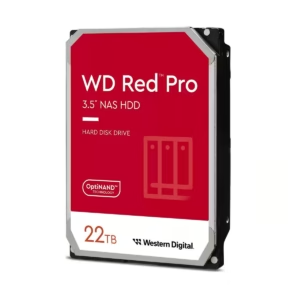
The Pillars of Data Infrastructure: A Comprehensive Evaluation of the Top Enterprise Hard Drives for 2023
In the modern landscape of digital infrastructure, the demand for robust, high-capacity...






