
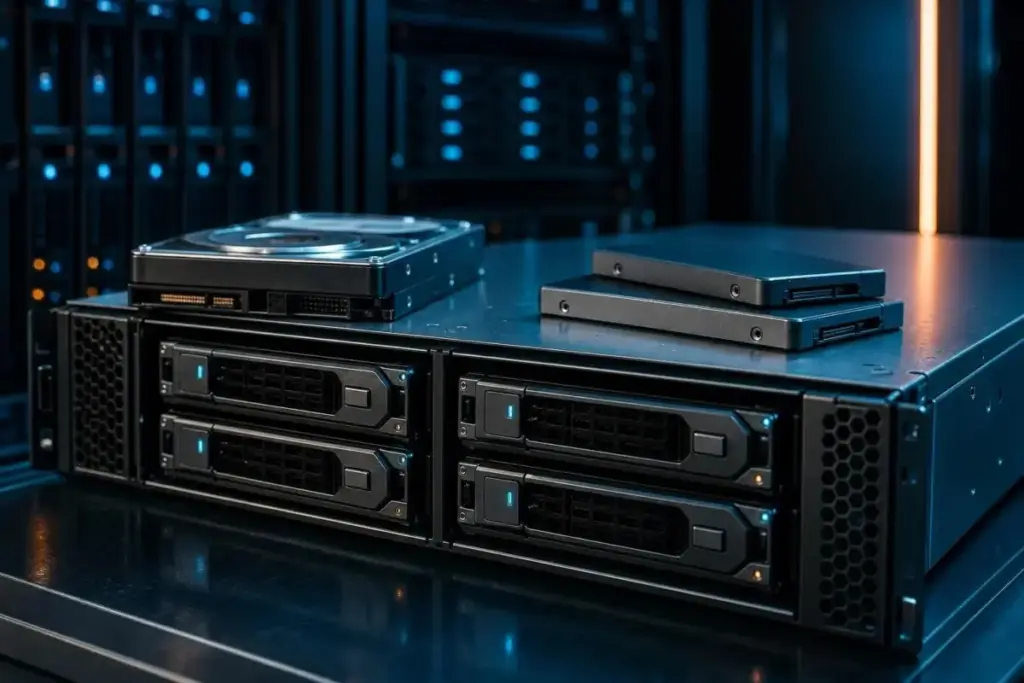
Online Transaction Processing (OLTP) databases, such as those running on SQL Server or Oracle, are the classic use case for RAID 10. These systems require constant, rapid-fire updates to data, and the lack of parity overhead in RAID 10 ensures that the storage layer does not become a bottleneck. Similarly, dense virtualization hosts, where dozens or hundreds of virtual machines are simultaneously requesting I/O, benefit from the predictable performance and fast rebuild times that RAID 10 provides.
In modern data centers, this often leads to a tiered storage strategy. High-performance flash drives are configured in RAID 10 to host active databases and virtual machine boot disks, while cheaper, high-capacity nearline HDD storage is configured in RAID 6 or erasure coding for backups and bulk archival data. This allows the organization to utilize RAID 10 where its performance is required and avoid its high cost where capacity is the priority.
Conversely, for large sequential-capacity tiers or massive all-flash deployments where the cost of doubling the drive count is prohibitive, RAID 10 is rarely the best bargain. In these scenarios, software-defined replication or erasure-coded object storage often provides similar levels of resilience at a much lower cost per usable terabyte.
Implementation Nuances: Linux and Hardware Controllers
The actual behavior of a RAID 10 array is heavily influenced by how it is implemented, whether through software or dedicated hardware. In the Linux ecosystem, for example, software RAID offers three distinct choices. Administrators can manually stack RAID 1 and RAID 0, or they can use the complex RAID 10 level via mdadm.
The complex form of RAID 10 is particularly powerful because it is not strictly nested. It allows for even or odd device counts, whereas a traditional nested RAID 1+0 requires an even number of disks. Furthermore, it offers different data layouts—near, far, or offset—each of which provides different performance characteristics. For instance, the "far" layout can offer read performance similar to RAID 0 by spreading data across different physical sectors of the disks, though this comes at the cost of slower write performance.
LVM (Logical Volume Manager) also provides RAID 10 capabilities. However, management of these arrays requires foresight. Commands like lvconvert --repair are used to fix failed legs of a RAID 10 volume, but these commands often require a spare physical volume to be already available within the volume group. Without this preparation, the system may have nowhere to rebuild the data when a failure occurs.
Hardware controllers introduce their own set of proprietary rules. Broadcom’s MegaRAID family, a staple in many enterprise servers, can support RAID 10 spans across as few as 4 or as many as 240 drives. However, the firmware dictates specific thresholds; it might require a single-span configuration for smaller arrays and automatically shift to multi-span configurations as the drive count increases. These thresholds are specific to the hardware vendor and the firmware version, meaning that an administrator’s experience with one brand of controller may not directly translate to another.
Ultimately, RAID 10 remains a cornerstone of enterprise storage because of its simplicity and performance. While it requires a significant investment in hardware to overcome its 50% capacity limitation, the peace of mind provided by rapid rebuilds and high-speed I/O makes it the preferred choice for the world’s most critical data workloads. As with any storage technology, the key to success lies in understanding the specific failure modes of the chosen implementation and designing the physical infrastructure to match the mathematical redundancy of the RAID level.
 Enterprise Tech & Infrastructure
Decoding the Total Cost of Ownership: A Strategic Approach to Amazon S3 Storage Optimization
For the modern enterprise, the Amazon S3 bill is frequently a source...
 Enterprise Tech & Infrastructure
Protecting the Enterprise Perimeter: The Evolving Security Challenges of DAS and NAS Storage
In the modern enterprise landscape, data is often described as the new...
 Enterprise Tech & Infrastructure
Navigating the Shift to Software-Defined Storage: Expert Strategies for Enterprise Success
The modern enterprise data center is undergoing a fundamental transformation, driven by...







