
The Role of the Controller and the Necessity of Over-Provisioning
While the NAND chips store the data, the SSD controller acts as the brain of the operation. Raw NAND chips are not capable of managing themselves; they require a sophisticated layer of logic to handle the inherent limitations of flash memory. One of the most vital functions of the controller is wear-leveling. Because each flash cell has a finite number of times it can be written to before it wears out, the controller must ensure that writes are spread evenly across all available cells to prevent any single part of the drive from failing prematurely.
Furthermore, the controller manages "garbage collection," a process used to reclaim blocks of memory that contain stale or deleted data. Unlike HDDs, which can overwrite data in place, flash memory must erase an entire block before new data can be written to it. The efficiency of the controller’s garbage collection algorithms often determines the difference between a drive that maintains its speed over time and one that slows down significantly under load.
To assist with these background tasks, manufacturers utilize "over-provisioning." This involves reserving a portion of the drive’s total NAND capacity—beyond what is advertised to the user—specifically for the controller’s use. According to a selection guide from SK Hynix, standard over-provisioning typically ranges from 7% to 28%. This hidden capacity provides a "workspace" for the controller to perform wear-leveling and garbage collection without interrupting the user’s data flow. Higher-grade enterprise drives generally feature more over-provisioning than client-grade drives, allowing them to sustain consistent performance even when the drive is nearly full.
Performance is also frequently bolstered by the use of a pseudo-SLC write cache. In many TLC and QLC drives, a portion of the NAND is programmed to operate temporarily in a single-bit mode. This allows the drive to accept incoming data at much higher speeds. However, as Computer Compatibility observes, this high-speed performance is temporary. Once the cache is filled during a long write session, the drive’s speed will drop to the native, slower rate of the underlying TLC or QLC NAND.
Interface Constraints and the Transition to NVMe
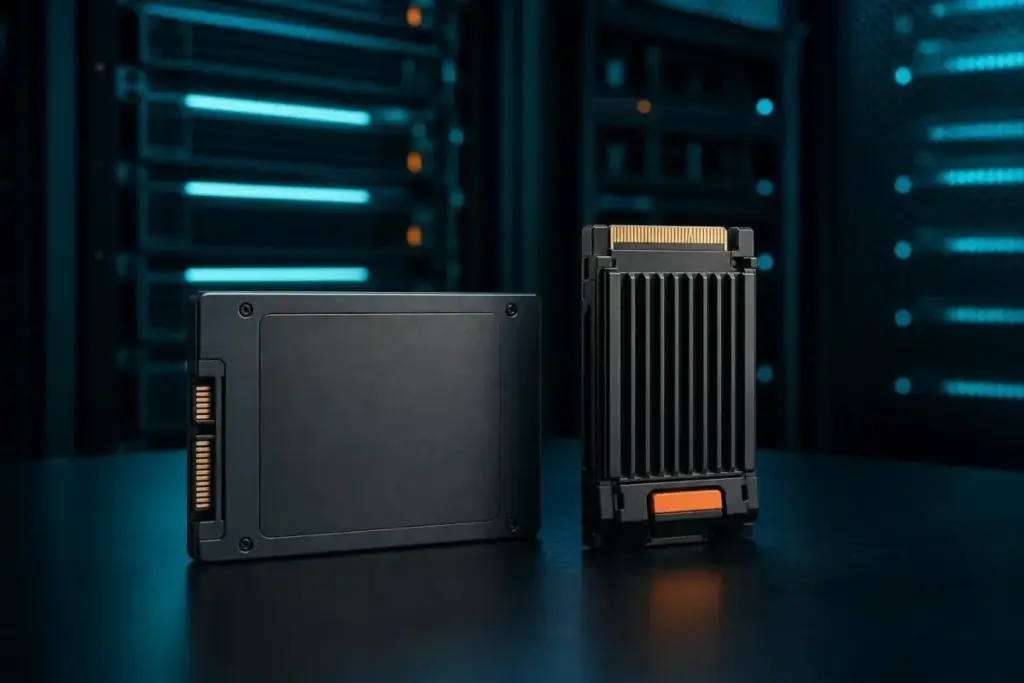
Beyond the internal components, the physical and logical interface of an SSD sets the hard ceiling on its performance. For years, SSDs utilized the SATA interface, which was originally designed for spinning hard drives. SATA SSDs are generally capped at speeds of around 550 MB/s due to the limitations of the 6 Gb/s SATA bus. While SATA remains a cost-effective choice for legacy system compatibility and bulk storage, it has largely been surpassed in performance-critical environments by NVMe (Non-Volatile Memory Express).
NVMe was designed from the ground up for flash memory. It communicates directly with the CPU over PCIe lanes, bypassing the bottlenecks inherent in the older SATA protocol. IBM notes that while every NVMe device is technically an SSD, the reverse is not true, as many budget and older drives still rely on the SATA standard. The performance gap is staggering: while a SATA drive struggles to exceed 550 MB/s, modern NVMe Gen 4 drives can routinely achieve throughput between 4,500 and 7,000 MB/s.
 Enterprise Tech & Infrastructure
Navigating the Financial Realities of Enterprise Cloud Storage: A Comprehensive Analysis of Amazon S3 Cost Management
In the rapidly evolving landscape of enterprise cloud infrastructure, the management of...
 Enterprise Tech & Infrastructure
Nvidia Unveils Silicon-Level Guardrails as Industry Grapples with Surging AI Agent Breaches
The artificial intelligence industry, once defined by a breakneck race toward ever-greater...
 Enterprise Tech & Infrastructure
Upscale AI Challenges Nvidia’s Dominance with SkyHammer Scale-Up Fabric and Unified AI Networking
The history of the semiconductor industry is littered with the remains of...







