
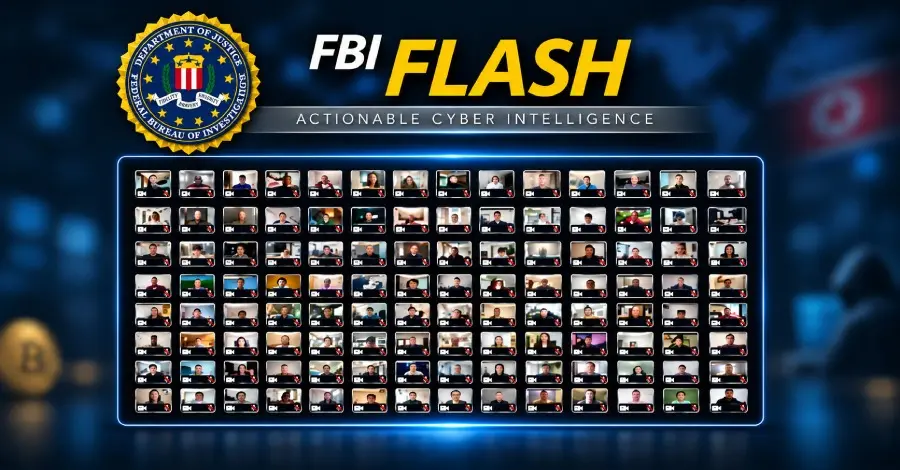
In a significant blow to the digital financing of sanctioned regimes, the U.S. Federal Bureau of Investigation (FBI) and the Department of Justice (DoJ) have announced a series of coordinated actions to disrupt a sophisticated North Korean cyber-theft operation. Federal investigators have confirmed that threat actors tied to the Democratic People’s Republic of Korea (DPRK) have successfully siphoned more than $400 million in cryptocurrency over the past 18 months through a highly targeted social engineering scheme dubbed "FaceStealer."
The announcement marks a critical milestone in the ongoing battle against state-sponsored financial crime. As part of these operations, law enforcement agencies successfully seized the cloud-based infrastructure that underpinned the FaceStealer campaign. Authorities described the operation as "hard-to-detect," noting its reliance on advanced psychological manipulation and cutting-edge technology to bypass traditional security perimeters.
Parallel to the FaceStealer disruption, the Department of Justice revealed the court-authorized seizure and restraint of an additional $1.2 billion in digital assets. These funds are linked to the North Korea-backed "TraderTraitor" group, which was responsible for the high-profile hack of the cryptocurrency exchange Binance. According to federal officials, these plundered assets are not merely criminal proceeds but serve a direct geopolitical purpose: funding Pyongyang’s illicit weapons of mass destruction (WMD) and ballistic missile programs.
"The North Korean regime relies on proceeds from large-scale cryptocurrency theft to fund its illicit weapons program, stealing billions of dollars in recent years," stated FBI Cyber Branch Operations Director Brett Leatherman. He emphasized that the FaceStealer scheme specifically targeted the most vulnerable and yet most valuable links in the digital asset chain: individuals working within the cryptocurrency and Web3 sectors. Through deceptive social engineering, the regime has turned digital innovation into a primary source of state revenue.

The Mechanics of FaceStealer: Deepfakes and Deception
The FaceStealer campaign represents a sophisticated evolution in North Korean cyber tactics. Unlike traditional phishing, which often relies on bulk emails and generic lures, FaceStealer is characterized by its intimacy and technical complexity. The Justice Department revealed that the scheme relies heavily on surreptitiously recorded videos and deepfake technology to facilitate theft.
The operation often begins with the compromise of a trusted contact. Using stolen accounts belonging to previous victims, the attackers send invitations to video meetings to individuals within the victim’s professional or personal circle. When a target joins the meeting, they are met with a sophisticated illusion. The attackers use a dual-stream approach: they record the victim’s live video feed while simultaneously playing a prerecorded webcam video of a person known to the target. This use of familiar likenesses is designed to build immediate trust and lower the target’s defenses.
To further increase the effectiveness of the scheme, the DoJ noted the use of "super intelligence" (SI) to develop deepfake videos of influential figures in the cryptocurrency and Web3 industries. By appearing as a well-known industry leader or a trusted peer, the attackers can manipulate targets into performing high-risk actions.
The trap is typically sprung just a few seconds into the meeting. The attackers present a mock technical error, claiming the victim cannot be heard or that there is a synchronization issue. They then provide a link to a "fix"—a classic ClickFix-style lure. In reality, the link is designed to install malware on the victim’s workstation. This malware is capable of not only stealing cryptocurrency and private keys but also leveraging the victim’s authenticated access to compromise broader corporate infrastructure.

This activity overlaps significantly with research published by Kaspersky in October 2025 under the name "GhostCall." Both campaigns highlight the regime’s pivot toward interactive, media-rich social engineering. The FBI’s investigation has linked these efforts to BlueNoroff, a prolific and financially motivated threat cluster also known as APT38, Stardust Chollima, and Sapphire Sleet. BlueNoroff is widely recognized by the international intelligence community as the financial cyber-arm of the Lazarus Group, tasked specifically with generating hard currency for the North Korean state.
Expanding the Target Set: From Executives to Open-Source Developers
While the initial focus of North Korean cyber operations was often large financial institutions, the FaceStealer campaign demonstrates a strategic shift toward the Web3 and software development ecosystems. Data from cybersecurity firm Arctic Wolf indicates that the campaign has targeted over 677 individuals across 58 countries, with a heavy concentration in the United States, Singapore, the United Kingdom, and South Korea.
The victimology is strikingly specific. Approximately 80% of identified targets operate directly within cryptocurrency or blockchain finance. Perhaps more alarming is the focus on leadership; founders and C-suite executives account for nearly half of the target set. By compromising a CEO or a founder, the attackers gain a direct pathway to significant capital, wallet infrastructure, and investment authority.
However, the threat extends beyond immediate financial assets. BlueNoroff has increasingly singled out developers involved in the maintenance of popular open-source software. The goal is to facilitate software supply chain attacks. Earlier this year, the FaceStealer scheme was used to target the maintainer of the Axios npm package, a widely used library in the JavaScript ecosystem. By gaining access to the developer’s workstation, the attackers were able to push a trojanized version of the package that delivered a cross-platform remote access trojan (RAT) to thousands of downstream users.

To maintain the quality of their lures, the threat actors have expanded their reconnaissance. They no longer rely solely on stolen webcam footage. Investigators found that the group scrapes YouTube interviews, conference talks, and social media profiles to capture the likeness and voice of their targets. This allows them to create synthetic meeting footage of high-value individuals—such as a specific CEO—without ever having to compromise that individual directly. This "synthetic reconnaissance" allows for the creation of highly credible lure content that can be reused across multiple targets.
From FaceStealer to Contagious Interview
While FaceStealer focuses on video-based deception, another parallel campaign known as "Contagious Interview" (or "ClickFake Interview") targets the professional recruitment sector. This campaign leverages the global nature of remote work to deceive job seekers and developers.
In these scenarios, attackers pose as recruiters on platforms like LinkedIn. They approach prospective candidates with enticing job opportunities and quickly move the conversation toward a "technical assessment." This assessment often involves running code from a repository or downloading a project file.
Alina Krasavina, an engineering manager who was targeted by this campaign, detailed the professional nature of the deception. In one instance, a fake recruiter sent a project containing over 100 files, with a backdoor hidden deep within the configuration code. In another instance, a "Member of Technical Staff" insisted on a screen-sharing session where the candidate was required to download and run a repository locally. When Krasavina refused, the interview was abruptly terminated, and she was blocked.

The Contagious Interview campaign is estimated to have compromised at least 30,000 devices globally. Cybersecurity firm Sophos recently disclosed that one of its own employees’ macOS devices was briefly compromised after they cloned a weaponized VS Code workspace as part of a fake interview process. The repository contained a modified terminal profile that silently executed a JavaScript loader known as "BeaverTail," which in turn delivered a Python backdoor called "InvisibleFerret."
The Rise of Decoy Infrastructure
The professionalization of these attacks has reached a new peak with the creation of entire decoy companies. Research from JFrog recently uncovered "AccuraSoftHire," a fake company established by North Korean actors to provide a veneer of legitimacy to their recruitment scams. The company featured a professional website, client testimonials, job ads on mainstream boards, and even recruiters with "verified" badges on LinkedIn.
"Our research shows these lures are built to pass the checks people rely on," said Guy Korolevski, a senior security researcher at JFrog. He noted that the sophistication of these environments makes it nearly impossible for individual employees to identify the threat in isolation.
As the FBI continues to process the data from the seized FaceStealer infrastructure—including over 900 webcam recordings of victims used for impersonation—the message to the global technology sector is clear: the threat is persistent, evolving, and highly resourced. Security experts recommend that organizations implement strict policies regarding the execution of unknown code, suggesting that all interview assignments and external repositories be handled within isolated, disposable virtual environments.

The ongoing efforts by the FBI and DoJ represent a vital step in raising the cost of these operations for the North Korean regime. However, as BlueNoroff and its affiliates integrate generative AI and more complex social engineering into their toolkit, the defense of the global digital economy will require continued vigilance and international cooperation.
 Cybersecurity Basics & Security News
Beyond Policy Intent: Why Identity Visibility Has Become the Critical Frontier in Modern Cybersecurity
In the current landscape of enterprise security, the traditional perimeter has not...
 Cybersecurity Basics & Security News
The Rise of the Personal AI Agent: Navigating the Shift from BYOD to BYOAI in the Corporate Security Landscape
The rollout of personal artificial intelligence agents is proving to be a...
 Cybersecurity Basics & Security News
PostgreSQL Issues Critical Security Updates to Address Type Confusion Flaw and 51 Other Vulnerabilities
The PostgreSQL Global Development Group has announced the release of critical security...







