
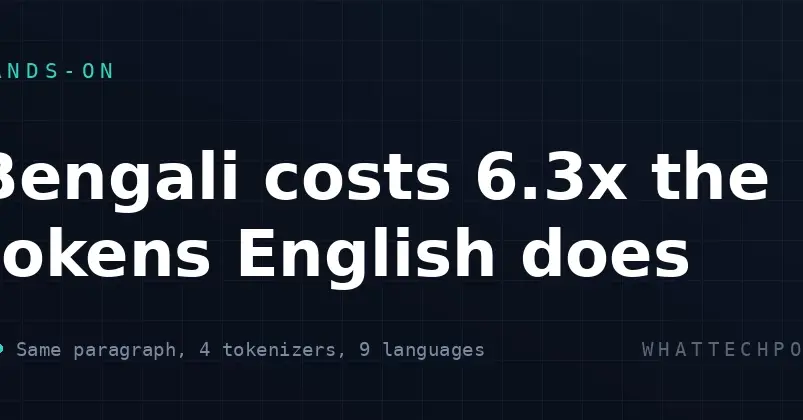
While token counts provide a measurable floor for the penalty non-English speakers face, they do not tell the whole story. The Michigan study found that energy costs (up to 15.3x for Bengali) were significantly higher than the raw token multipliers (maxing out at 6.3x).
This gap represents the "output side" of the problem. When an AI model is less "comfortable" in a language—meaning it has seen less of it during training—it doesn’t just take more tokens to read the input; it also struggles to generate the output. Models often become less accurate in high-cost languages, leading to answers that are longer, more repetitive, or heavily hedged with "AI-isms."
Furthermore, because these models generate text one token at a time, a Bengali response that requires six times as many tokens will take six times as long to generate and consume six times the computational power. This compounds the energy cost, leading to the massive 180x disparities observed in some of the more extreme cases in the Michigan study.
The Triple Penalty in Practice
For a developer or a business in a country like Bangladesh or India, these technical discrepancies manifest as a "triple penalty" that hampers the adoption of AI technology.
First, there is the literal cost. Most AI companies charge for their services on a per-million-token basis. Under this pricing model, a Bengali-speaking startup using a Llama-based API is effectively paying six times more for the same amount of information as an English-speaking competitor.
Second, there is the issue of the "context window." Every AI model has a limit on how much text it can "remember" at one time, known as its context window. For Llama 3.1, this window is 128,000 tokens. While this is enough to hold a massive amount of English text, the 6.3x multiplier means that for a Bengali speaker, that window effectively shrinks to just 20,000 tokens. The model’s "memory" is physically smaller for certain languages.
Third, the languages that are the most expensive to process are also the ones where the models are the least accurate. Users are paying more for a shorter memory and a worse result.
A Call for Balanced Tokenization
The solution to this divide is unglamorous but essential: AI developers must prioritize the training of tokenizers on balanced, multilingual corpora. As the success of Gemma 3 demonstrates, allocating vocabulary based on global speaker populations rather than training-data convenience can almost entirely erase the token tax.
As AI becomes the backbone of global infrastructure, the "receipt" for linguistic inequity is being printed in the tokenizer files of the world’s most popular models. Until more developers follow the lead of models like Gemma 3, hundreds of millions of people will continue to pay a premium for a technology that, by design, treats their native tongue as an afterthought. For now, the disparity remains a stark reminder that in the world of artificial intelligence, not all words are created equal.
 Software Development & Scripting for IT
Navigating the Choice Between Legged and Wheeled Robotics for Industrial Inspection
In the rapidly evolving landscape of industrial automation, the deployment of autonomous...
 Software Development & Scripting for IT
Enhancing Web Resilience: How Promise.allSettled is Redefining Asynchronous JavaScript Patterns
In the modern landscape of web development, the efficiency and reliability of...
 Software Development & Scripting for IT
The Architecture Gap: Why AI Coding Agents Are Generating More Code but Less Software
In the modern landscape of software development, a peculiar paradox has begun...







