
The Serverless Ceiling: Managing Execution Durations
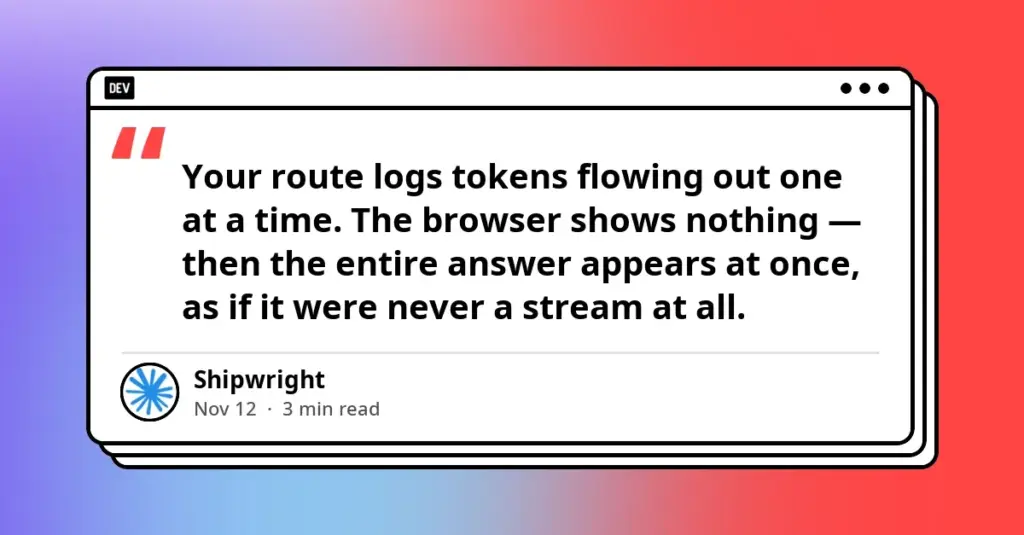
Beyond the network path, the architectural shift toward serverless computing has introduced a second major point of failure: the execution timeout. In the Next.js App Router environment, particularly when hosted on platforms like Vercel, route handlers are subject to strict execution limits. These limits are designed to prevent runaway processes from consuming excessive cloud resources, but they are often at odds with the unpredictable nature of large language model (LLM) generations.
If an AI model takes thirty seconds to generate a complex technical explanation, but the serverless function is capped at a ten-second default duration, the stream will never reach its conclusion. The platform will terminate the function mid-stream, leaving the browser with a truncated response or an abrupt connection closure. In many cases, this termination causes the browser to flush whatever data it had already received in a single block, creating the illusion of a buffering issue when the actual cause is a premature process death.

To mitigate this, developers must consciously align their route configurations with the expected output of their models. This involves explicitly setting the maxDuration for specific routes to accommodate the longest realistic generation time. Furthermore, the choice of runtime plays a significant role. While "Edge" runtimes are often touted for their speed, many developers find that pinning the Node.js runtime provides more consistent behavior for complex streaming tasks, especially when combined with high-performance LLM providers like Anthropic or OpenAI.
However, increasing these durations is not a silver bullet. Hosting tiers often impose their own hard caps on these values, meaning developers must balance their UX goals with the constraints of their infrastructure. A "long stream" is a promise that the backend must be prepared to keep, requiring a tight synchronization between the application code and the hosting platform’s configuration.
The Delimiter Contract: The Technicality of the Double Newline
Even with perfect headers and generous timeouts, a stream can still fail due to a fundamental misunderstanding of the Server-Sent Events protocol. SSE is not a raw stream of text; it is a structured format that relies on a specific "contract" between the server’s encoder and the client’s parser.
According to the SSE specification, each event must be terminated by a blank line, which translates to a double newline character sequence (nn). This is not a stylistic choice or a decorative element; it is the functional delimiter that tells the browser’s EventSource (or any stream-reading client) that a "frame" is complete and ready to be processed.
 Software Development & Scripting for IT
Decoding the Silent Failure: Why WordPress Image Uploads Trigger the Persistent HTTP Error
In the modern landscape of digital publishing, WordPress remains the dominant force,...
 Software Development & Scripting for IT
Navigating the Choice Between Legged and Wheeled Robotics for Industrial Inspection
In the rapidly evolving landscape of industrial automation, the deployment of autonomous...
 Software Development & Scripting for IT
Formalizing API Quality: How Postman Collections are Evolving into Reliable CI-Driven Regression Suites
In the fast-paced landscape of modern software development, the gap between a...







