
In the rapidly evolving landscape of generative artificial intelligence and real-time web applications, the user experience is increasingly defined by "streaming." When a user interacts with a modern AI interface, they expect to see the machine’s "thought process" in real-time—tokens appearing one by one, mimicking the cadence of human speech or typing. However, a persistent technical hurdle has begun to plague developers deploying these features within the Next.js ecosystem: the "blob" phenomenon.
The issue is as frustrating as it is deceptive. During local development, the stream might function perfectly, with data flowing seamlessly from the server to the client. Yet, upon deployment to production environments, the real-time effect vanishes. Instead of an incremental stream, the browser remains idle for several seconds, only to suddenly render the entire response in a single, massive "flush." This breakdown in the streaming pipeline transforms a dynamic AI interaction into a static, legacy-style request-response cycle, undermining the very purpose of utilizing Server-Sent Events (SSE).
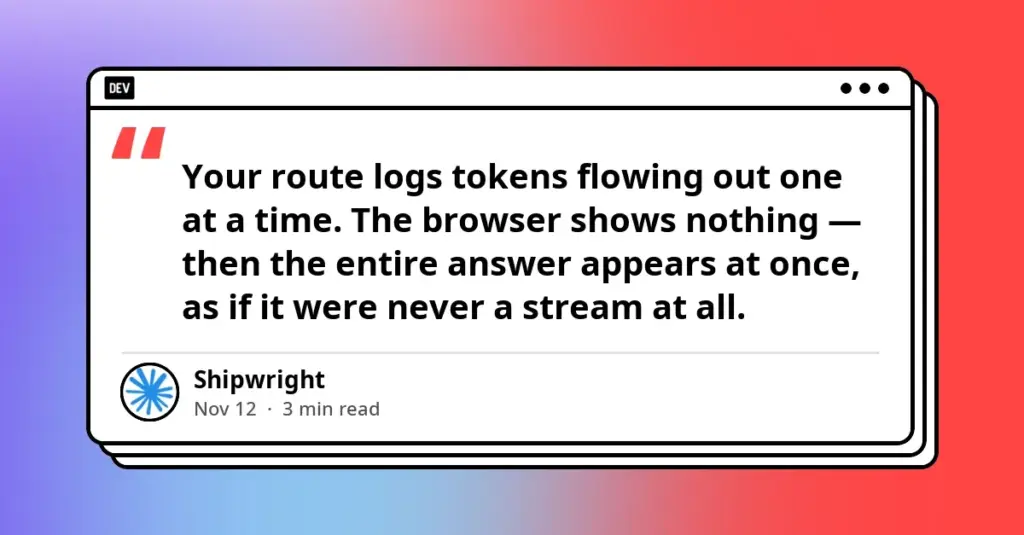
Technical post-mortems from industry experts, including those behind the Shipwright development toolkit, suggest that this failure is rarely the fault of the AI model itself. If server logs indicate that tokens are being emitted sequentially, the bottleneck inevitably lies in the infrastructure between the route handler and the end-user’s browser. Resolving this requires a sophisticated understanding of how modern proxies, serverless timeouts, and protocol delimiters interact within a production stack.
The Invisible Middleman: How Proxy Buffering Stalls Data
The primary culprit behind the "one-blob" problem is often found in the invisible layers of the modern web: proxies, Content Delivery Networks (CDNs), and load balancers. These systems are designed to optimize web traffic, and historically, "optimization" has meant buffering. By collecting small fragments of data into a single, larger packet, a proxy can reduce the overhead of a transmission and improve efficiency for standard web pages.
For a stream, however, this efficiency is catastrophic. When an SSE response leaves a Next.js server, it must signal to every "hop" along the network path that the data is time-sensitive and should not be tampered with. This is achieved through a specific set of HTTP response headers. The most critical of these is the no-transform directive within the Cache-Control header.
Under standard conditions, a CDN or an intermediary proxy like Nginx is permitted to compress or transform a response to save bandwidth. In a streaming context, these transformations often involve waiting for the stream to complete so the proxy can calculate the final size or apply compression algorithms. By explicitly setting Cache-Control: no-cache, no-transform, developers withdraw this permission, effectively forcing the proxy to pass bytes through the moment they arrive.
The challenge is compounded when dealing with specific server configurations like Nginx, which is frequently used as a reverse proxy in containerized deployments. Nginx employs its own internal buffering logic, which can override standard HTTP headers unless specifically addressed. Experts note that the X-Accel-Buffering: no header is often the missing link in these environments. Without this specific instruction, Nginx may continue to hold the stream in its buffer, waiting for a threshold to be reached before releasing the data to the client, regardless of the no-transform status.
The Serverless Ceiling: Managing Execution Durations
Beyond the network path, the architectural shift toward serverless computing has introduced a second major point of failure: the execution timeout. In the Next.js App Router environment, particularly when hosted on platforms like Vercel, route handlers are subject to strict execution limits. These limits are designed to prevent runaway processes from consuming excessive cloud resources, but they are often at odds with the unpredictable nature of large language model (LLM) generations.
If an AI model takes thirty seconds to generate a complex technical explanation, but the serverless function is capped at a ten-second default duration, the stream will never reach its conclusion. The platform will terminate the function mid-stream, leaving the browser with a truncated response or an abrupt connection closure. In many cases, this termination causes the browser to flush whatever data it had already received in a single block, creating the illusion of a buffering issue when the actual cause is a premature process death.

To mitigate this, developers must consciously align their route configurations with the expected output of their models. This involves explicitly setting the maxDuration for specific routes to accommodate the longest realistic generation time. Furthermore, the choice of runtime plays a significant role. While "Edge" runtimes are often touted for their speed, many developers find that pinning the Node.js runtime provides more consistent behavior for complex streaming tasks, especially when combined with high-performance LLM providers like Anthropic or OpenAI.
However, increasing these durations is not a silver bullet. Hosting tiers often impose their own hard caps on these values, meaning developers must balance their UX goals with the constraints of their infrastructure. A "long stream" is a promise that the backend must be prepared to keep, requiring a tight synchronization between the application code and the hosting platform’s configuration.
The Delimiter Contract: The Technicality of the Double Newline
Even with perfect headers and generous timeouts, a stream can still fail due to a fundamental misunderstanding of the Server-Sent Events protocol. SSE is not a raw stream of text; it is a structured format that relies on a specific "contract" between the server’s encoder and the client’s parser.
According to the SSE specification, each event must be terminated by a blank line, which translates to a double newline character sequence (nn). This is not a stylistic choice or a decorative element; it is the functional delimiter that tells the browser’s EventSource (or any stream-reading client) that a "frame" is complete and ready to be processed.
If a developer’s encoder emits only a single newline (n) between data packets, the client-side parser will remain in a state of anticipation. It will continue to buffer the incoming bytes, assuming that the current event is still being transmitted. It is only when the connection finally closes—either because the generation is finished or the server times out—that the client realizes no more data is coming and flushes the entire accumulated buffer to the UI.
This creates a symptom that is indistinguishable from proxy buffering to the naked eye. The logs show data leaving the server, but the UI remains static until the very end. The solution lies in the precision of the encoder. By ensuring that every enqueued chunk ends with the mandatory nn, developers fulfill the protocol’s requirements, allowing the client to render each token the millisecond it is received.
Towards a More Robust Streaming Architecture
The transition from static pages to streaming-first applications represents a significant leap in web development complexity. The "one-blob" issue is a symptom of a transition period where high-level frameworks like Next.js are being pushed to handle low-level streaming protocols in highly abstracted serverless environments.
As noted by the creators of Shipwright, a starter kit designed for Next.js and Claude-powered applications, the solution is often to move away from fragmented configurations and toward unified helpers. By encapsulating header management, timeout settings, and protocol-compliant encoding into a single utility—such as a chatStream helper—developers can bypass the common pitfalls that only manifest in production.
This holistic approach also addresses the "other half" of the streaming equation: cleanup. Efficient streaming is not just about getting data to the user; it is about stopping the flow when the user is no longer there. In production, a user navigating away from a page or closing a tab should trigger an immediate halt to the backend generation to save costs and compute cycles. This requires integrating "abort-on-disconnect" logic directly into the streaming pipeline, a feature that is often overlooked until a project scales.
Ultimately, the goal of streaming in Next.js is to create an interface that feels alive. When the "blob" problem is resolved, the technical barrier between the machine’s processing and the user’s perception disappears. The result is a seamless, token-by-token delivery that fulfills the promise of the generative AI era, turning a series of complex infrastructure configurations into a simple, engaging user experience.
 Software Development & Scripting for IT
The High Stakes of Autonomy: Navigating the Promise and Peril of AI in Security Operations
The modern Security Operations Center (SOC) is currently undergoing a radical transformation....
 Software Development & Scripting for IT
The Eloquence of Deception: Why Businesses Are Turning to AI-as-Judge to Combat Hallucinations
In the rapidly evolving landscape of generative artificial intelligence, a troubling paradox...
 Software Development & Scripting for IT
From Hawaii to the Modern Web: How the ALOHA Protocols Defined the Efficiency of Digital Communication
The history of the modern internet is often told through the lens...







