

The secondary market for domain names has long been a barometer for the broader health of the digital economy. Traditionally, the trajectory of a domain sale followed a predictable, often slow-moving path: a buyer would acquire a premium name, hold it for a period of strategic planning, and eventually—perhaps months or even years later—launch a functional website. However, data emerging in late 2026 suggests that this traditional lifecycle has been fundamentally disrupted. The primary catalyst for this shift is not a change in the domains themselves, but a revolution in the ease with which they can be transformed into fully realized digital products.
According to recent observations from industry veteran Andrew Allemann, who has tracked the domain market for over two decades through Domain Name Wire, the speed at which newly acquired domains are being developed has reached a historic high. The data indicates a stark contrast between the current year and the previous two, highlighting a paradigm shift in how entrepreneurs and developers approach the transition from acquisition to launch.
In an analysis of his own sales portfolio for 2026, Allemann revealed a striking statistic: four out of every five domains he has sold this year have already been developed into active websites or forwarded to established projects. This represents a significant acceleration in the "time-to-market" for digital assets, suggesting that the barrier to entry for creating complex web applications has effectively vanished.
A Quantifiable Surge in Development Velocity
The numbers provide a clear picture of this acceleration. By mid-September 2026, Allemann had recorded 27 domain sales. As of October 1, 22 of those 27 domains—approximately 81%—were already hosting active content or serving as functional redirects for live businesses. This rapid turnaround is unprecedented in the history of the domain aftermarket, where "parked" pages and "under construction" placeholders were once the norm for the first year of a domain’s new ownership.
To understand the magnitude of this shift, one must look at the performance of sales from previous years. When Allemann examined his transactions from 2025, he found that fewer than half of those domains had become active websites, despite those owners having had an additional year to work on their projects. The disparity is even more pronounced when looking back to 2024; even with two full years of lead time, less than 50% of the domains sold in that year have been developed.
The fact that 2026 acquisitions are outpacing the development rates of 2024 and 2025 acquisitions—despite the latter having a massive head start—points to a structural change in the industry. The lag time that once defined the web development process appears to have been compressed from years into mere weeks.
The AI Factor: From Teams to Individuals
The underlying driver of this trend is the maturation of artificial intelligence in the field of software engineering and web design. Only a few years ago, the creation of a complex, data-driven website or a sophisticated web application was a labor-intensive endeavor. It typically required a significant capital investment to hire a team of specialists, including front-end designers, back-end developers, and database architects. Alternatively, a solo founder would have to spend months, if not years, mastering the necessary coding languages to build the site themselves.
In the 2026 landscape, that friction has been largely removed. The rise of advanced AI coding assistants and autonomous development platforms has empowered individuals to perform tasks that previously required an entire department. Today, a single person can describe a concept to an AI agent, which can then generate the underlying architecture, write the code, and deploy the application in a fraction of the time it once took.
This technological leap has fundamentally changed the profile of a domain buyer. In previous cycles, many buyers were speculators or long-term planners. In 2026, the buyer is increasingly an "instant builder." Because the cost and time required to build a site have plummeted, the domain name itself has become the most significant hurdle in the launch process. Once the right brand identity is secured through an aftermarket purchase, the actual construction of the site is no longer a deterrent.

Impact on the Aftermarket and Domain Values
This shift in development ease is having a direct impact on the volume and nature of aftermarket domain transactions. When the "utility value" of a domain can be realized almost instantly, the motivation to invest in premium names increases. Buyers are no longer looking at a domain as a static asset to be sat upon; they see it as the immediate front door to a revenue-generating application.
The increased development rate also suggests a healthier ecosystem. When domains are put to use quickly, they contribute to the vibrancy of the internet, creating new services, tools, and platforms. This is a departure from the "domain squatting" eras of the past, where high-quality names often sat dormant for decades. In 2026, the market is being driven by builders rather than just collectors.
Furthermore, the ease of development has expanded the pool of potential buyers. Small business owners, niche hobbyists, and independent "solopreneurs" who might have been intimidated by the technical requirements of the web in 2024 are now active participants in the 2026 aftermarket. They are willing to pay a premium for the right .com or specialized TLD because they know they can have a professional presence live within days of the transaction.
The Changing Role of the Domain Investor
For domain investors like Allemann, who has been active in the space for over 25 years, these observations provide a roadmap for the future of the industry. The value of a domain is increasingly tied to its immediate "developability." Names that lend themselves to specific AI-driven niches—such as specialized tools, automated services, or localized web apps—are seeing higher turnover rates.
The data from 2026 suggests that the industry is entering a new era of "Active Ownership." The traditional metric of success for a domain seller was simply the closing price. Now, a secondary metric—the utilization rate—is becoming a key indicator of market health. A market where 80% of sold assets are immediately put to work is a market with high liquidity and genuine end-user demand.
As AI continues to lower the barriers to creation, the importance of a strong, memorable, and authoritative domain name only grows. In a world where anyone can build a complex site in an afternoon, the brand identity—the domain—becomes the primary differentiator in a crowded digital marketplace.
A New Standard for the Digital Lifecycle
The contrast between the development rates of 2024, 2025, and 2026 serves as a powerful testament to the speed of technological adoption. The fact that older sales remain largely undeveloped while the vast majority of new sales are already live indicates that the tools of the present are far more effective than the tools of even the recent past.
This acceleration is likely to continue as AI models become more integrated and intuitive. For the domain industry, this means the "aftermarket" is becoming less of a secondary storage unit for names and more of a high-speed launchpad for the next generation of the web. The ease of building web apps has not just simplified the life of the developer; it has revitalized the economic engine of the domain name industry, ensuring that when a name changes hands, it is almost certainly destined for immediate growth.
As the year progresses, the industry will be watching to see if this 80% development rate holds steady. If it does, 2026 will be remembered as the year the "parked domain" began its descent into obsolescence, replaced by a web that is as dynamic and fast-moving as the technology used to build it. For Andrew Allemann and others who have witnessed the long-term evolution of the internet, this shift represents a fulfillment of the web’s original promise: a space where ideas can be realized as quickly as they can be imagined.
 Web Hosting & Domain Management
Shri Dharmasthala Temple Successfully Recovers Stolen Digital Identity Through International Arbitration
In a landmark decision for the protection of digital assets belonging to...
 Web Hosting & Domain Management
The Afterlife of Authority: How Expired Domains are Fueling a Global Casino Boom
The digital landscape is often built upon the ruins of what came...
 Web Hosting & Domain Management
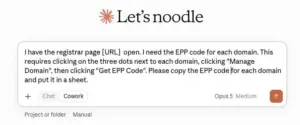
AI Automation Offers New Solution for Bulk Domain Transfer Authorization Challenges
The process of managing a large portfolio of domain names has long...







