

For several years, the narrative in the artificial intelligence infrastructure space was clear: if you were building an application powered by Large Language Models (LLMs), your architecture required a dedicated vector database. As teams scrambled to implement Retrieval-Augmented Generation (RAG) and semantic search, a new crop of specialized players emerged to fill a glaring void in the market. For a moment, it seemed that the vector database would become a permanent, independent fixture of the modern AI stack, sitting alongside primary data stores as a necessary specialist.
That moment, however, appears to have passed. The specialized "vector database" as a standalone category is not disappearing because the technology failed, but because it succeeded so thoroughly that it has been absorbed by the incumbents. Approximate nearest-neighbor (ANN) search, once a boutique requirement for niche research projects, has become a standard column type in the databases that engineering teams already operate. From Postgres and Elasticsearch to MongoDB and Redis, the capability to store and query dense embeddings is now a native feature rather than an external dependency.
The central question facing architects today—"Do I need a new database for my vectors?"—has largely answered itself with a resounding "No." Yet, while the operational complexity of managing multiple systems is decreasing, the underlying "physics" of vector search remains as challenging and expensive as ever. The consolidation of the category into general-purpose engines solves the problem of data sprawl, but it does not magically lower the bill for high-performance memory or the computational cost of high-recall searches.
The Category Collapsed Into The Engines You Already Run
The dedicated vector database was a legitimate category born out of necessity. When Pinecone launched its managed service in 2021, it effectively defined the segment. Soon after, others like Milvus, Weaviate, and Qdrant arrived, offering purpose-built architectures designed specifically for the unique demands of high-dimensional vector math. At the time, their pitch was unassailable: general-purpose databases were fundamentally unequipped for ANN indexing. If you wanted semantic search at any reasonable scale, you had to move your data to a specialized home.
The response from the incumbent database world was swift and decisive. Recognizing that vector search was becoming a core requirement for nearly every enterprise application, established vendors closed the feature gap in record time. Elasticsearch integrated approximate k-Nearest Neighbor (k-NN) capabilities based on the Hierarchical Navigable Small World (HNSW) graph algorithm, leveraging Lucene’s robust implementation. OpenSearch followed suit, including a k-NN plugin as early as its 1.0 release.
Perhaps the most significant turning point occurred in the relational world. In August 2023, the pgvector extension for PostgreSQL added HNSW support in version 0.5.0. This update effectively turned any standard Postgres instance into a credible, high-performance vector store. MongoDB Atlas Vector Search reached general availability in December 2023, and Redis had already exposed vector similarity in its RediSearch module by 2022. Even ClickHouse, known for its analytical prowess, made its HNSW vector similarity index generally available in version 25.8.
The reason this consolidation has stuck is not merely because the features look similar on a marketing slide. Rather, it is because production-grade information retrieval is rarely a "pure" vector lookup. Real-world systems require a complex orchestration of lexical scoring (traditional keyword search), structured filters (filtering by tenant ID, language, or access control lists), and real-time aggregations.
In a standalone model, developers are forced into a "dual-write" architecture, where data must be synchronized between a primary database and a vector database. This creates a secondary consistency model to manage and, more importantly, a second system that can fail. When the database an organization already operates can treat an embedding as just another field in a row, the standalone system must justify its existence through extraordinary performance gains—gains that are becoming increasingly difficult to prove.
What Actually Drives Cost: Memory Is The Whole Story
While the logo on the database box may have changed, the hardware requirements have not. The primary algorithm powering this revolution, HNSW, is a graph-based structure that must be traversed through "pointer chasing." For this traversal to be fast enough for interactive applications, the graph and its associated vectors must reside in RAM.
The moment the index spills from memory to disk, performance degrades sharply. Latency becomes dominated by page faults—the time it takes for the system to fetch data from the SSD—rather than the actual mathematical computation of distances. Consequently, the dominant cost of vector search at scale is memory, and memory requirements scale linearly with the product of the number of vectors and their dimensionality.
The mathematical reality of this is blunt. To understand the capacity planning involved, one can look at the standard formula for an in-memory HNSW index, often cited by the OpenSearch project: 1.1 × (4 × dimension + 8 × M) bytes per vector. In this equation, the 4 × dimension term represents the float32 vector itself, while 8 × M accounts for the overhead of the graph’s connections between nodes. The 1.1 multiplier provides a necessary 10 percent buffer for overhead.
Consider the scale of a modern AI application. If a team uses OpenAI’s text-embedding-3-large model, each vector has 1,536 dimensions. A collection of one million such vectors requires approximately 6.1 GB of RAM before accounting for the graph structure. At ten million vectors, the requirement jumps to roughly 60 GB of RAM. This is not a trivial amount of memory; it is a figure that transforms a "feature" into a significant infrastructure expense.
The graph structure only compounds the pressure. Because HNSW stores neighbor lists at every layer of the graph, the total index size can often reach two to five times the size of the raw vectors. This is why the instinctive reaction to slow search—simply adding more shards or increasing the ef_search parameter—often backfires. Each adjustment increases memory pressure or CPU fan-out. At scale, the slowest shard in a cluster dictates the p99 latency, and the curve between recall and throughput is unforgiving. Pushing an HNSW index from 95 percent to 100 percent recall can result in a seven-fold decrease in throughput. In most production environments, that final two percent of accuracy is the most expensive and least noticeable investment a team can make.
The Levers That Bend The Curve: Quantization And Tiering
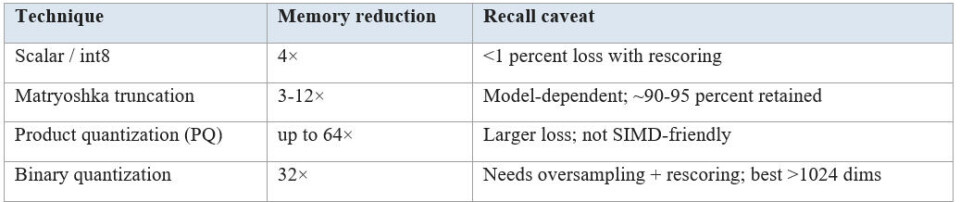
If memory is the primary cost driver, then compression is the primary tool for cost reduction. This is where the real engineering battle is currently being fought. Quantization techniques allow teams to shrink the footprint of each vector by trading a controlled amount of precision for a massive reduction in bytes. Crucially, these techniques are largely orthogonal to the choice of database vendor; whether you use a specialized tool or a general-purpose engine, the math remains the same.
The most common technique is Scalar Quantization (int8), which converts 32-bit floats into 8-bit integers. This typically reduces memory requirements by 75 percent. To maintain accuracy, systems often use a "rescoring" step, where the top candidates identified by the compressed index are re-ranked using the full-precision vectors stored on cheaper disk storage.
More aggressive techniques are also gaining traction. Matryoshka embeddings allow for "truncation," where only the first few hundred dimensions of a large vector are used for the initial search, cutting costs by 3 to 12 times. Then there is Binary Quantization, which collapses each dimension down to a single bit. While it sounds extreme, Qdrant has reported that on high-dimensional OpenAI embeddings, binary quantization can achieve 0.98 recall with 32 times less memory, provided a slight "oversampling" is used during the search. Elasticsearch’s "Better Binary Quantization" has shown even more dramatic results, taking a 138-million-point dataset from 535 GB down to just 19 GB.
The second major lever for cost control is admitting that not every vector needs to live in expensive RAM. This has led to the rise of Disk-based ANN and tiered storage models. Microsoft’s DiskANN project demonstrated that it is possible to index a billion points on a single machine with 64 GB of RAM by keeping the bulk of the index on SSDs.
For applications where latency is less critical—such as agentic workflows where a model might spend several seconds "reasoning"—object storage tiers like Amazon S3 Vectors offer up to a 90 percent cost reduction. The trade-off is clear: an in-memory path might offer a 24 ms latency, while a disk-based path might take 96 ms. For an autocomplete feature, that 72 ms difference is disqualifying; for a background research agent, it is an easy bargain to make.
Where The Self-Managed Versus Managed Line Really Falls
Since most database engines have converged on the same HNSW algorithms and compression toolkits, the decision to use a managed service versus self-managing a database is no longer about technical capability. Both paths offer quantization, both offer tiering, and both can achieve high recall.
Instead, the decision now rests on who owns three specific responsibilities: memory-sizing math, the management of the "latency cliff," and the routing between hot and cold storage tiers.
Managed services, such as Pinecone or the managed offerings from MongoDB and Elastic, earn their margin by absorbing the provisioning headache. They handle the complex task of isolating vector traffic onto dedicated nodes so that a heavy search query doesn’t crash the operational side of the database. They hide the complexity of cold-tier fetching behind a single API. For a team with a small operations crew and a strict latency budget, paying a premium to "stop owning the failure modes" is often the correct business move.
Conversely, the self-managed path—running pgvector on a custom Postgres instance or managing an OpenSearch cluster—provides every possible knob and lever. This allows a team to fine-tune the ef_construction parameters, set their own rebuild cadences, and directly control the quantization-to-oversampling ratio. However, this freedom comes with "sharp edges." A self-managed team inherits the risk of recall drift as data distributions change and the danger of "tail-latency traps" caused by over-sharding.
Ultimately, the choice of infrastructure should be driven by two questions: Does the vector data already reside in an operational store you currently run? And what is the latency budget relative to the cost ceiling?
If the data is already in Postgres, adding a column is almost always the right first step. It avoids the complexity of a second system and keeps the architecture lean. If the workload demands billion-scale searches with sub-20ms requirements, the focus shifts to whichever platform provides the most seamless path to memory-optimized tiering. In the current landscape, the winning strategy is to pick the engine for the workload, rather than letting the data type dictate the engine. The era of the "vector database" as a standalone entity is ending, replaced by a more mature era of integrated, high-performance retrieval.
 Enterprise Tech & Infrastructure
Strategic Navigation of Amazon S3 Economics: Beyond the Per-Gigabyte Price Point
In the landscape of modern enterprise cloud architecture, Amazon S3 has long...
 Enterprise Tech & Infrastructure
Upscale AI Challenges Nvidia’s Scale-Up Dominance with SkyHammer Fabric and $2 Billion Valuation
For decades, the architecture of high-performance computing was defined by a fiercely...
 Enterprise Tech & Infrastructure
Navigating the Hidden Complexities of Amazon S3 Cost Management for Enterprise Storage
In the modern enterprise landscape, cloud storage has transitioned from a simple...







