

The second major lever for cost control is admitting that not every vector needs to live in expensive RAM. This has led to the rise of Disk-based ANN and tiered storage models. Microsoft’s DiskANN project demonstrated that it is possible to index a billion points on a single machine with 64 GB of RAM by keeping the bulk of the index on SSDs.
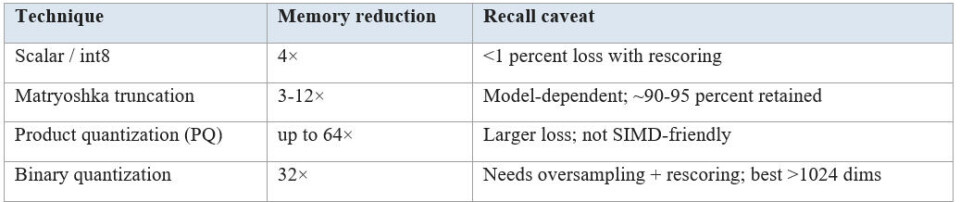
For applications where latency is less critical—such as agentic workflows where a model might spend several seconds "reasoning"—object storage tiers like Amazon S3 Vectors offer up to a 90 percent cost reduction. The trade-off is clear: an in-memory path might offer a 24 ms latency, while a disk-based path might take 96 ms. For an autocomplete feature, that 72 ms difference is disqualifying; for a background research agent, it is an easy bargain to make.
Where The Self-Managed Versus Managed Line Really Falls
Since most database engines have converged on the same HNSW algorithms and compression toolkits, the decision to use a managed service versus self-managing a database is no longer about technical capability. Both paths offer quantization, both offer tiering, and both can achieve high recall.
Instead, the decision now rests on who owns three specific responsibilities: memory-sizing math, the management of the "latency cliff," and the routing between hot and cold storage tiers.
Managed services, such as Pinecone or the managed offerings from MongoDB and Elastic, earn their margin by absorbing the provisioning headache. They handle the complex task of isolating vector traffic onto dedicated nodes so that a heavy search query doesn’t crash the operational side of the database. They hide the complexity of cold-tier fetching behind a single API. For a team with a small operations crew and a strict latency budget, paying a premium to "stop owning the failure modes" is often the correct business move.
Conversely, the self-managed path—running pgvector on a custom Postgres instance or managing an OpenSearch cluster—provides every possible knob and lever. This allows a team to fine-tune the ef_construction parameters, set their own rebuild cadences, and directly control the quantization-to-oversampling ratio. However, this freedom comes with "sharp edges." A self-managed team inherits the risk of recall drift as data distributions change and the danger of "tail-latency traps" caused by over-sharding.
Ultimately, the choice of infrastructure should be driven by two questions: Does the vector data already reside in an operational store you currently run? And what is the latency budget relative to the cost ceiling?
If the data is already in Postgres, adding a column is almost always the right first step. It avoids the complexity of a second system and keeps the architecture lean. If the workload demands billion-scale searches with sub-20ms requirements, the focus shifts to whichever platform provides the most seamless path to memory-optimized tiering. In the current landscape, the winning strategy is to pick the engine for the workload, rather than letting the data type dictate the engine. The era of the "vector database" as a standalone entity is ending, replaced by a more mature era of integrated, high-performance retrieval.
 Enterprise Tech & Infrastructure
Understanding the Architecture of Modern Storage: Why the Choice Between Flash and SSD Is a Matter of Components, Not Categories
In the rapidly evolving landscape of enterprise data management, the terminology used...
 Enterprise Tech & Infrastructure
The Architecture of Performance: Balancing Redundancy and Speed with RAID 10
In the complex landscape of enterprise data storage, the selection of a...
 Enterprise Tech & Infrastructure
Navigating the Abstraction Layer: Strategic Best Practices for Software-Defined Storage Deployment
As the modern enterprise grapples with an unprecedented explosion of data, the...







