
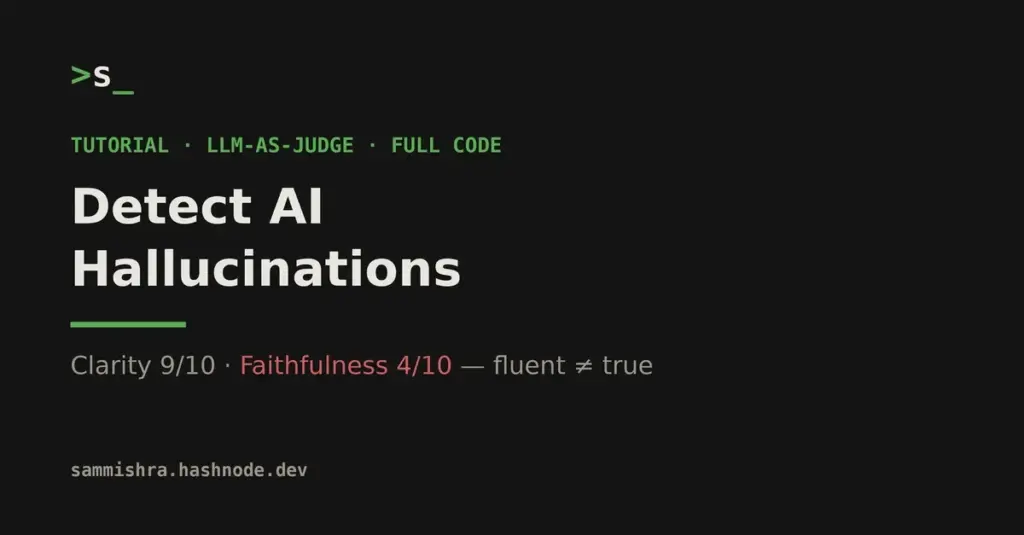
Faithfulness is treated as the most critical metric. It measures whether every claim made in the AI’s answer appears in or follows directly from the source text. In this framework, the model is instructed to heavily penalize the invention of facts, numbers, names, or policies. Relevance assesses whether the answer actually addresses the information covered in the source, while completeness checks if the AI utilized all the important information available to it. Clarity, the metric where most modern LLMs already excel, measures organization and ease of understanding.
The output of such a tool is a structured JSON report that includes a list of "unsupported claims"—specific quotes or paraphrases from the answer that the source does not support—a final verdict on reliability, and a suggested fix. This structured data allows businesses to automate their quality assurance, flagging problematic answers for human review or blocking them from reaching the customer entirely.
Engineering the Audit: FastAPI and the Logic of Weighting
The technical implementation of these checkers often relies on lightweight, high-performance frameworks like FastAPI. By serving the auditor through an API endpoint, companies can integrate real-time checks into their existing support workflows. The process involves stripping the source text and the generated answer of unnecessary whitespace, then feeding them into a system prompt designed for a "rigorous AI-output auditor."
A notable design choice in these systems is the weighting of the final score. In many implementations, the "faithfulness" score is weighted double compared to relevance, completeness, or clarity. The logic behind this is straightforward: a clear, relevant, and complete answer that incorrectly states a company’s legal refund policy is still a catastrophic failure. By weighting what truly matters—the truth—the system ensures that eloquence never masks a lack of accuracy.
The infrastructure for these tools often leverages high-speed providers like Groq to minimize latency, ensuring that the audit doesn’t significantly slow down the customer experience. However, the move toward more complex "reasoning" models has introduced new engineering challenges that developers must navigate.
Navigating the Technical Pitfalls of AI Auditing
As the field of AI auditing matures, developers are identifying several common "traps" that can undermine the effectiveness of an automated judge. One of the most significant hurdles involves the "token budget" of modern reasoning models. Unlike simpler models, advanced AI auditors often engage in a "chain-of-thought" process, thinking through the logic of an audit before producing a final answer. These internal thoughts consume tokens, which can lead to the actual report being truncated if the maximum token limit is set too low. This often results in a failure to generate a valid JSON object, rendering the audit useless.
Furthermore, even with strict formatting requirements, LLMs can occasionally fail to produce perfectly structured data. Robust auditing tools now incorporate defensive parsing techniques. This includes retrying requests without strict JSON modes if a failure occurs and manually stripping code fences or locating the correct brackets within a text string.
 Software Development & Scripting for IT
Bridging the Gap: How Sess is Revolutionizing Human-in-the-Loop Interactions for Autonomous AI Agents
The rapid evolution of artificial intelligence has transitioned from simple text-based chatbots...
 Software Development & Scripting for IT
Streamlining Web-to-PDF Workflows: The Shift Toward Dependency-Free Headless Chrome Integration
In the modern landscape of web development, the demand for high-fidelity document...
 Software Development & Scripting for IT
UNC6240 Exploits Critical Oracle PeopleSoft Vulnerability Through Sophisticated WAF Bypass Techniques
A sophisticated cyber-espionage and data theft campaign has been identified targeting organizations...






