In the rapidly evolving landscape of generative artificial intelligence, a troubling paradox has emerged: the more articulate an AI model becomes, the more dangerous its potential for misinformation. For businesses deploying large language models (LLMs) in customer-facing roles, the primary challenge is no longer just making the AI sound human, but ensuring it remains tethered to reality. Recent findings from AI researchers suggest that the most well-written portions of an AI’s response are often the ones containing the most significant fabrications, a phenomenon that has led to the development of new auditing frameworks designed to measure "faithfulness" over mere fluency.
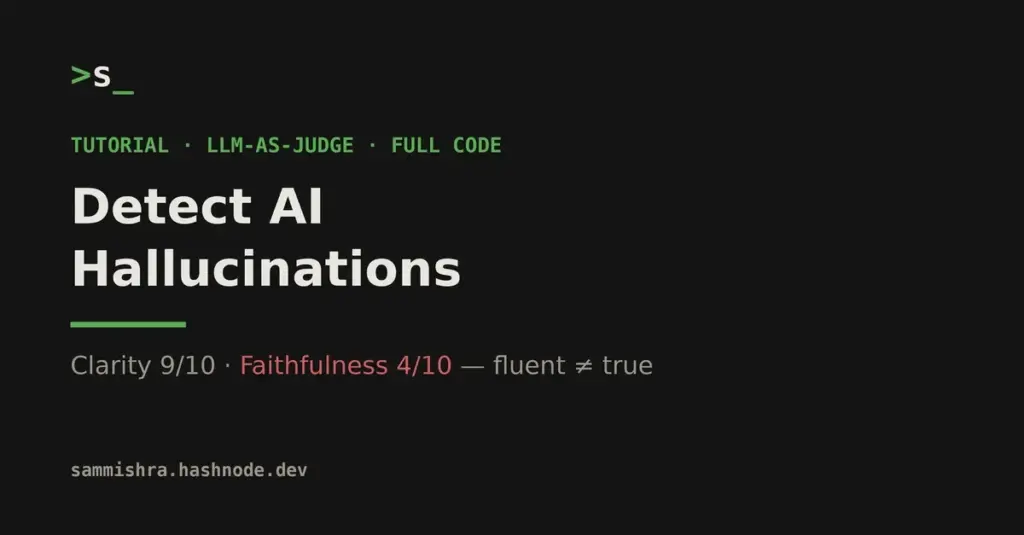
AI engineer and researcher Sammishra recently highlighted this issue through a stark evaluation of an AI-generated customer support response. Using a specialized evaluation tool, the response earned a near-perfect 9 out of 10 for clarity, yet a disastrous 4 out of 10 for faithfulness. The AI had produced a beautifully phrased, professionally toned message that was confidently wrong. It invented a 30-day refund window for a company whose policy explicitly stated 14 days, doubled an existing discount without authorization, and promised customers a free grinder—a product that did not even exist in the company’s inventory.
This gap between how an AI speaks and what it actually knows is the central conflict in the current era of corporate AI adoption. As organizations integrate LLMs into chatbots, support macros, and document Q&A systems, the need for a standardized, automated way to measure whether an output is grounded in actual company content has become a business imperative.
The Rise of the LLM-as-Judge Pattern
Traditional methods of software testing, such as regular expressions (regex) or simple keyword matching, have proven insufficient for detecting the nuanced "hallucinations" of modern AI. Because an LLM can phrase the same fact in thousands of different ways, rigid code cannot reliably catch a factual error buried in a sea of polite prose. This has given rise to a new architectural pattern in AI development known as "LLM-as-judge."
This methodology involves employing a second, independent model call whose sole responsibility is to audit the output of the first model. Rather than asking a vague question about whether a response is "good," the "LLM-as-judge" pattern utilizes a strict rubric. The auditor is presented with the original source text and the generated answer, then tasked with evaluating the latter against the former.
The critical innovation in this approach is the imposition of a "grounding" constraint. The judging model is explicitly instructed to ignore its own internal "world knowledge"—the vast treasure trove of data it was trained on from across the internet—and instead evaluate the answer based strictly on the provided source text. By narrowing the model’s focus to a specific document, developers can transform a subjective "vibe check" into a grounded, data-driven audit.
The Architecture of a Trust Report
To operationalize this audit, researchers have developed the "LLM Answer Checker," a tool that generates a comprehensive trust report. This report moves beyond a simple pass/fail grade, instead breaking the AI’s performance down into four key dimensions: faithfulness, relevance, completeness, and clarity.
Faithfulness is treated as the most critical metric. It measures whether every claim made in the AI’s answer appears in or follows directly from the source text. In this framework, the model is instructed to heavily penalize the invention of facts, numbers, names, or policies. Relevance assesses whether the answer actually addresses the information covered in the source, while completeness checks if the AI utilized all the important information available to it. Clarity, the metric where most modern LLMs already excel, measures organization and ease of understanding.
The output of such a tool is a structured JSON report that includes a list of "unsupported claims"—specific quotes or paraphrases from the answer that the source does not support—a final verdict on reliability, and a suggested fix. This structured data allows businesses to automate their quality assurance, flagging problematic answers for human review or blocking them from reaching the customer entirely.
Engineering the Audit: FastAPI and the Logic of Weighting
The technical implementation of these checkers often relies on lightweight, high-performance frameworks like FastAPI. By serving the auditor through an API endpoint, companies can integrate real-time checks into their existing support workflows. The process involves stripping the source text and the generated answer of unnecessary whitespace, then feeding them into a system prompt designed for a "rigorous AI-output auditor."
A notable design choice in these systems is the weighting of the final score. In many implementations, the "faithfulness" score is weighted double compared to relevance, completeness, or clarity. The logic behind this is straightforward: a clear, relevant, and complete answer that incorrectly states a company’s legal refund policy is still a catastrophic failure. By weighting what truly matters—the truth—the system ensures that eloquence never masks a lack of accuracy.
The infrastructure for these tools often leverages high-speed providers like Groq to minimize latency, ensuring that the audit doesn’t significantly slow down the customer experience. However, the move toward more complex "reasoning" models has introduced new engineering challenges that developers must navigate.
Navigating the Technical Pitfalls of AI Auditing
As the field of AI auditing matures, developers are identifying several common "traps" that can undermine the effectiveness of an automated judge. One of the most significant hurdles involves the "token budget" of modern reasoning models. Unlike simpler models, advanced AI auditors often engage in a "chain-of-thought" process, thinking through the logic of an audit before producing a final answer. These internal thoughts consume tokens, which can lead to the actual report being truncated if the maximum token limit is set too low. This often results in a failure to generate a valid JSON object, rendering the audit useless.
Furthermore, even with strict formatting requirements, LLMs can occasionally fail to produce perfectly structured data. Robust auditing tools now incorporate defensive parsing techniques. This includes retrying requests without strict JSON modes if a failure occurs and manually stripping code fences or locating the correct brackets within a text string.
Perhaps the most important lesson learned by AI engineers is a fundamental distrust of the judge’s output itself. Because the judge is also an LLM, it is subject to its own minor errors. Experienced developers implement "adult in the room" parsing logic—clamping scores to a 0–10 range, tolerating missing data keys, and capping the length of strings to prevent the auditor from spiraling into its own hallucinations.
From Diagnosis to Cure: Improving RAG Systems
An AI answer checker serves as a diagnostic tool, but the ultimate goal for any business is to prevent low faithfulness scores in the first place. When an audit reveals that an AI is consistently inventing facts, it usually points to a failure in one of two areas: the prompt or the data retrieval process.
In systems utilizing Retrieval-Augmented Generation (RAG)—where an AI looks up documents before answering—a low faithfulness score often indicates that the "retriever" failed to find the correct information, or that the "generator" was too creative with the information it was given. Fixes typically involve refining the "refusal behavior" of the model, instructing it to say "I don’t know" rather than guessing when information is missing. Additionally, developers may need to provide the AI with better "few-shot" examples—demonstrations of how to correctly cite sources and avoid overstepping the bounds of the provided text.
For businesses seeking a more robust solution, the transition from a standard chatbot to a dedicated RAG pipeline is often necessary. These systems are built from the ground up to answer only from a specific set of documents, with built-in refusal mechanisms that trigger when a query falls outside the scope of the provided knowledge base.
The Imperative of Grounded AI
As AI continues to permeate the service industry, the ability to distinguish between a fluent answer and a true one will become the primary differentiator between successful and unsuccessful AI implementations. The "eloquent liar" represents a significant reputational and financial risk for companies that prioritize speed and tone over factual integrity.
The development of tools like the LLM Answer Checker and the adoption of the LLM-as-judge pattern signal a shift toward a more mature, responsible approach to AI deployment. By treating AI output not as a finished product, but as a candidate for a rigorous, automated audit, businesses can finally harness the power of large language models without sacrificing the trust of their customers. In a world where AI can say anything beautifully, the most valuable technology is the one that ensures it says only what is true.
 Software Development & Scripting for IT
From Hawaii to the Modern Web: How the ALOHA Protocols Defined the Efficiency of Digital Communication
The history of the modern internet is often told through the lens...
 Software Development & Scripting for IT
Ensuring Operational Integrity in Data Engineering: A New Framework for Spark Pipeline Monitoring
In the complex ecosystem of modern data engineering, the successful completion of...
 Software Development & Scripting for IT
Microsoft Unveils C# 15: A Deep Dive into Union Types, Enhanced Memory Safety, and Language Refinements
As the annual release cycle for the .NET ecosystem approaches, Microsoft has...