In the current landscape of digital transformation, every modern enterprise operates on a foundation of credentials. These digital keys—ranging from API tokens and database passwords to SSH keys and certificates—are the connective tissue of the modern tech stack. They allow humans, automated systems, and increasingly, artificial intelligence agents to connect securely to data and services. However, as the infrastructure supporting these connections grows more complex, the layer of credentials protecting them is expanding faster than most security teams can monitor.
GitGuardian, a leader in the secrets security space, identifies three pillars essential to securing this layer: Detection, Remediation, and Prevention. While many organizations have made significant strides in the first phase—detecting when a secret has been exposed—the journey often stalls at the second phase. Credential remediation remains the stage where security programs frequently bog down, paralyzed by a lack of context and the fear of operational disruption.
The challenge is not merely knowing that a secret exists in the wrong place, but understanding the implications of its removal. This difficulty is underscored by recent research from GitGuardian’s State of Secrets Sprawl 2026 report, which revealed a staggering statistic: 64% of valid secrets discovered in 2022 were still active in January 2026. This four-year window of exposure highlights a systemic failure in the remediation process that leaves organizations vulnerable to exploitation long after a leak has been identified.
Why Credential Remediation is So Hard for So Many Teams
The primary reason remediation proves so difficult is a fundamental disconnect between those who find the problem and those who have the power to fix it. A security engineer monitoring a scanning platform might receive an alert that a sensitive API key has been committed to a public repository. They can verify that the key is valid and poses a high risk, but they rarely possess the granular knowledge of the production environment to know exactly what that key does.
In most large-scale organizations, the security engineer cannot immediately determine which microservices will fail or which customer-facing features will break if a credential is revoked. Because breaking production is often viewed as a higher immediate risk to the business than the theoretical possibility of a breach, decision paralysis sets in. Security teams find themselves embarking on time-consuming internal investigations just to answer basic questions about ownership and impact.
The developers, who are the natural owners of these keys, are often insulated from these security concerns by their own high-pressure workflows. Tasked with shipping new features and maintaining uptime, a developer receiving a vague security alert—often containing little more than a file path—may view it as a distraction. Without immediate, actionable context, these requests frequently sink to the bottom of the engineering backlog.
Furthermore, the sheer scale of modern enterprises exacerbates the issue. In a mature organization, information about a single credential may be siloed across multiple departments. Application security (AppSec) teams monitor the code where keys are utilized; Identity and Access Management (IAM) teams govern the identities that were issued those keys; and Platform Engineering teams manage the vaults where the secrets should have been stored in the first place. Adding to this complexity, endpoint security teams are now tracking secrets stored on individual workstations, as software supply chain attacks increasingly target plaintext credentials on developer machines. When these disparate groups do not communicate, the remediation process slows to a crawl.
Action Before Investigation Invites Downtime
The tension between security and availability is at the heart of the remediation struggle. Mature organizations recognize that addressing leaks before they become active breaches is the ideal path, yet the average time to remediate remains measured in weeks rather than hours. This delay is largely a function of how quickly responders can gather and verify information.
Before any action can be taken, responders must determine the scope of the credential’s access. For instance, consider two different cloud credentials. The first might grant read-only access to a single, non-sensitive storage bucket. The second could be a root-level administrative key with the power to delete production databases. While both are "leaked secrets," the urgency and the response strategy for each are vastly different.
The ultimate goal is the rapid removal of the leaked key, but this must be done without interrupting the production pipeline. If a security team causes a major outage by revoking a key without proper coordination, they will face significant internal resistance the next time they request a rotation. This "once bitten, twice shy" dynamic can severely damage the security culture of a company, making it even harder to enforce safety standards in the future.
Prioritize by Impact, Not Just Validity
Traditionally, the first step in triage is checking if a credential is valid. While validity is a critical signal, it is an incomplete one. Relying solely on validity can lead to a false sense of security. GitGuardian’s research indicates that validity-only triage misses approximately 46% of critical secrets, such as custom API tokens and SSH keys, because these specific types of credentials often cannot be verified through automated calls to a central provider.
Effective remediation requires a living risk score that accounts for multiple factors: What can the secret access? Where was it exposed? Was it leaked on the public internet or just an internal Slack channel? As new information is gathered, this risk score must be adjusted in real-time. Much like a CVSS score for a software vulnerability, the initial assessment is just a starting point; the actual risk to the organization depends on the specific context of the deployment.
By centralizing this information, security teams can move away from manual spreadsheets and toward a more automated, high-velocity response. Having a unified view allows responders to see the boundaries of the systems they are touching and make informed decisions about whether a secret needs to be rotated in the next sprint or revoked within the next minute.
Route the Work to the Right People Who Can Push the Change
A major hurdle in the remediation workflow is the "over the fence" mentality, where security teams send a ticket to developers and consider their job done. For remediation to be successful, the request must be routed to the specific individual or team with the authority to change the code.
Any request sent to a developer or platform team should be "pre-triaged." It should include the validity status, the known locations of the exposure, and a list of dependencies. If the person receiving the ticket understands the business impact and the technical requirements for the fix, they are far more likely to act quickly.
In large organizations, finding the right person can be a challenge. It requires leveraging commit attribution, source metadata, and integration with existing IAM systems. Once the work is routed, communication must be a two-way street. Developers may need guidance on how to rotate a specific type of key without causing a service interruption. Centralizing the tracking of these tickets ensures accountability and provides a clear audit trail for compliance and insurance purposes.
Rotate, Revoke, and Vault: The Order Matters
Security is often described through the CIA triad: Confidentiality, Integrity, and Availability. In the context of credential remediation, maintaining "Availability" is just as important as protecting "Confidentiality." To achieve this, organizations must follow a specific, disciplined order of operations when fixing a leak.
For organizations with high security maturity, the process is streamlined by the use of secrets managers or vaults. If a production application is already configured to consume credentials from a vault, rotating the secret is straightforward. Once the new secret is updated in the vault, the old, leaked version can be revoked at the source, rendering any plaintext copies in the codebase harmless.
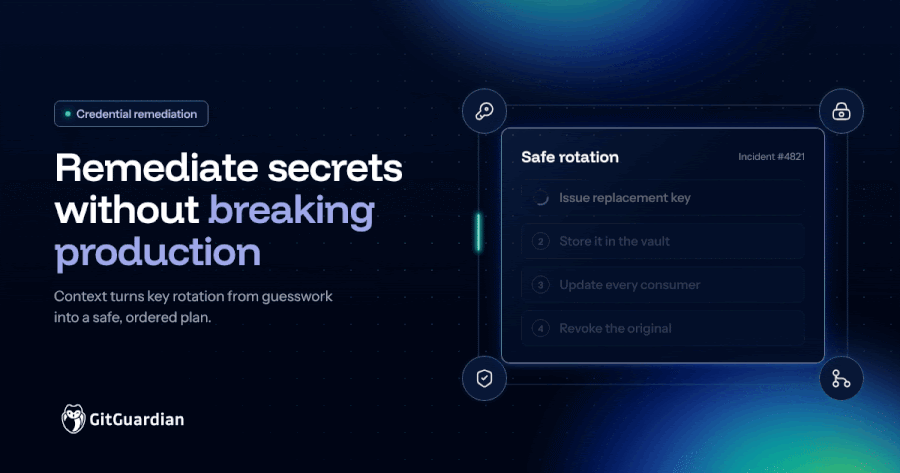
However, many organizations are still in the process of transitioning to vaulted environments. In these cases, the order of operations is vital. The team must first issue a replacement credential and store it securely. Then, every occurrence of the plaintext secret must be replaced with a call to the vault or the new credential value across all consumers. Only after the new code has been deployed and the system’s health has been verified should the original, compromised key be revoked. Reversing these steps—revoking the key before the new one is fully deployed—turns a routine security fix into a self-inflicted incident.
Verify the Fix and Keep the Evidence
The remediation process is not complete until there is verifiable proof that the danger has been removed. This means confirming that the old credential no longer authenticates with the service provider. Closing a ticket simply because a developer said they "fixed it" is a common pitfall.
In some cases, a team might rotate a key in one system while the old key remains active in another. This often happens when teams operate in silos and lack a unified view of where a single credential might be used. A robust remediation program requires a final verification step to ensure that no "ghost" credentials remain active in the environment.
Maintaining a detailed incident record is also essential for long-term security health. These records show auditors and leadership how long remediation took, who was involved, and what patterns are emerging. If a specific team or user is repeatedly leaking credentials, it may point to a need for better training or a more fundamental change in how that team handles configuration files.
One Credential, Start to Finish with GitGuardian
To illustrate the complexity of this process, GitGuardian points to a common real-world scenario involving a Kubernetes application. In this instance, a developer troubleshooting a connection issue might copy an API key from a secrets manager into a local configuration file for testing. If that local file is accidentally committed to a repository, the secret is now exposed.
Using GitGuardian’s platform, the leak is detected the moment the commit is made. An automated validity check is triggered, and a Secret Analyzer identifies the permissions associated with the key. For organizations using full platform integrations, a "Fingerprint Matching" feature can even tie the committed value back to the specific vaulted copy in the enterprise’s secrets manager.
With this context, the security team can approach the developer with a complete picture: "This key is valid, it has administrative access to our external service, and it is currently being used by our production Kubernetes cluster." This level of detail eliminates the guesswork and allows the rotation to proceed with confidence. Everyone involved can track the progress of the replacement PR, ensuring that the old key is only revoked once the new system is stable.
From Fixing to Preventing
While remediation is about reducing the risk of current exposures, it also serves as a diagnostic tool for the organization. By analyzing why and where secrets are leaking, companies can identify the systemic weaknesses in their development lifecycle.
The process of remediation, though difficult, is the bridge between reactive security and proactive prevention. As organizations refine their ability to rotate and revoke secrets with minimal friction, they build the resilience necessary to handle the ever-expanding credential layer. The final stage of this journey involves moving security further "left," stopping leaks before they ever reach a repository—a topic that remains the ultimate goal for modern DevSecOps teams.
 Cybersecurity Basics & Security News
Advanced Wazza Phishing Kit Leverages Multi-Stage Routing and Device Code Tactics to Target Critical Global Sectors
The landscape of email-based threats is undergoing a fundamental transformation. Phishing kits,...
 Cybersecurity Basics & Security News
The Silent Proliferation: Enterprise Security Grapples with the Rise of Invisible AI Agents
As the enterprise landscape prepares for the full-scale integration of artificial intelligence,...
 Cybersecurity Basics & Security News
Microsoft Addresses Critical Remote Code Execution Vulnerability in Windows Paint via Microsoft Store Update
Microsoft has officially released a definitive patch for CVE-2026-83844, a significant remote...