
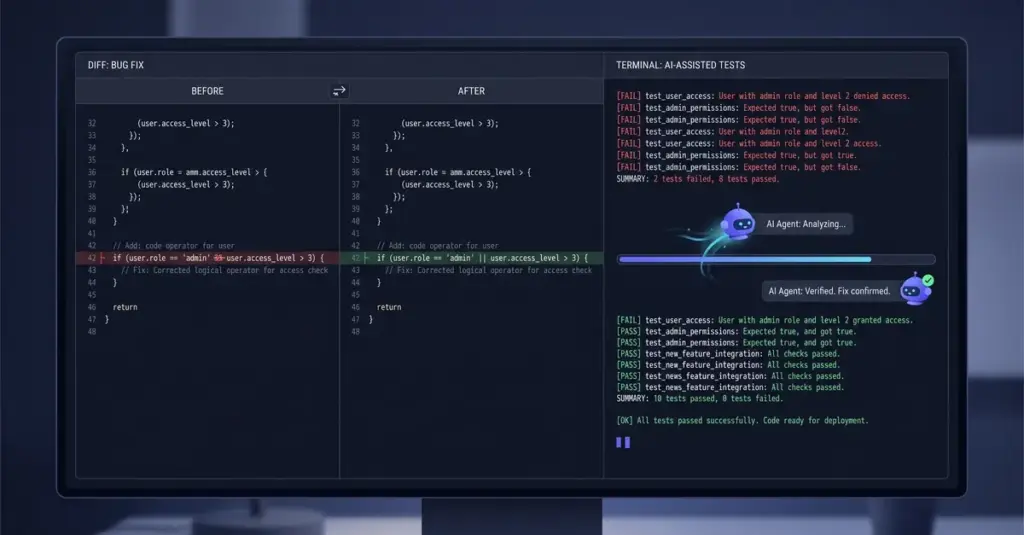
The process of struggling through a complex stack trace or manually tracing data flow through a codebase is not merely a chore; it is a pedagogical necessity. These "crucibles of frustration" are where architectural understanding is forged. When a junior developer encounters an error and immediately asks an AI to fix it, they bypass the critical thinking required to understand why the error occurred.
The result is a generation of engineers who may be highly efficient at generating boilerplate but lack the system-level comprehension needed to navigate a production outage. If developers continue to be treated as passive reviewers of AI output rather than active creators, the industry risks creating a workforce that is highly dependent on the very tools that created the errors they are trying to solve. This "atrophy of understanding" could have dire consequences for the stability and security of future software infrastructure.
Shifting from Manual QA to Agentic Verification
Recognizing that the current path is unsustainable, some corners of the industry are calling for a fundamental shift in how AI is integrated into the development lifecycle. The consensus emerging is that the burden of verifying AI-generated code must shift from human line-by-line reading to automated, "agentic" execution. The goal is to move the human developer back to the role of an architect who defines requirements and reviews validated outcomes, rather than a janitor cleaning up raw AI output.
MonkeysCode has positioned itself at the forefront of this shift, addressing the "button-pushing" dilemma through its latest updates to the Capuchin agent and the Agent Manager CLI. Released on October 5, 2026, MonkeysCode Editor 1.2.12 and Agent Manager 1.0.16 introduce a workflow that prioritizes autonomous verification over raw generation.
The philosophy behind Capuchin is that an AI should not simply dump code into a file and leave. Instead, the agent is designed to work within a "test-and-repair loop." When assigned a task, Capuchin creates a plan, edits the necessary files across the codebase, and—crucially—executes the project’s own test suite. If the tests fail, the agent does not wait for a human to find the error. It reads the stack trace, analyzes the failure, and attempts to repair the code autonomously.
This process continues until the tests pass or the agent reaches a predefined iteration limit. By the time the developer is asked to review the changes, the code has already been validated against the project’s actual requirements. This shifts the human’s role from "Does this syntax look right?" to "Does this logic meet the business requirements?"—a significantly more engaging and less exhausting task.
Supervised Runs with Agent Manager
For developers who operate primarily in the terminal or need to integrate these agentic workflows into existing CI/CD pipelines and scripts, the release of MonkeysCode CLI 1.0.2 and Agent Manager 1.0.16 provides a more granular level of control. This setup allows for "supervised agent runs," where the developer can delegate complex implementation tasks directly from the command line.
 Software Development & Scripting for IT
"Outside in 20" Redefines Digital Wellness with Local AI-Driven Outdoor Encouragement
In an era where digital connectivity often feels inescapable, a new open-source...
 Software Development & Scripting for IT
Bridging the Linguistic Divide: How Word Embeddings Revolutionized Machine Understanding of Human Language
In the rapidly evolving landscape of artificial intelligence, one of the most...
 Software Development & Scripting for IT
Architecting Precision: Why Staged Retrieval and Explicit Contracts are Redefining AI Insurance Claims Intake
In the rapidly evolving landscape of insurance technology, the integration of Large...






