
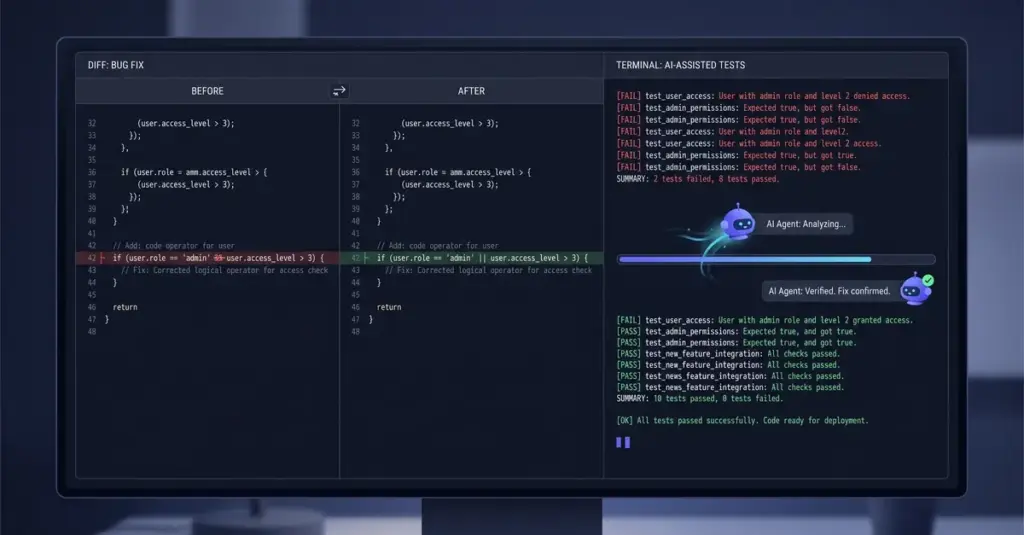
The process is designed to be transparent, providing the developer with real-time visibility into the agent’s reasoning and actions. For example, a developer might issue a command to implement a new middleware and ensure all associated tests pass. The Agent Manager then orchestrates the entire lifecycle of that task:
- Planning: The agent identifies which files need to be modified (e.g., the middleware itself and the test files).
- Execution: The agent applies the edits.
- Verification: The agent runs the specific test suite related to the changes.
- Iteration: If a system error occurs—such as a 500 error when a 401 was expected—the agent analyzes the stack trace and applies a fix.
- Completion: Only after the tests pass (e.g., "4 passing") does the agent mark the task as ready for human review.
This automated verification loop aims to eliminate the "almost right" trap. When the developer finally opens the code in the editor, they are not hunting for syntax errors or basic logic flaws; those have already been filtered out by the agent’s interaction with the compiler and test runner.
To further streamline this, MonkeysCode Editor 1.2.11 introduced improved diff navigation. When a developer reviews the agent’s work, diff card headers allow them to jump directly to the affected file tabs. This targeted inspection ensures that the human’s cognitive energy is spent on high-level logic and architectural alignment, rather than the tedious work of finding where the AI made a change.
Model Choice and BYOK
A significant source of frustration for many engineering teams has been the "black box" nature of many AI tools. Being locked into a single, opaque model can lead to inconsistent results and a lack of trust in the tool’s output. To counter this, the latest industry trends—and the MonkeysCode platform—are moving toward multi-model routing and "Bring Your Own Key" (BYOK) architectures.
By allowing developers to choose which model powers their agentic workflows, teams can match the reasoning engine to the specific needs of their codebase. Some models may perform better with legacy Java systems, while others might excel at modern TypeScript architectures. This flexibility, combined with the ability to use private API keys, provides teams with a sense of control and security that is often missing from one-size-fits-all AI solutions.
Takeaway
The software engineering industry is at a crossroads. The data from major industry surveys and reports suggests that the current trajectory—where developers act as manual QA testers for AI-generated snippets—is leading to a crisis of burnout and a dangerous decline in foundational skills among junior staff. The "almost right" illusion has proven to be a significant drain on cognitive resources, threatening the very productivity that AI was supposed to enhance.
The solution lies in evolving the workflow from passive code generation to active, agentic verification. By shifting the burden of syntax checking, test execution, and basic debugging back to the machine, tools like Capuchin and the Agent Manager CLI aim to restore the developer’s role as an architect and problem-solver. As these autonomous test-and-repair loops become the standard, the industry may finally be able to realize the efficiency of AI without sacrificing the well-being and expertise of the engineers who build and maintain our digital world.
 Software Development & Scripting for IT
UNC6240 Exploits Critical Oracle PeopleSoft Vulnerability Through Sophisticated WAF Bypass Techniques
A sophisticated cyber-espionage and data theft campaign has been identified targeting organizations...
 Software Development & Scripting for IT
Re-evaluating the Enterprise Test Automation Stack: Why Past Decisions Require New Scrutiny in the Age of AI
In the fast-moving world of enterprise software, a test automation tool that...
 Software Development & Scripting for IT
Bridging the Gap Between Canvas and Cafe: Developer Builds Local AI Suite to Help Madrid Artist Manage Exhibitions
In the bustling cultural landscape of Madrid, where neighborhood cafes and local...






