
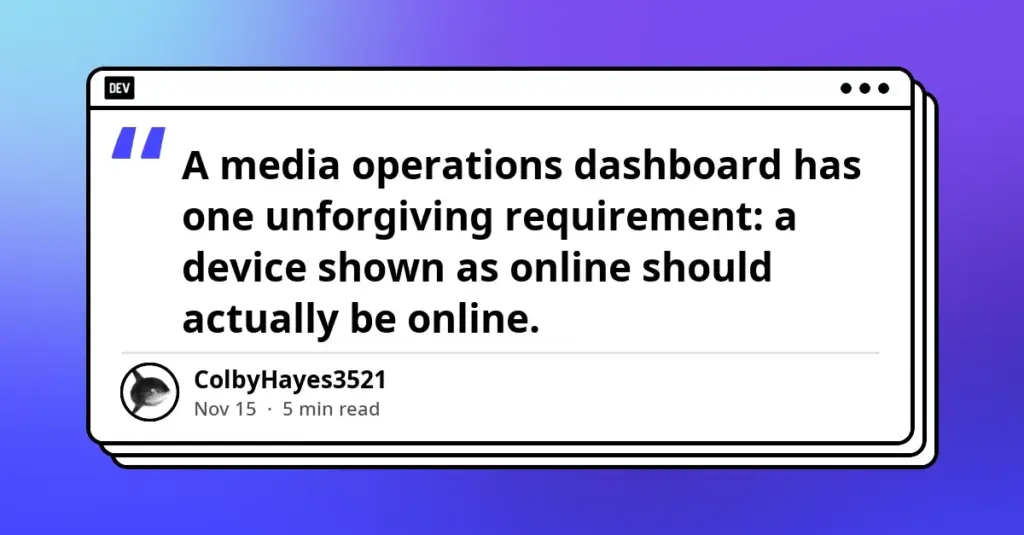
In the high-pressure environment of a media operations center, the reliability of a dashboard is not merely a matter of user experience; it is a fundamental operational requirement. When a fleet of video encoders is responsible for delivering live content to millions, the monitoring system must provide an absolute reflection of reality. In this context, a device shown as "online" must actually be online. However, achieving this level of synchronized truth across multiple screens introduces a complex architectural challenge: how to balance the freshness of data against the computational cost of delivering it.
The traditional approach to updating web-based dashboards has long been polling—a method where the client browser repeatedly asks the server for the latest state. While simple to implement, polling faces a scaling wall in professional environments. When several operators watch the same fleet of devices, repeated polling forces the system to spend resources rediscovering state that is mostly unchanged. Simultaneously, because each browser operates on its own internal timer, different viewers often see different versions of the truth, leading to confusion during critical incidents.
To solve this, system architects are increasingly moving toward server-side presence calculations and push-based delivery. By calculating presence once on the server and pushing only the changes to connected dashboards, organizations can ensure consistency and reduce unnecessary load. While polling still retains a place in recovery scenarios and low-attention background screens, the push model has emerged as the superior choice for active operational monitoring.
Why Pushing Beats Polling Above a Handful of Viewers
The shift from polling to pushing is driven by a simple mathematical reality of scale. Consider a scenario involving a control room dashboard monitoring 12 high-density video encoders. If a single viewer polls the system every five seconds to check for status changes, that creates 12 read opportunities per minute. However, as the team grows, the load scales linearly. Eight viewers create 96 reads per minute. If none of the encoders change state during that interval, all 96 reads are essentially wasted effort, confirming old knowledge at the expense of database and network resources.
The push model adopts a different shape. In this architecture, device signals—often heartbeats—update a single, authoritative presence record on the server. The service then "fans out" state changes to all open dashboards as they happen. While fan-out load still grows with the number of viewers, the crucial difference is that the system stops performing timer-driven reads when nothing is happening.
The threshold for switching from polling to pushing is not a universal number of users. Instead, it is a calculation where pushing wins when the product of viewers and polls per minute exceeds the real rate of change plus the overhead required to maintain open connections. For a small operation with five viewers watching rapidly changing devices, push might actually be more expensive than polling. Conversely, for 50 viewers watching a relatively quiet fleet, push is significantly more efficient. For a solo developer or a small SaaS startup, the decision also involves "opportunity cost." Every hour spent managing the complex infrastructure required for real-time delivery is an hour not spent shipping new features. Therefore, the decision must be based on a careful measurement of payloads, query costs, and event frequency.
The Constraint That Changed the Design
Beyond the efficiency of the network, the primary driver for moving to a push-based system is the need for operational consistency. When every browser independently decides whether a device is present, a single operational fact is divided across many different clocks. In a polling setup, one operator’s tab might have just refreshed, showing an encoder as "offline," while another operator’s tab is still four seconds away from its next poll, showing the device as "online."
This disagreement between screens is more than a nuisance; it is a liability when an operator must decide in a split second whether an encoder is ready for a live broadcast. To eliminate this, the presence of a device should be defined on the server using the latest accepted signal and a strict deadline. Under this model, the browser receives an initial snapshot of the entire fleet upon connection, followed by a stream of revisions. The browser then accepts only newer events, ensuring that an old update cannot overwrite fresh data.
There is, however, a meaningful trade-off in how these deadlines are set. A long deadline—the time the server waits before declaring a silent device "offline"—can hide a genuine failure for too long. A deadline that is too short can turn a brief, harmless network hiccup into "flapping," where devices appear to toggle rapidly between online and offline states. The ideal deadline should be derived from the device’s heartbeat contract and a clear understanding of the consequences of a false positive versus a false negative.
By centralizing this logic, the failure states become explicit. In a well-designed system, "offline" means the presence deadline has elapsed, while "unknown" means the dashboard has lost its connection to the server and cannot confirm the current state. Combining these into a single "offline" indicator is a "clean-looking lie" that can mislead operators during a system-wide outage.
The Smallest Node.js Implementation
Implementing a push-based system does not necessarily require a heavy commercial service. A single-process Node.js example can expose the underlying state machine. In such a system, the server maintains an authoritative map of devices and a set of connected viewers. When a device sends a heartbeat, the server updates its map, increments a revision number, and publishes the change to all connected viewers using Server-Sent Events (SSE).
In this architectural pattern, the server handles the "expiry" of devices. A background interval checks the "last seen" timestamp of every device; if the time elapsed exceeds the predefined timeout, the server marks the device as offline and pushes that update to the dashboards. This ensures that the logic for "what constitutes being online" lives in exactly one place.
The client-side logic in this scenario remains remarkably simple. The browser maintains its own map of the fleet. When it receives a presence event, it compares the revision number of the incoming data with the revision of the data it currently holds. If the new revision is higher, it updates the display. This "boring" approach is highly effective because it prevents out-of-order messages—common in distributed networks—from causing the dashboard to display stale information.
Recovery is Part of the Operating Cost
While an open stream is efficient during steady-state operations, it does not eliminate the possibility of failure. In fact, the move to push-based systems introduces new responsibilities for the developer. Deployments will inevitably disconnect viewers, networks will drop idle paths, and server processes will restart, wiping out in-memory maps.
A robust design must account for the "recovery budget." This includes providing a fresh snapshot upon reconnection and implementing exponential backoff to prevent "reconnect storms" from overwhelming the server after a brief outage. The most dangerous time for a push-based system is not during normal operation, but during the seconds immediately following a deployment or a network recovery, when hundreds or thousands of clients simultaneously demand a full state snapshot.
Architects must test the state machine against more than just the "happy path." A production-ready system must gracefully handle duplicate events, out-of-order revisions, and stream closures. The goal is convergence: after any failure or recovery event, every viewer must eventually arrive at the same authoritative state held by the server, without ever allowing an older revision to overwrite a newer one.
At a larger scale, it becomes necessary to separate the different stages of the data pipeline. Ingestion, the calculation of authoritative presence, and the delivery of updates to clients should be handled by distinct components. A shared message broker or log can carry ordered changes to delivery nodes, while a durable state store serves the initial snapshots. For many organizations, this is "undifferentiated plumbing," and outsourcing these components to specialized service providers can be a wise move, provided the interface aligns with the operational requirements.
The Final Decision Rule
The choice between polling and pushing ultimately comes down to the specific needs of the application. For an administrative screen that is rarely opened, where data freshness is not critical and reads are inexpensive, polling remains the most rational and simple choice. It is easy to reason about and requires minimal infrastructure.
However, when presence must converge quickly across multiple screens and when the cost of repeated, redundant reads begins to dominate the system’s workload, the move to push is essential. Even then, retaining a low-rate reconciliation path—a slow poll or a periodic full-state sync—is a valuable form of insurance against missed events. In the world of high-stakes media operations, the dashboard is the primary window into a complex machine; ensuring that window is clear and accurate is worth the architectural investment.
 Software Development & Scripting for IT
The Technical Divide: How Design Control and Risk Management Distinguish ISO 13485 from ISO 9001 in Medical Manufacturing
In the complex world of medical device procurement and engineering, the presentation...
 Software Development & Scripting for IT
From Hawaii to the Modern Web: How the ALOHA Protocols Defined the Efficiency of Digital Communication
The history of the modern internet is often told through the lens...
 Software Development & Scripting for IT
Modernizing Authentication: A Comprehensive Approach to Passkey Implementation in Symfony 8.1
The digital authentication landscape is undergoing a fundamental shift as the industry...







