
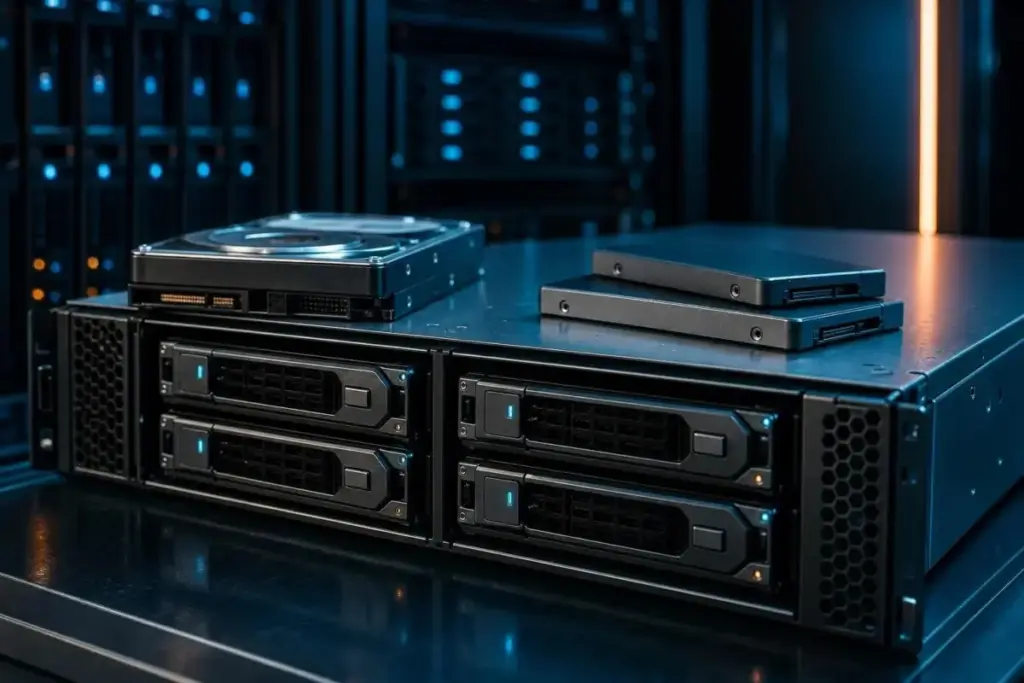
In many modern data centers, a tiered approach is used. Flash-based storage running RAID 10 is reserved for mission-critical databases and virtual machines, while high-capacity Nearline HDD arrays running RAID 6 are used for bulk storage, backups, and archival data. This strategy allows each RAID level to perform the task it was designed for without overspending on redundant hardware for non-critical data.
For those who require even higher levels of safety, complex software RAID 10 implementations allow for more than two replicas per data block. While this further reduces usable capacity, it provides a level of redundancy that can survive multiple failures even within the same logical "pair." This remains a niche option, typically reserved for data of extreme value where loss is not an option.
Implementation Details That Change the Rules
The actual behavior of a RAID 10 array can vary significantly depending on whether it is managed by software or a dedicated hardware controller. Linux software RAID, for instance, provides three distinct choices. Beyond nested RAID 1+0 and 0+1, the mdadm utility offers a "complex" RAID 10 level. This version allows for odd device counts—a feat impossible with traditional nested RAID 10—and offers different data layouts: near, far, or offset. The "far" layout, for example, can significantly improve sequential read performance by spreading data in a way that allows the system to utilize the outer tracks of the disks more effectively.
Logical Volume Management (LVM) also offers RAID 10 capabilities. Created with the lvcreate command, these arrays are repaired using lvconvert --repair. However, as noted in Oracle’s Linux LVM documentation, this repair process is contingent on having a spare physical volume already available within the volume group. Without this preparation, the system has no destination for the rebuilt data, leading to extended periods of vulnerability.
Hardware controllers introduce their own proprietary rules. Broadcom’s MegaRAID family, a staple in enterprise servers, supports spanned RAID 10 across up to 240 drives. However, these controllers often enforce specific "span" requirements—such as requiring even-numbered spans or shifting configuration logic once the drive count exceeds 32. These thresholds are specific to the firmware and hardware in use and are not universal properties of RAID 10.
Frequently Asked Questions
As organizations evaluate their storage needs, several common questions regarding RAID 10 frequently arise. One of the most vital is whether RAID 10 can serve as a substitute for a backup. The answer is a definitive no. RAID 10 protects against hardware failure, but it offers no protection against data corruption, accidental deletion, or ransomware.
Another common query involves mixing drive sizes. While most controllers allow for mismatched drives, the pair will always be capped at the size of the smallest disk. This leads to wasted capacity and potential latency imbalances. For a stable production environment, matching drives within a pair is considered the only viable baseline.
Regarding the protection against whole-enclosure failures, RAID 10 does not provide this by default. Because its logic is based on the relationship between disks, it cannot account for the failure of a shared controller or power source unless the administrator has specifically designed the physical layout to distribute pairs across different hardware boundaries.
Finally, the question of whether SSD-based RAID 10 is worth the cost remains a point of internal debate for many IT departments. While flash storage inherently offers lower latency and faster rebuilds, the added cost of doubling the number of SSDs can be staggering. Most organizations find that the performance gains are real, but they must be validated against specific workloads to ensure the budget allocation is justified. As with all storage decisions, the specific needs of the application must dictate the architecture of the array.
 Enterprise Tech & Infrastructure
Navigating the Complexities of Amazon S3 Cost Management: Why the Per-Gigabyte Rate Is Only the Beginning
In the world of enterprise cloud infrastructure, Amazon S3 has long been...
 Enterprise Tech & Infrastructure
Decoding the Amazon S3 Bill: Why the Per-Gigabyte Rate Is Often the Smallest Part of Cloud Storage Costs
In the world of enterprise cloud infrastructure, the Amazon S3 storage bill...
 Enterprise Tech & Infrastructure
The Architecture of Modern Storage: Navigating the Technical Nuances of Flash Memory and Solid-State Drives
In the rapidly evolving landscape of data storage, the terminology used to...







