
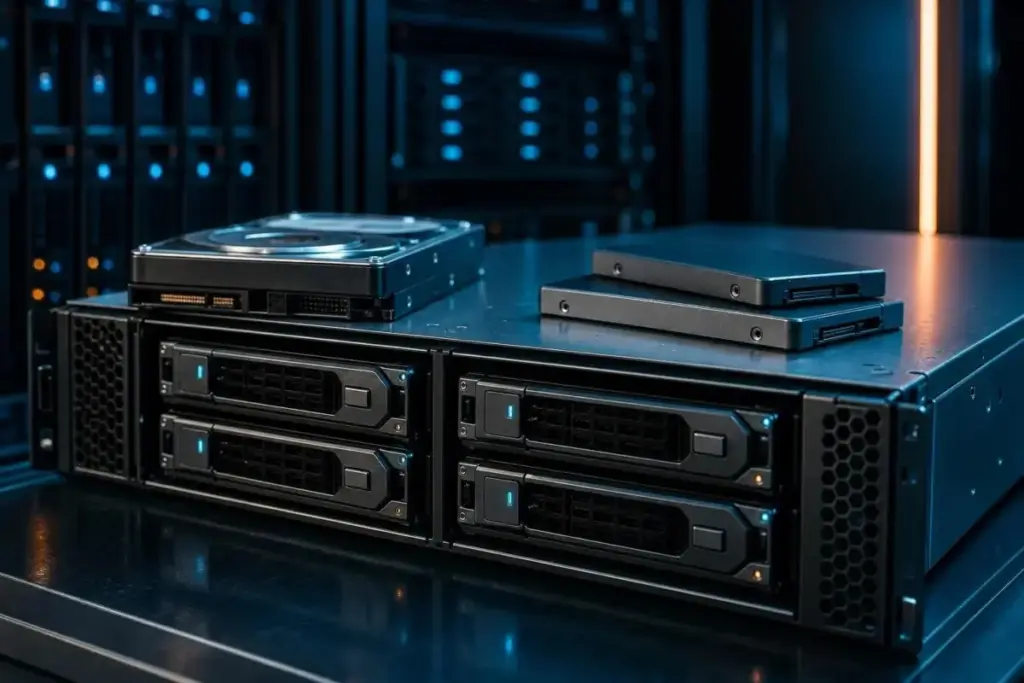
When choosing a RAID level, organizations typically weigh RAID 10 against RAID 6 and RAID 1. Each offers a different balance of usable capacity, failure tolerance, and performance.
The capacity gap is perhaps the most immediate consideration. In RAID 10, usable capacity is approximately 50% of the raw storage, calculated as the number of drives divided by the number of replicas. In a standard two-replica setup, eight 16 TB drives yield only 64 TB of usable space. In contrast, RAID 6 utilizes a "N-2" formula, where N is the total number of drives. Those same eight 16 TB drives would yield 96 TB in a RAID 6 configuration. As drive counts scale up, the "capacity tax" of RAID 10 becomes increasingly expensive, often making it cost-prohibitive for massive archival tiers.
In terms of fault tolerance, RAID 6 is objectively more robust in a general sense, as it can survive the loss of any two drives across the entire array. RAID 10’s tolerance is conditional: it can survive many failures if they are distributed across different pairs, but a second failure within the same pair is catastrophic.
Performance, however, is where RAID 10 justifies its cost. The write-path difference is architectural. RAID 10 writes each block to both halves of a mirror with no parity calculations required. RAID 6 must compute and write two separate parity blocks for every stripe. This creates a significant "write penalty." While real-world results vary based on controller cache and workload size, simplified models suggest a roughly two-fold write penalty for RAID 10, compared to a six-fold penalty for RAID 6. For latency-sensitive applications, this difference is the deciding factor.
The general rule of thumb for architects is to pay the RAID 10 capacity premium for sustained small-block random writes and transactional workloads. Conversely, RAID 6 or erasure coding is preferred when capacity efficiency or very large drive counts are the primary requirements.
What Actually Happens When a Drive Fails
The true test of a RAID array occurs during a drive failure and the subsequent rebuild process. In a RAID 10 environment, a rebuild is a straightforward operation: the system copies data from the surviving member of the mirrored pair to a replacement disk. This process does not require the recalculation of parity across the entire array, which is a computationally expensive task.
Industry experts, including those from DiskInternals and Servnet UK, note that RAID 10 rebuilds are generally less taxing on the system than parity-based rebuilds (like RAID 5 or 6). Because the rebuild only involves the surviving partner of the failed disk, the rest of the array continues to operate with minimal performance degradation. However, the duration of this process is not fixed; it depends heavily on drive speed, the volume of data, and how the controller throttles background tasks.
There is a hard boundary to this resilience: if two disks within the same mirror pair fail before the rebuild is complete, that pair’s data is lost. Even if the other six drives in an eight-drive array are healthy, the loss of one pair renders the entire volume unreadable.
Furthermore, RAID 10’s mathematical model assumes that drive failures are independent events. In reality, failures are often correlated. Drives that share a common backplane, power supply, or firmware version may fail in quick succession due to external stressors. To mitigate this, experts recommend a design-heavy approach: deliberately distributing mirror pairs across separate backplanes or enclosures. This ensures that a single hardware failure outside of the disks themselves does not take out both members of a mirrored pair simultaneously.
Where the Capacity Cost Is Worth Paying
RAID 10 is rarely the most economical choice, but in specific environments, it is the only choice that meets performance demands. Online Transaction Processing (OLTP) and heavy-duty databases, such as SQL Server or Oracle-class workloads, thrive on the low-latency characteristics of RAID 10. Similarly, dense virtualization hosts, where multiple virtual machines are performing simultaneous random writes, benefit from the lack of parity overhead and the speed of recovery.
 Enterprise Tech & Infrastructure
IBM, AMD, and Oak Ridge National Laboratory Launch Integrated Co-Design Platform to Accelerate Quantum Error Correction
The pursuit of fault-tolerant quantum computing has long been defined by a...
 Enterprise Tech & Infrastructure
Huang shrugs off protestors to kick off GTC Berlin with DSX Pods, Robots
The DSX Pod represents a significant evolution in how high-performance computing is...
 Enterprise Tech & Infrastructure
The Strategic Role of RAID 10 in Modern Enterprise Storage Architecture
In the high-stakes world of enterprise data management, the choice of a...







