
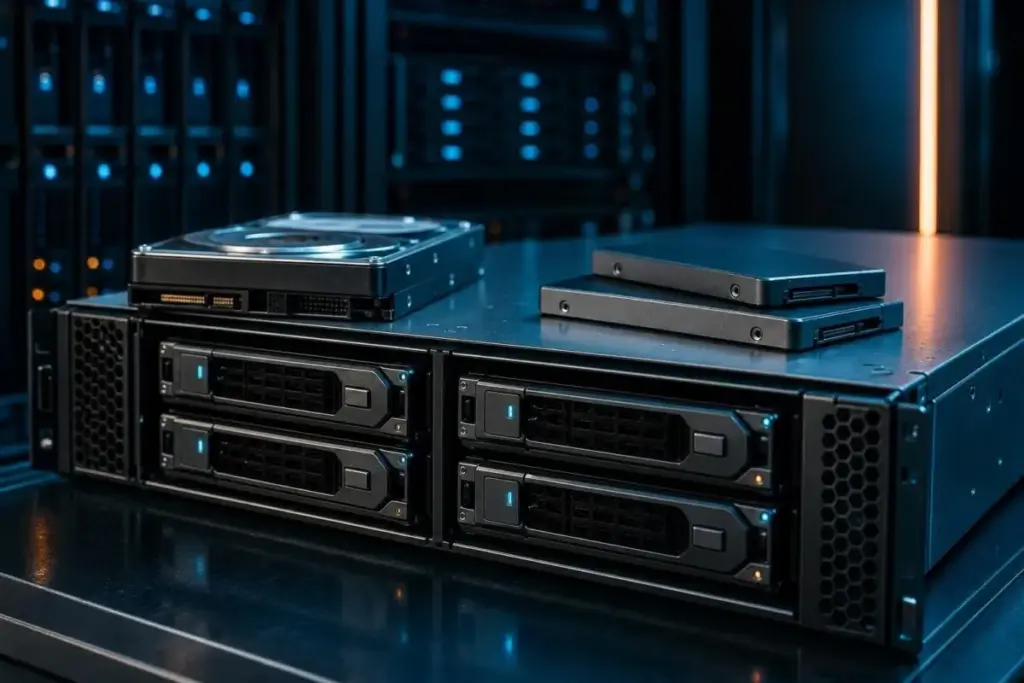
To mitigate this, sophisticated storage architects often manually distribute mirror pairs across different physical enclosures or backplanes. This ensures that a single hardware failure—like a short circuit on a disk shelf—doesn’t take out both halves of a critical data pair. RAID 10 does not provide this geographic redundancy automatically; it is a design layer that must be implemented by the administrator.
Software Implementations and the Linux Factor
While hardware RAID controllers have long been the standard, software-defined storage has introduced new flexibility to the RAID 10 model. Linux, through the mdadm utility, offers a "complex" RAID 10 level that differs from traditional nested RAID.
The Linux mdadm --level=10 implementation does not necessarily build separate RAID 1 and RAID 0 layers. Instead, it allows for more flexible configurations, including odd numbers of disks—a feat traditional nested RAID 10 cannot achieve. It also offers different data layouts, such as "near," "far," and "offset," which can be tuned to favor either read or write performance depending on the specific application.
Similarly, Logical Volume Management (LVM) in Linux provides its own RAID 10 capabilities. However, as noted in Oracle’s Linux documentation, these systems require careful preparation. For instance, the lvconvert --repair command used to fix a degraded LVM RAID 10 volume requires a spare physical volume to be available within the volume group. If an administrator fails to allocate this spare capacity in advance, the automated repair process cannot initiate, leaving the data at risk.
The Strategic Buy-In
Ultimately, the decision to deploy RAID 10 is a decision to prioritize uptime and transactional speed over storage efficiency. For Online Transactional Processing (OLTP) environments, such as SQL Server or Oracle databases, the 50% capacity tax is viewed as a necessary premium for the low-latency performance required to handle thousands of concurrent queries.
In many enterprise environments, a tiered approach has become the standard. High-performance flash storage is configured in RAID 10 to host active databases and virtual machine boot disks, while slower, high-capacity hard drives are configured in RAID 6 or erasure-coded clusters to handle backups, archives, and bulk sequential data.
As drive capacities continue to climb into the 20 TB and 30 TB range, the stakes of array rebuilds grow higher. In this environment, the simplicity of the RAID 10 rebuild remains its most compelling feature. By avoiding the mathematical complexity of parity, RAID 10 offers a predictable, high-performance path for data management, provided the organization is willing to pay the price in hardware.
 Enterprise Tech & Infrastructure
Quantum Elements Bridges the Hardware-Software Gap in Quest for Fault-Tolerant Computing
The journey toward a practical, large-scale quantum computer has long been defined...
 Enterprise Tech & Infrastructure
The Architecture of Modern Storage: Navigating the Technical Nuances of Flash and Solid-State Drives
In the rapidly evolving landscape of data storage, terms like "Flash" and...
 Enterprise Tech & Infrastructure
The Architecture of Data: A Comprehensive Analysis of Modern Computer Memory and Storage Systems
In the modern computing landscape, the term "memory" serves as a broad...







