
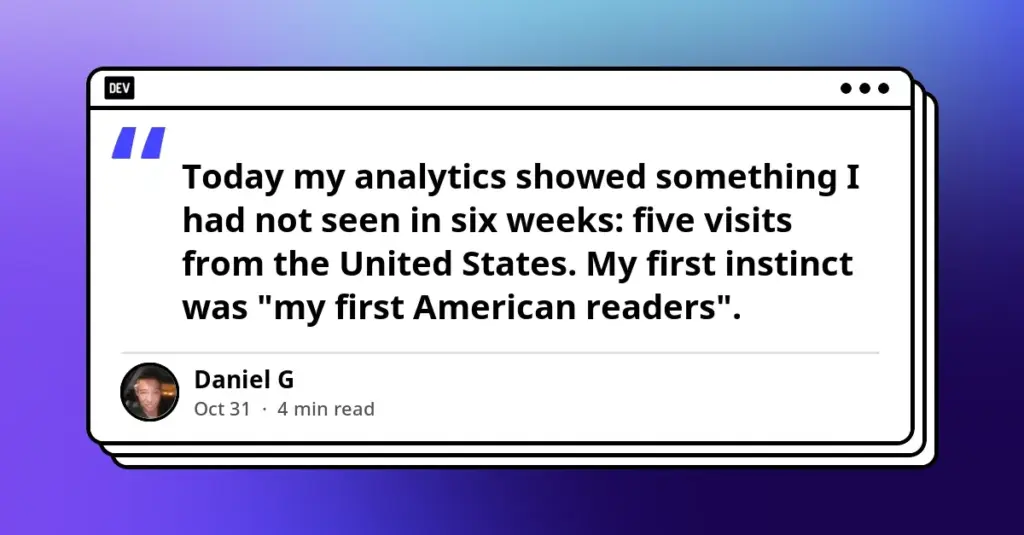
In the quiet hours of a Singapore evening, specifically at 23:00 SGT on October 31, 2026, a lone developer sat before a glowing dashboard, staring at a metric that had remained dormant for six weeks. For the first time since the project’s inception, the analytics panel registered five distinct visits originating from the United States. To an outside observer, five visits might seem statistically insignificant, a mere rounding error in the vast ocean of global internet traffic. But for the creator of a niche indie application, those five pings represented a potential breakthrough—the first signs of an American audience.
However, in the modern era of web development, where automated crawlers, headless browsers, and search engine spiders outnumber human users, optimism must be tempered with rigorous verification. The developer’s initial instinct to celebrate "the first American readers" was immediately met with a practiced skepticism. Before these visits could be classified as human beings, they had to pass a gauntlet of three specific analytical checks designed to separate genuine interest from mechanical noise. The resulting conclusion was a sobering reflection on the reality of modern software launches: these were "probable" readers, but far from "proven" ones.
The project at the center of this investigation is "One Minute Magic," a habit-tracking application designed with a specific, unconventional philosophy. Unlike traditional productivity apps that rely on the high-pressure "streak" mechanic—where a single missed day resets progress to zero—One Minute Magic focuses on resilience and low-friction entry. The app allows users to track up to three habits, each requiring only sixty seconds of commitment. The unique selling point is the requirement of a photograph: users must snap a picture of the moment they complete their sixty-second task, providing a visual log of their consistency. Crucially, if a day is missed, the "run" is merely paused rather than destroyed, catering to those whose lives do not always follow a linear, predictable path.
Despite the innovative approach to habit formation, the struggle for visibility remains the project’s primary hurdle. The marketing operation for One Minute Magic is a lean, two-part system consisting of a single automated bot and the developer themselves. Over the course of six weeks, this effort yielded 23 articles, 343 views, 11 reactions, and 13 comments across various platforms. This modest distribution network is the lifeblood of the app, which currently offers 30 free promotional spots. As of the latest reading, all 30 spots remain unclaimed, highlighting the immense gap between a "view" on an article and a "conversion" on a product.
The Product: Habit Tracking Without the "Streak" Penalty
The philosophy behind One Minute Magic is a direct response to the psychological fatigue often induced by modern productivity tools. Many users find that the "streak" model—popularized by language learning apps and fitness trackers—eventually becomes a source of anxiety rather than motivation. When a user breaks a 100-day streak due to an illness or a family emergency, the emotional blow can lead to "abandonment syndrome," where the user gives up on the habit entirely because the counter has returned to zero.
One Minute Magic attempts to solve this by emphasizing the "minute" over the "streak." By limiting habits to sixty seconds, the barrier to entry is lowered to a point where even the busiest individual can find the time. The photo requirement adds a layer of mindfulness and proof, turning a digital log into a tangible gallery of effort. However, even with a compelling value proposition, the developer has found that attracting the right eyes is a technical and psychological challenge.
The data from the most recent 24-hour window tells a story of cautious progress. Two independent counters, monitored simultaneously, showed five visits that appeared "people-shaped." Further analysis revealed that while these visitors navigated the site, only one proven click originated from a published article and reached the specific offer page. Despite this movement, the counter for the 30 free places remained at zero, illustrating the difficulty of moving a stranger from curiosity to commitment.
The Three-Step Verification Process
To navigate this landscape of uncertainty, the developer utilizes a three-check framework to validate traffic. This methodology is essential for any indie creator who needs to understand if their marketing efforts are reaching humans or simply feeding the algorithms of various web-crawling services.
1. Geographic Baseline Comparison
The first and most accessible filter is geography. For this specific project, the vast majority of domain loads—approximately 99%—originate from Singapore. This is the "baseline," largely composed of the developer’s own internal processes and cron jobs that "walk" the site roughly 500 to 700 times a day to ensure everything is functioning correctly.
A visitor from the United States is, therefore, a significant outlier. However, the developer warns that country of origin is a "cheap" filter that can easily mislead. A previous incident on October 22 saw four visitors from Germany and Poland appear at midnight, prompting a brief moment of excitement. That excitement was extinguished when it was discovered that a JavaScript-running crawler from a European data center looks identical to a human user at first glance. Geography, therefore, only proves that a visitor is "not obviously me."
2. The Build Window Analysis
The second check is more granular, involving a comparison of visit times against the project’s internal "build window." Like many modern web applications, One Minute Magic undergoes a nightly build process. Between 00:1x and 01:2x Singapore time, a fresh browser is automatically opened to verify the site’s deployment. This automated browser interacts with the site in a way that is virtually indistinguishable from a stranger; it writes to the same database tables and follows the same navigation paths.
The developer noted a recent example where three "named a first habit" events occurred on consecutive nights. Each event took place precisely within the automated build window. Without the context of the timing, this would have appeared to be the project’s best week of engagement. Instead, the data revealed a hard truth: all three events were the developer’s own scripts. The rule for the future is clear: every test row must be explicitly tagged with a "test-shaped" channel, or it risks being misread as human engagement.
3. Technological Diversity: Browsers and Operating Systems
The third and most reliable indicator of human presence is the diversity of the "user-agent" strings. Most simple crawlers and bots present a single, uniform user-agent, or perhaps a small, rotating set that utilizes the same underlying operating system.
The five recent American visits passed this test with a degree of variety that is expensive and difficult for basic bots to fake. The traffic was spread across the Chrome and Edge browsers, as well as Chrome-on-iOS. The hardware involved four Windows desktops and one iPhone. While this diversity is not absolute proof of humanity—sophisticated botnets can mimic these patterns—it provides a much higher probability of real-world interest. This variety is the primary reason the developer chose to count these five visits as "probable" readers.
Correcting the Self-Referential Data Loop
One of the most significant hurdles in the early stages of a software project is the pollution of analytics by the developer’s own actions. In one 30-day window, the developer found that 53 out of 57 recorded visits were actually their own internal probes, often labeled with diagnostic names like self-check-pre-guard.
The solution was not to build a more complex filter but to implement a strict "rule on the writer." By ensuring that every internal test script identifies itself through a specific channel, the "noise" can be effectively silenced. However, solving the technical data problem only revealed a deeper marketing problem.
The developer recently overhauled the homepage to speak directly to a specific audience: the "nurse on rotating shifts," the "parent with a newborn," and the "student in exam week." These are individuals for whom traditional, rigid habit trackers fail. While this change in messaging successfully attracted the five American visitors to land on the page, it did not result in a single click beyond the initial landing. The messaging "got them to land," but it "did not get them to move."
The Challenge of Conversion: When Awareness Does Not Equal Action
The gap between landing on a site and taking action is the "valley of death" for many digital products. The developer’s analysis suggests that the next phase of work is not more content or more articles, but a fundamental refinement of the user interface. The goal is to move the core offer into the first three lines a phone displays—the "above the fold" area—ensuring that the call to action is unavoidable and the value proposition is immediate.
The current offer remains generous: the first 30 people to sign up receive the One Minute Magic app and an accompanying ebook for free, requiring only an email address and no credit card information. This low-friction offer is designed to attract those who have "started the same habit three times and stopped believing the counter." It is an appeal to the disillusioned—those who were not lazy, but whose lives simply did not fit a standard 24-hour schedule.
As the developer concludes this period of reflection, the reality remains that nothing has been definitively proven. The five visits might have been five people, or they might have been a highly sophisticated scraper. The one tagged click might have been a stranger, or it might have been a known reader. In the world of indie development, success is not measured in "shapes" or "traffic," but in claimed places and active users. Until those 30 free spots begin to disappear, the numbers are just a silhouette of a potential audience, waiting to be turned into a reality.
 Software Development & Scripting for IT
Hard-Coding Discipline: Why LLM Agent Instructions Must Become Enforced Logic to Control Context and Cost
In the rapidly evolving landscape of autonomous AI agents, a recurring challenge...
 Software Development & Scripting for IT
The Technical Divide: How Design Control and Risk Management Distinguish ISO 13485 from ISO 9001 in Medical Manufacturing
In the complex world of medical device procurement and engineering, the presentation...
 Software Development & Scripting for IT
Bridging the Gap Between Logic and Instruction: An In-Depth Look at the Runbook Repair Lab
In the rapidly evolving landscape of software engineering, the "runbook"—a routine set...







