
1. Geographic Baseline Comparison
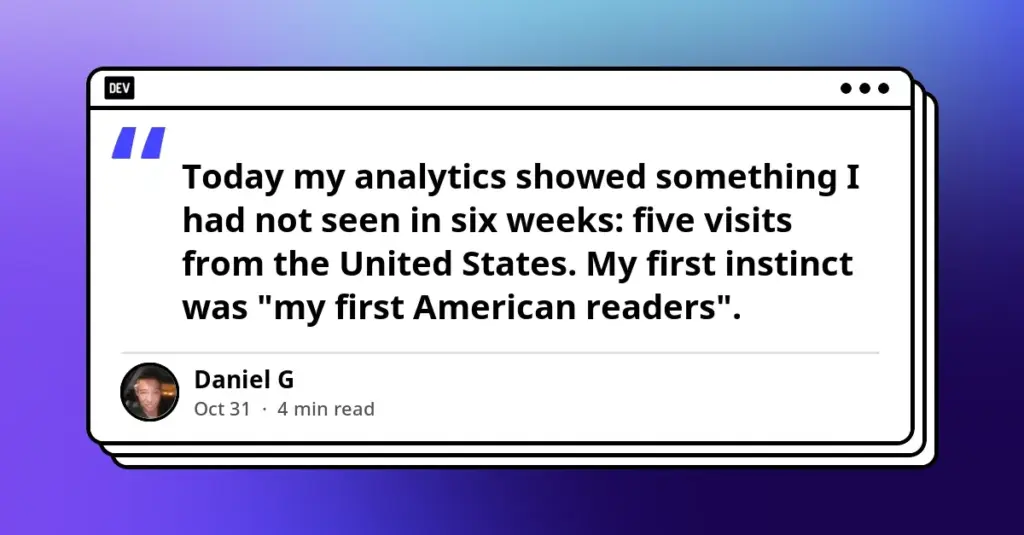
The first and most accessible filter is geography. For this specific project, the vast majority of domain loads—approximately 99%—originate from Singapore. This is the "baseline," largely composed of the developer’s own internal processes and cron jobs that "walk" the site roughly 500 to 700 times a day to ensure everything is functioning correctly.
A visitor from the United States is, therefore, a significant outlier. However, the developer warns that country of origin is a "cheap" filter that can easily mislead. A previous incident on October 22 saw four visitors from Germany and Poland appear at midnight, prompting a brief moment of excitement. That excitement was extinguished when it was discovered that a JavaScript-running crawler from a European data center looks identical to a human user at first glance. Geography, therefore, only proves that a visitor is "not obviously me."
2. The Build Window Analysis
The second check is more granular, involving a comparison of visit times against the project’s internal "build window." Like many modern web applications, One Minute Magic undergoes a nightly build process. Between 00:1x and 01:2x Singapore time, a fresh browser is automatically opened to verify the site’s deployment. This automated browser interacts with the site in a way that is virtually indistinguishable from a stranger; it writes to the same database tables and follows the same navigation paths.
The developer noted a recent example where three "named a first habit" events occurred on consecutive nights. Each event took place precisely within the automated build window. Without the context of the timing, this would have appeared to be the project’s best week of engagement. Instead, the data revealed a hard truth: all three events were the developer’s own scripts. The rule for the future is clear: every test row must be explicitly tagged with a "test-shaped" channel, or it risks being misread as human engagement.
3. Technological Diversity: Browsers and Operating Systems
The third and most reliable indicator of human presence is the diversity of the "user-agent" strings. Most simple crawlers and bots present a single, uniform user-agent, or perhaps a small, rotating set that utilizes the same underlying operating system.
 Software Development & Scripting for IT
From Hawaii to the Modern Web: How the ALOHA Protocols Defined the Efficiency of Digital Communication
The history of the modern internet is often told through the lens...
 Software Development & Scripting for IT
Afterlight: Bridging the Supernatural and Open-Source AI in a New Browser-Based Storytelling Studio
As the final week of Hacktoberfest 2024 unfolds, the global developer community...
 Software Development & Scripting for IT
The Architecture of Thought: Why Modern Software Engineering Mentorship is Moving Beyond Syntax
In the modern landscape of software development, a stark divide has emerged...







