

Intelligent-Tiering’s built-in monitoring replaces the need for manual scheduling but comes with a cost that scales with the number of objects. For a portfolio containing millions of small objects, this monitoring fee can become a substantial line item. Additionally, administrators should be aware that tag-based Lifecycle evaluations run daily, and updates can take time to propagate. Removing a tag does not necessarily stop a transition that has already been queued by the system.
Modeling the Risks of Early Exit and Retrieval
Before committing to any class with a minimum duration, enterprises must model the potential for "early-exit" fees. If an object is deleted, overwritten, or transitioned before the class’s minimum duration is met, AWS triggers a prorated fee for the remainder of that duration. Whether a single early restore or deletion wipes out the projected savings of a lower-cost tier depends entirely on the object size and the volume of data involved.
Furthermore, every transition to a Glacier tier adds 40 KB of per-object overhead. This consists of 8 KB billed at Standard rates and 32 KB at the destination Glacier rate. For organizations managing billions of small files, this overhead can entirely negate the benefits of a lower storage rate. In such cases, AWS recommends aggregating small objects into larger archives before applying Lifecycle rules—a step that adds complexity to the data pipeline but is often necessary for true cost optimization.
Visibility and Governance in Cloud Storage
Effective cost control is impossible without proper governance and visibility. Activating cost-allocation tags is a fundamental step, allowing bucket-level spending to appear on detailed billing reports. However, there is a delay in this process; it can take up to 24 hours for a tag to appear on the cost allocation page and another 24 hours to become active.
For monitoring the actual impact of these strategies, AWS suggests using S3 Storage Lens dashboards rather than relying solely on CloudWatch metrics. Storage Lens provides a clearer view of daily storage changes resulting from Lifecycle actions. This should be cross-referenced with S3 Inventory and server access logs to verify that objects are landing in the intended tiers and that expiration events are occurring as scheduled.
Ultimately, the choice of approach should be dictated by the workload. If an organization has a known aging curve and object sizes well above the 128 KB threshold, Lifecycle rules are the most efficient path. If the workload is new, unpredictable, or involves a complex data lake, Intelligent-Tiering provides essential insurance against the high costs of manual errors. In all cases, the storage-class rate is only one part of a much larger financial picture that requires constant monitoring and precise modeling to master.
 Enterprise Tech & Infrastructure
The Great Vector Consolidation: Why the Dedicated Vector Database Category is Fading into the General Stack
For several years, the narrative in the artificial intelligence infrastructure space was...
 Enterprise Tech & Infrastructure
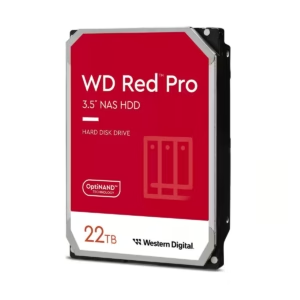
Seagate, Western Digital, and Toshiba Lead 2023 Rankings for Enterprise-Grade Storage Solutions
In the rapidly evolving landscape of corporate data infrastructure, the demand for...
 Enterprise Tech & Infrastructure
Nvidia Unveils Silicon-Level Guardrails as Industry Grapples with Surging AI Agent Breaches
The artificial intelligence industry, once defined by a breakneck race toward ever-greater...







