
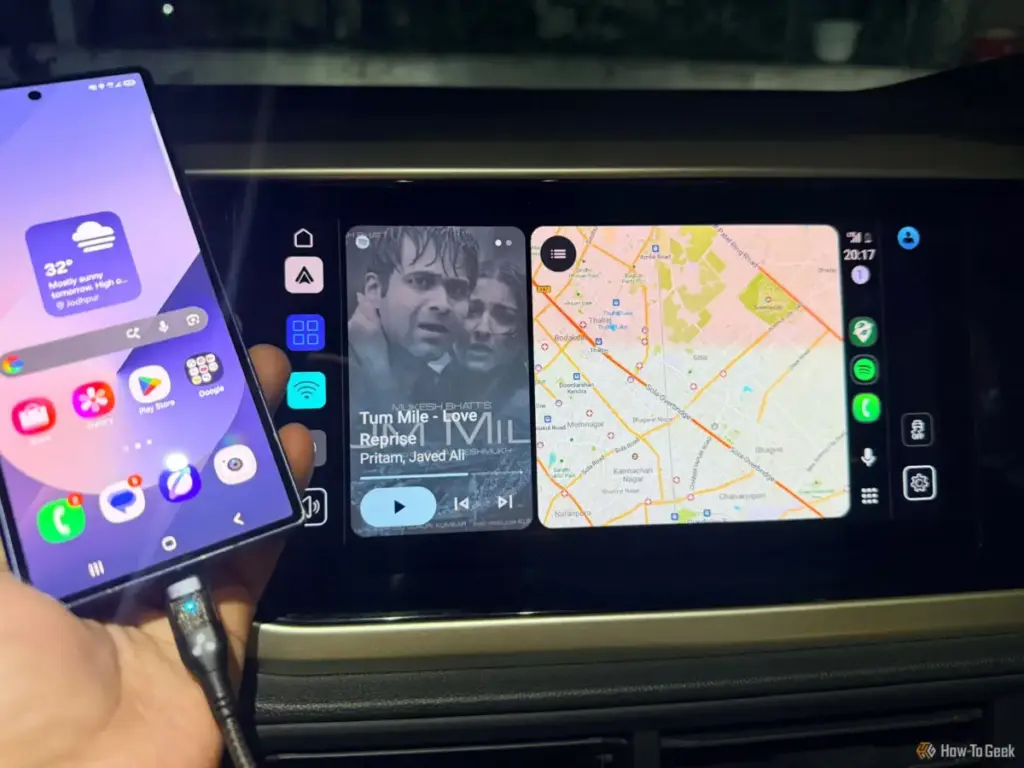

The primary drawback of Sygic, however, is its monetization model. Unlike many of its competitors, Sygic locks its most valuable features—including Android Auto connectivity itself and advanced driving tools—behind a "Premium+" subscription. This creates a significant barrier to entry for users accustomed to the free-to-use models of Google and Waze. Furthermore, there remains a functional disparity between the phone app and the car interface; several settings available on the mobile device are inaccessible through the vehicle’s touchscreen. While Sygic offers a premium experience, the recurring cost and interface limitations make it a difficult sell for the average daily driver.
3. TomTom GO Expert
Useful Lane Guidance, But the Interface Has Limits
TomTom is a name synonymous with the early era of portable navigation devices, and its GO Expert application attempts to bring that professional-grade heritage to the Android Auto platform. The app is particularly well-regarded by those who drive larger vehicles or who require highly specific lane instructions. In testing, the lane guidance was a standout feature, providing early and accurate warnings about which lane to occupy before reaching a tricky exit or a major highway split. This proactive approach to navigation significantly reduces the "last-minute scramble" that can lead to driver stress and unsafe maneuvers.
In addition to its lane-level precision, TomTom GO Expert provides reliable traffic alerts and excellent offline map management. However, the software’s transition to the car display is marred by several arbitrary limitations. Most notably, the Android Auto interface restricts search results, favorites, and recent destinations to just six entries. For power users with extensive lists of saved locations, this restriction feels unnecessarily punitive and forces frequent interaction with the smartphone to find destinations not present in the short list.
Much like Sygic, TomTom GO Expert suffers from a lack of parity between the mobile app and the in-car display. Many of the deep-dive settings that allow for a customized experience are missing from the dashboard, leaving the user with a simplified version that may not meet the needs of a "pro" user. While it remains a solid choice for those who value the TomTom brand’s accuracy, these interface hurdles prevent it from reaching the top of the rankings.
2. Waze
A Serious Google Maps Rival with Its Own Loyal Fan Base
Waze has cultivated a unique position in the market by transforming navigation into a collaborative, community-driven experience. On Android Auto, Waze excels at providing a real-time "pulse" of the road ahead. Its defining feature is its crowdsourced reporting system, which allows drivers to alert others to police presence, accidents, road hazards, speed cameras, and sudden traffic congestion. During the evaluation, the ease with which a driver can report an incident directly from the car’s display was noted as a major advantage for community safety and awareness.
The visual style of Waze is distinct, favoring a more stylized, icon-heavy map that prioritizes alerts over aesthetic realism. For many drivers, this focus on "what’s happening now" makes Waze an indispensable tool for avoiding delays and fines. However, Waze’s heavy reliance on an active internet connection for its core features—live traffic and dynamic rerouting—can be a liability in areas with poor connectivity.
 Tech Tutorials & How-To Guides
The Intersection of Innovation and Literature: How 3D Printing is Transforming the Modern Reading Experience
In an era dominated by digital screens and rapid-fire content, the enduring...
 Tech Tutorials & How-To Guides
From Pixels to Plastic: How Major Game Studios are Embracing the Official 3D Printing Movement
The relationship between video games and 3D printing has long been defined...
 Tech Tutorials & How-To Guides
Innovation in Pocket Utility: The Development of a MagSafe-Compatible EDC Toolbox
In the modern landscape of personal productivity, the concept of "Every Day...







