
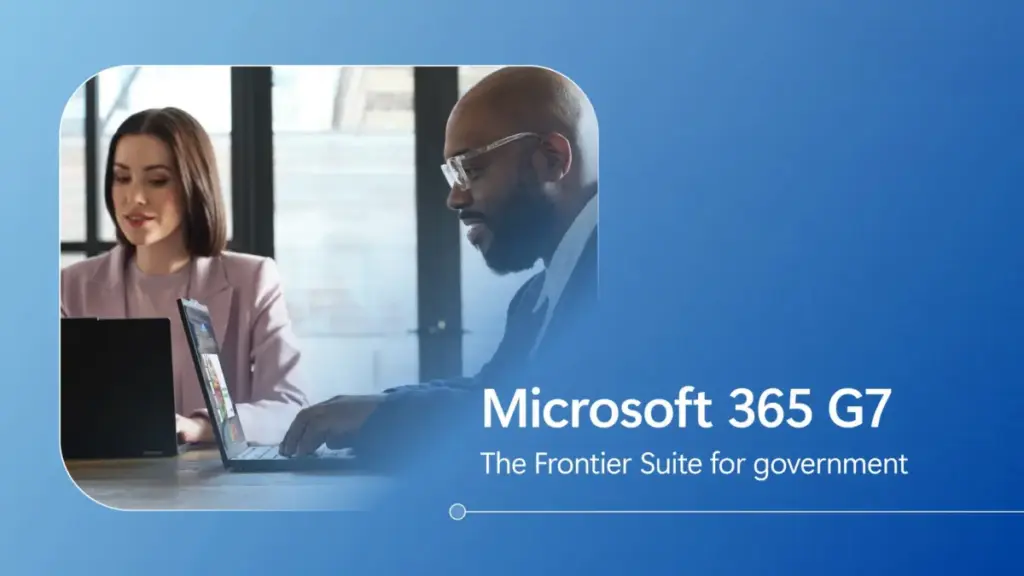
In a significant move to modernize the digital infrastructure of the United States public sector, Microsoft has announced the launch of Microsoft 365 G7, a comprehensive suite of tools designed specifically for government agencies. Dubbed the "Frontier Suite for government," this new offering is tailored for organizations operating within Government Community Cloud (GCC) environments. The announcement marks a pivotal shift in how the federal, state, and local governments are expected to integrate generative artificial intelligence, advanced security, and rigorous data governance into their daily operations.
The introduction of Microsoft 365 G7 comes at a time when government leaders are facing a complex trifecta of challenges: the urgent need to modernize aging legacy systems, the necessity of defending against increasingly sophisticated cybersecurity threats, and the pressure to meet the rising service expectations of the public. While AI has long been touted as a potential solution to these hurdles, Microsoft’s latest release emphasizes that technology alone cannot bridge the gap. Instead, the G7 suite is built on the philosophy that innovation and trust must advance in lockstep, providing a controlled environment where AI can be deployed at scale without compromising the stringent security standards required for public service.
Beginning October 1, GCC customers will be able to purchase Microsoft 365 G7 and the accompanying Agent 365 platform. Additional purchasing options are scheduled to follow on November 1. Due to the high-stakes nature of government missions, Microsoft is implementing a phased rollout. This approach allows agencies to begin licensing and planning their adoption of available experiences immediately, while more complex workloads will be introduced as they clear specific GCC authorization milestones and regulatory hurdles.
Built on the Trusted Foundation of Microsoft 365 for Government
The foundation of Microsoft 365 G7 is rooted in the existing G5 framework, which has served as the standard for secure productivity and collaboration within the public sector for years. However, G7 represents a substantial evolution of that foundation. It integrates the core capabilities of G5—such as information protection and advanced compliance—with the newly introduced Microsoft Entra Suite. This integration brings sophisticated identity management, access governance, and network security to the forefront, ensuring that both human users and automated AI agents operate within a secure, verified perimeter.
The concept of "Frontier Transformation" is central to the G7 value proposition. For many government agencies, AI has previously been relegated to isolated experiments or small-scale pilot programs. G7 is designed to break down these silos, providing the infrastructure necessary for governed adoption across an entire organization. By connecting intelligence directly to the flow of everyday work, the suite aims to move agencies from the "proof of concept" stage to a reality where AI is a standard, secure component of the mission.
This transition is supported by a robust control plane. IT and security leaders within the public sector are often wary of "shadow AI"—the unauthorized use of AI tools by employees. G7 addresses this concern by providing comprehensive visibility and management tools. These allow administrators to manage people, data access, and the behavior of AI agents with a level of confidence that matches the sensitivity of government data.
AI Embedded in the Flow of Work
One of the primary goals of Microsoft 365 G7 is to ensure that AI does not become another "destination" or a separate platform that employees must navigate. Instead, Microsoft is embedding Copilot and other AI-powered experiences directly into the applications that government workers use every day, such as Word, Excel, and Teams. The intent is to make the technology invisible yet indispensable, simplifying tasks rather than adding complexity to the user experience.
A critical component of this integration is "Work IQ." This technology grounds AI experiences in an agency’s specific organizational data, context, and existing tools. Unlike consumer-grade AI, which draws from the open internet, Work IQ ensures that the assistance provided by Copilot is informed by the unique mission and historical context of the agency. Crucially, these experiences are designed to operate strictly within the bounds of applicable permissions. This means that an AI assistant will only have access to the information that a specific user is already authorized to see, maintaining the integrity of data silos and security protocols.
At the time of general availability, G7 will offer a unified Copilot experience tailored for government needs. This will allow teams to conduct deep research, synthesize vast amounts of organizational knowledge, and collaborate on content creation with unprecedented speed. Looking ahead, Microsoft has signaled a "surge" of new capabilities arriving in the months following the initial launch. These updates are expected to include the latest commercially available GPT models, enhanced personalization features via Work IQ, and "Copilot Cowork"—a feature designed to assist with longer-running, multi-step projects that require sustained coordination across different applications.
Agents at the Mission’s Edge
Beyond general-purpose AI assistance, Microsoft 365 G7 introduces an "agentic foundation" for government work. In this context, agents are specialized AI entities designed to handle specific, high-value tasks such as policy analysis, grant management, case inspections, or constituent services. These agents are not merely chatbots; they are grounded in Work IQ and operate within accredited government clouds, ensuring they can connect securely to approved agency systems.
Agencies can begin their journey by utilizing pre-built Microsoft agents, such as the "Researcher" and "Analyst" models, which are optimized for common public sector workflows. For more specialized requirements, the suite includes Agent Builder and Microsoft Copilot Studio. these tools allow teams to create custom agents tailored to the unique demands of their specific mission.
To facilitate this, Microsoft 365 Copilot Connectors allow these agents to draw knowledge from disparate systems, bringing a wealth of agency data into a reachable, actionable format. The use of natural-language creation tools means that building these agents is no longer restricted to high-level developers; specialized program staff can participate in the creation process, while IT departments maintain overarching organizational controls to ensure all deployments align with agency standards and security policies.
Agent 365: The Control Plane for AI Adoption
As the use of AI agents expands, the need for oversight becomes paramount. The rapid adoption of autonomous or semi-autonomous tools can lead to significant blind spots if not managed correctly. Government leaders need definitive answers to questions regarding who owns an agent, what data it can access, and whether its operations remain within the scope of its intended purpose.
Agent 365 serves as the dedicated control plane for this new ecosystem. It provides a centralized dashboard where organizations can discover, register, and manage every agent active within their environment. This platform allows administrators to take immediate governance actions, such as deploying new agents to specific departments, blocking those that do not meet security criteria, or removing agents that are no longer needed.
At its launch, Agent 365 will focus on providing a unified foundation for discovery and identification. However, Microsoft expects the platform’s capabilities to evolve rapidly, eventually encompassing full lifecycle governance, advanced risk management, and deeper security integrations. This roadmap reflects the "Intelligence + Trust" vision, ensuring that as the intelligence of the agents grows, the tools to govern them grow in parallel. For agencies navigating the complexities of GCC compliance, the status of these features will be updated continuously as they clear the necessary authorization milestones.
Advancing the Mission with Confidence
The overarching goal of Microsoft 365 G7 is to empower government teams to build greater capacity and resilience. In an era where public servants are often asked to do more with less, AI represents a significant opportunity to scale impact. Whether it is responding more effectively to constituent inquiries or strengthening the resilience of national infrastructure, the G7 suite is positioned as the technological backbone for these efforts.
Realizing the full potential of this technology, however, requires more than just a software license. Microsoft’s announcement emphasizes the importance of leadership, workforce readiness, and responsible governance. The G7 suite provides the tools, but the success of "Frontier Transformation" will depend on how agencies integrate these tools into their broader mission strategies.
The phased rollout and the focus on accredited government clouds underscore Microsoft’s commitment to the unique requirements of the U.S. public sector. By combining AI directly within the flow of work with specialized mission agents and a robust governance control plane, Microsoft 365 G7 offers a path forward for agencies to modernize. It provides a framework where the pursuit of innovation does not come at the expense of the trust and security that are fundamental to public service.
Ultimately, the transformation of the public sector is about the people who serve. With the launch of G7, the focus remains on helping those individuals navigate complex work environments and advance their missions with the confidence that their tools are as secure as they are intelligent. As the capabilities of the suite continue to expand, it is poised to become a cornerstone of the modern, AI-enabled government.
 Productivity Software & Office Suites
Microsoft Announces General Availability of Work IQ APIs, Ushering in the Era of Agentic Software
REDMOND, Wash. — In a move that signals a fundamental transformation in...
 Productivity Software & Office Suites
Microsoft Reports 30 Million Copilot Seats as Enterprise AI Shifts from Assistance to Autonomous Agents
In its most recent earnings report, Microsoft announced a significant milestone in...
 Productivity Software & Office Suites
Microsoft Unveils Reimagined Copilot with Agentic Capabilities and New "Autopilot" Digital Teammate
Microsoft has announced a sweeping overhaul of its Copilot platform, signaling a...







