
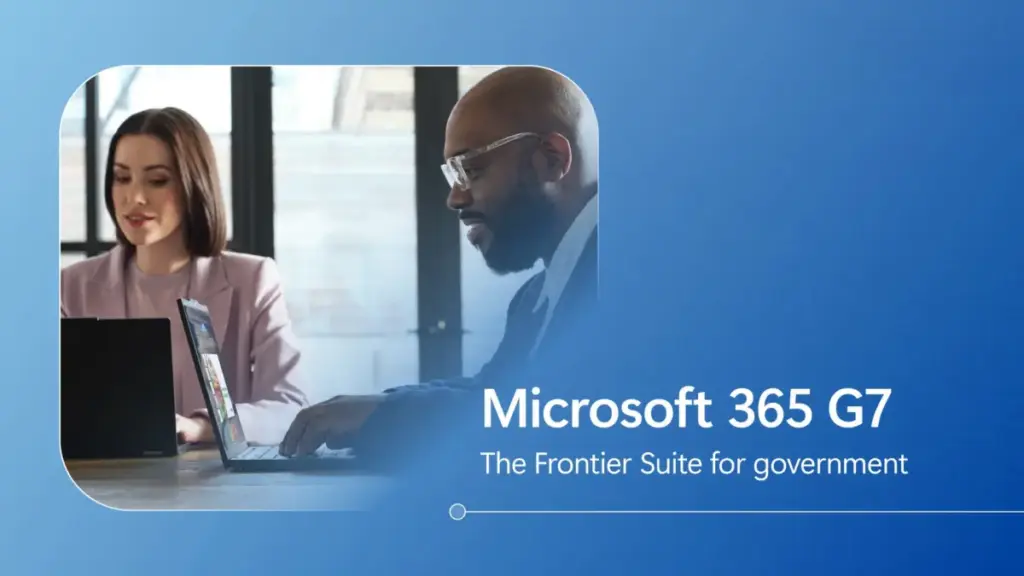
In a move designed to redefine how the public sector interacts with artificial intelligence and cloud productivity, Microsoft has announced the launch of Microsoft 365 G7. Dubbed the "Frontier Suite" for government, this new offering is tailored specifically for Government Community Cloud (GCC) environments, marking a significant milestone in the evolution of digital tools for U.S. public sector agencies.
The announcement comes at a pivotal moment for government leadership. Across federal, state, and local levels, officials are facing a complex trifecta of challenges: the urgent need to modernize aging legacy services, the requirement to address increasingly sophisticated cybersecurity threats, and the pressure to meet the rising expectations of constituents. Microsoft’s introduction of the G7 suite is positioned as a comprehensive solution to these pressures, integrating productivity, AI, specialized agents, security, identity, and governance into a single, cohesive ecosystem.
Central to this launch is the "Intelligence + Trust" vision, a framework first introduced with the commercial Microsoft 365 E7 suite. By extending this vision to government-specific environments, Microsoft aims to provide agencies with a secure path toward adopting AI at scale. The company emphasizes that while technology is a powerful catalyst for change, it must be grounded in the specific workflows of government work and overseen by a robust control plane to ensure that innovation does not outpace security.
Built on the trusted foundation of Microsoft 365 for government
The Microsoft 365 G7 suite does not exist in a vacuum; rather, it is built upon the established foundation of Microsoft 365 G5. For years, G5 has served as the standard for government organizations requiring advanced productivity tools coupled with high-level information protection and compliance capabilities. G7 takes this foundation several steps further, integrating the Microsoft Entra Suite to provide advanced identity management, access governance, and network security.
This architectural approach is particularly relevant for agencies operating under the Zero Trust security model. In a modern government environment, identity is the new perimeter. The inclusion of the Entra Suite within G7 ensures that both human users and automated AI agents are subject to rigorous access controls. This level of oversight is essential as agencies transition from isolated AI experimentation—often characterized by "shadow AI" or siloed pilot programs—toward a model of governed, organizational-scale adoption.
By providing a unified platform, Microsoft 365 G7 allows IT and security leaders to manage data and access with a higher degree of confidence. The goal is to facilitate what Microsoft calls "Frontier Transformation," a state where agencies can leverage the most advanced technological tools available while remaining firmly within the boundaries of federal regulatory and security requirements.
AI embedded in the flow of work
One of the primary critiques of early AI implementations in the workplace has been the "destination problem"—the requirement for users to leave their primary applications to interact with an AI tool. Microsoft 365 G7 addresses this by embedding Microsoft Copilot directly into the applications that government employees use every day, such as Word, Excel, PowerPoint, and Outlook.
The integration is powered by "Work IQ," a sophisticated layer that grounds AI experiences in an organization’s specific data, context, and tools. Crucially for the public sector, these experiences are designed to operate in strict accordance with existing permissions and governance policies. This ensures that when an employee uses Copilot to draft a report or analyze a dataset, the AI only accesses information that the employee is already authorized to see, maintaining the integrity of sensitive mission data.
At the time of general availability, G7 will offer a unified Copilot experience that enables government teams to conduct deep research, synthesize organizational knowledge, and collaborate on content creation with unprecedented speed. For a policy analyst, this might mean using AI to summarize thousands of pages of public comments on a proposed regulation. For a program manager, it might involve using Copilot to draft project plans based on historical performance data stored within the agency’s secure cloud.
Microsoft has also outlined a roadmap for the months following the initial launch. GCC customers can expect a surge of new capabilities, including the integration of the latest commercially available GPT models. Other upcoming features include Work IQ memory and personalization, which will allow the AI to "remember" preferences and context over time, and Copilot Cowork, a feature designed to assist with longer-running, multi-step workflows that involve multiple team members.
Agents at the mission’s edge
Perhaps the most forward-looking aspect of the G7 announcement is the emphasis on "agents." While general-purpose AI can assist with broad tasks, agents are specialized entities designed to support specific government functions. These can range from policy analysis and grant management to more operational tasks like building inspections and constituent service.
Microsoft 365 G7 provides an "agentic foundation," allowing agencies to deploy mission-focused agents that are grounded in Work IQ. These agents operate within accredited government clouds, ensuring that their connections to agency systems and data are both secure and policy-governed. At launch, agencies will have access to pre-built agents, such as Researcher and Analyst, which are designed to handle the heavy lifting of data gathering and synthesis.
To allow for more specialized missions, Microsoft is introducing Agent Builder and Microsoft Copilot Studio. These tools empower agencies to create custom agents tailored to their unique needs. For example, a department handling disaster relief could build an agent specifically designed to cross-reference grant applications with local property records and federal eligibility requirements.
To ensure these agents remain useful and secure, Microsoft 365 Copilot Connectors allow them to pull in knowledge from other systems. Managed connections provide a secure bridge to line-of-business applications, ensuring that the AI isn’t just generating text, but is actually interacting with the data that drives the agency’s mission. By using natural-language creation tools, Microsoft aims to broaden the pool of people who can build these agents, while maintaining organizational controls to keep deployments aligned with agency standards.
Agent 365: The control plane for AI adoption
As the use of AI agents expands within an organization, so does the complexity of managing them. Without proper oversight, an agency could quickly find itself with dozens of autonomous agents operating without clear ownership or transparency. Microsoft’s answer to this challenge is Agent 365, which serves as the central control plane for all agent activity within the G7 environment.
Agent 365 is designed to provide leaders with total visibility. It allows organizations to discover which agents are active, identify who owns them, and see exactly what data they are accessing. This transparency is vital for maintaining security and ensuring that AI tools are operating as intended. Through Agent 365, IT administrators can take decisive governance actions, such as deploying new agents to specific departments, blocking unauthorized agents, or removing those that are no longer needed.
At its general availability, Agent 365 will focus on these core discovery and identification capabilities. However, Microsoft expects the platform to evolve, eventually incorporating more advanced features related to risk management and the full lifecycle governance of AI entities. This structured approach to management is intended to prevent the "blind spots" that often accompany the rapid adoption of new technology, providing a disciplined framework for innovation.
Advancing the mission with confidence
The launch of Microsoft 365 G7 and Agent 365 is scheduled for October 1, when GCC customers can begin purchasing licenses and planning their deployments. However, the rollout will be phased. While customers can adopt many experiences at launch, certain workloads will become available only after they complete the required GCC authorization milestones. This phased approach is a deliberate nod to the "rigor government missions demand," ensuring that every feature meets the necessary security and compliance hurdles before it is deployed in a live environment.
The ultimate goal of the G7 Frontier Suite is to help public servants build capacity and strengthen resilience. In an era where government agencies are often asked to "do more with less," AI and automated agents offer a way to scale expertise and respond more effectively to the needs of the public.
Microsoft’s longstanding partnership with the U.S. government has always been predicated on the idea that public sector transformation is about more than just software; it is about empowering people to serve their communities better. By combining high-level intelligence with a foundation of trust and strict governance, Microsoft 365 G7 provides a roadmap for the future of the digital government. It offers a path where agencies can embrace the most advanced AI tools available today while maintaining the controls necessary to protect the public interest and advance national missions with confidence.
 Productivity Software & Office Suites
Microsoft Launches Copilot Cowork Globally, Bringing Agentic AI to the Fortune 500
Microsoft has officially announced the general availability of Copilot Cowork, marking a...
 Productivity Software & Office Suites
Microsoft Announces Microsoft 365 G7 and Agent 365 to Accelerate AI Adoption and Governance Across U.S. Government Agencies
In an era where the public sector faces the dual challenge of...
 Productivity Software & Office Suites
Microsoft Unveils ‘Autopilots’ and Scout: A New Frontier for Autonomous AI Agents in the Enterprise
The nature of professional productivity is undergoing a fundamental shift, moving away...







