
To support this shift toward user-generated solutions, Microsoft is introducing the "Copilot Managed Runtime." This hosting infrastructure allows the code generated by Copilot to run safely and securely within a company’s existing Microsoft 365 environment. It provides a sandboxed space governed by corporate IT departments, ensuring that while employees have the freedom to build tools, the organization maintains control over data security and compliance. This runtime environment will also be opened to third-party and professional developers, creating a unified foundation for apps built in Cowork, Code, and Copilot Studio.
Autopilot: The Persistent Digital Teammate
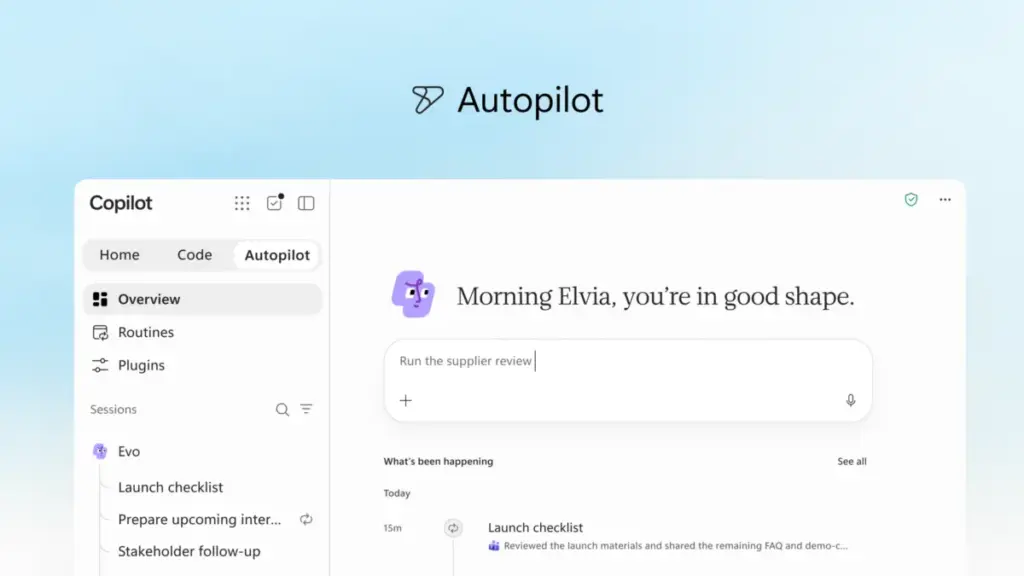
Perhaps the most significant leap toward autonomous AI is the introduction of "Autopilot." Formerly known during its development phase as "Scout," Autopilot is described as a digital teammate that can be assigned a specific name, role, and goal. Unlike traditional AI assistants that wait for a prompt, Autopilot is proactive and persistent. It works in the background, monitoring communication channels, following up on email threads, and managing recurring business processes.
Microsoft provided the example of a supplier review process to illustrate Autopilot’s potential. A user can task the agent with managing the entire cycle: building a schedule, handling pre-meeting preparations, conducting follow-ups, and even reaching out to stakeholders for updates. Because Autopilot is cloud-hosted, it continues to work even when the user is offline.

Autopilot is built on "Microsoft IQ," the company’s unified intelligence platform. It possesses its own identity, memory, and workspace within an organization’s tenant, allowing it to understand the specific nuances of how a particular business operates. It is designed to show up where people already work, such as in Microsoft Teams or Outlook, where it can be @mentioned like any other colleague. Microsoft emphasized that while the agent handles the heavy lifting, the human user remains in control, setting the boundaries and objectives while being kept informed of the agent’s progress.
Expanding Business Context and Data Grounding
For AI to be effective in an enterprise setting, it must be grounded in the specific data and context of that business. To this end, Microsoft is expanding the reach of Microsoft IQ. The platform now integrates "Fabric IQ," which brings more than 20 million semantic models from Power BI into the Copilot environment. This ensures that when a user asks a question or delegates a task, the AI is drawing from trusted, real-time organizational data.
Furthermore, Copilot is now grounded in workflows and data from Dynamics 365 and the Power Platform. This means a salesperson drafting a proposal can have Copilot automatically incorporate deal histories or customer support tickets directly into the document without having to switch apps or perform manual lookups.
To facilitate easier integration of third-party tools, Microsoft is launching a new "plugin registry." This unified catalog allows IT departments to centrally approve and manage plugins from Microsoft, its partners, and custom internal builds. Developers can publish a plugin once and have it extend Copilot’s capabilities across all supported Microsoft 365 experiences, providing a streamlined way to introduce new functionalities at scale.
Managing the Economics of AI
As AI usage grows within organizations, managing the associated costs has become a primary concern for business leaders. Microsoft addressed this by outlining a dual-track pricing and spending model.
 Productivity Software & Office Suites
Microsoft Unveils the Next Generation of Copilot: A Reimagined AI Platform for the Evolving Digital Workplace
In a significant move to redefine the intersection of artificial intelligence and...
 Productivity Software & Office Suites
Microsoft Launches Copilot Cowork Globally, Bringing Agentic AI to the Fortune 500
Microsoft has officially announced the general availability of Copilot Cowork, marking a...
 Productivity Software & Office Suites
Microsoft to Headline ESPC 2026 in Amsterdam as the European Tech Community Pivots Toward an Agentic AI Future
As the global landscape of work undergoes its most significant transformation since...







