

In a recent earnings call that signaled a pivotal moment for the future of productivity, Microsoft announced that Microsoft 365 Copilot has officially surpassed 30 million paid seats. The milestone is underscored by a remarkable acceleration in adoption, with net seat additions more than doubling on a quarter-over-quarter basis. While the raw numbers highlight a commercial success, Microsoft leadership suggests these figures point to a much deeper, more fundamental shift in the global labor market: the transition of artificial intelligence from a passive digital assistant to an active, autonomous participant in the workplace.
The data suggests that across nearly every major industry, organizations are no longer merely "using" AI as a tool; they are redesigning their entire operational workflows around it. Employees are increasingly moving into managerial roles over AI "agents," directing them to oversee complex tasks, long-term projects, and intricate business processes. This evolution is expanding the agency of the individual worker, allowing them to exert a level of impact that was previously reserved for large teams or high-level executives.
According to Microsoft, the first phase of enterprise AI was largely defined by adoption metrics—deployments, licensing, and the initial excitement over hours saved. While those gains continue to compound, the industry is now entering a second phase defined by total transformation. The company’s mission to empower every person and organization is finding new life as humans and agents collaborate to build solutions and execute strategies that were once considered impossible. New telemetry signals from Microsoft 365 Copilot, alongside real-world implementation stories from global partners, reveal a three-pronged transformation: deeper and broader usage, the emergence of net-new capabilities, and a shift toward role-specific specialization.
A Step Change in Innovation
The technological landscape has shifted in recent months with the emergence of a new category of AI: models wrapped in "agentic harnesses." Unlike standard generative AI that requires constant prompting, these agents can close their own feedback loops. They are designed to plan, execute, test, and correct their own work autonomously to deliver a final, polished result.
A primary example of this technology is Copilot Cowork, which reached general availability in June. Cowork is designed to handle multi-step, end-to-end projects. A user defines a task, and the agent manages the workflow from inception to completion. Its multi-model architecture allows it to scale its capabilities based on the complexity of the task, utilizing different models as needed. Internal testing has shown that this multi-model approach is not only more effective but also 30% to 40% more cost-efficient than relying on a single, massive model for every step of a process.
Alongside Cowork, Microsoft introduced "Microsoft Scout," an autopilot agent that functions as an always-on personal assistant with its own identity and set of permissions. Scout is designed to keep projects moving in the background, even when the human user is focused elsewhere. These outputs are grounded in what Microsoft calls "Work IQ"—a system that understands the specific context of an organization, including internal roles, project priorities, and institutional knowledge.
This innovation is also changing how software itself is built. Microsoft revealed that the core engineering team for Cowork remained intentionally small, growing from just three engineers at the start to only nine by the time the product hit the market. Despite the small headcount, the team achieved a remarkable speed-to-market, moving from initial concept to a preview used by half of the Fortune 500 within just six months. This breakthrough was made possible by rebuilding the software development process around agents, allowing a tiny team to achieve a scale of automation and speed that traditional engineering workflows could never match.
Omar Shahine, Corporate Vice President of Microsoft Scout, noted that his role has shifted from traditional management to "creating the conditions for expert teams to move quickly." By using autonomous agents with shared context and clear specifications, his team moved from concept to product in weeks rather than months. These "frontier teams" are serving as a blueprint for how knowledge work will likely be structured in the coming years.

Depth and Breadth of Use
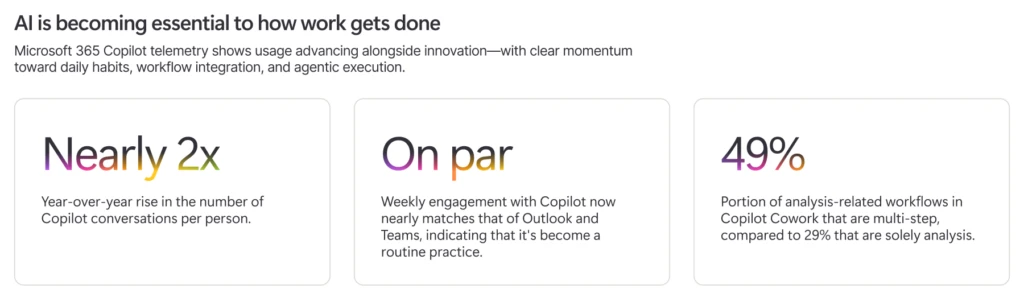
As the underlying technology matures, the way employees interact with Copilot is becoming more sophisticated. Over the past year, the number of AI conversations per user has nearly doubled. Furthermore, the number of users engaging with multiple Copilot features simultaneously has seen triple-digit growth. Perhaps most telling is that average weekly engagement with Copilot is now on par with foundational communication tools like Microsoft Outlook and Teams, suggesting that AI is no longer a "special use" tool but a staple of the daily routine.
There is also a noticeable shift in the types of requests being made. Microsoft’s analysis shows a significant rise in multi-step workflows. Users are no longer just asking for a summary of a meeting; they are asking Copilot to analyze a data set, draft a corresponding email, research potential solutions to a discovered problem, and then write the code to implement those solutions. Analysis-related work now accounts for 49% of all tasks when integrated into multi-step workflows, a sharp increase from the 29% seen when analysis is performed as a standalone task. This indicates that AI is increasingly responsible for managing entire sequences of work.
While early adopters were concentrated in the banking, manufacturing, and technology sectors, new industries are quickly catching up. Automotive and healthcare have emerged as some of the fastest-growing sectors for agent adoption. This suggests that the value of AI agents is successfully translating to industries with highly specific, non-digital operational needs.
The scale of deployment is also reaching new heights. The number of Microsoft customers with more than 50,000 seats has increased more than sevenfold year over year. Additionally, the number of enterprise customers deploying Copilot to the majority of their information workers grew by nearly 75% in the last quarter alone. Most impressively, the time it takes for a company to reach "high usage"—defined as more than 80% monthly active usage across the user base—has dropped from several months to just a few days over the last year.
What AI Makes Possible
For many organizations, the initial goal of AI was simple efficiency. However, the leaders in the space are now looking at how AI can expand the very boundaries of what an organization can achieve. Microsoft’s own Cloud Supply Chain team recently demonstrated this by taking a "lean before agents" approach. They first simplified six end-to-end workflows and established a shared data foundation before deploying 70 purpose-built agents across sourcing and logistics. This led to a 75% reduction in cycle time, proving that AI is most effective when it is layered onto optimized processes rather than broken ones.
At Eaton, an intelligent power management company, AI is being used to transform root cause analysis in manufacturing. Traditionally a time-intensive process, Eaton now employs an AI-powered quality agent to review manufacturing reports. The agent surfaces potential supplier insights and trends across thousands of reports, allowing experts to identify risks much earlier than before. To date, the agent has been applied to 5,000 reports, keeping human experts at the center of the final decision-making process while drastically accelerating the data-gathering phase.
In the healthcare sector, Premera Blue Cross has empowered its employees to build their own AI agents using Copilot Studio. By providing training and clear guardrails, the company allowed its staff to automate repetitive manual work. The result has been the creation of over 900 agents. One specific agent, designed for intelligent document processing, reduced a manual contract exhibit workflow from 45 minutes down to just three minutes. This time savings allows staff to focus more on member care and critical questions rather than paperwork backlogs.
Other companies are using AI to perform tasks that were previously deemed impossible due to their sheer scale. Levi Strauss & Co. utilized an agent to analyze 1,100 finance standard operating procedures, cataloging 18,000 individual tasks in a single day. Lisa Sterling, Vice President of Finance at Levi’s, noted that the agent was able to quantify opportunities that she had previously assumed were impossible to measure.
Similarly, global consulting firm EY has piloted an Autonomous Sourcing Agent (ASA) to handle low-cost, low-risk procurement transactions. The ASA can negotiate with multiple suppliers simultaneously regarding delivery timelines, costs, and warranties. Since its pilot began in October 2025, it has supported hundreds of transactions and is expected to handle 1,500 in the coming year, ensuring that human judgment is reserved for high-stakes escalations.
Specialization at Scale
A key differentiator for successful AI integration is specialization. Microsoft has observed that the organizations seeing the most value are moving away from "general-purpose" deployments. Instead of giving everyone the same tool, these companies are building AI around the specific patterns of individual roles.
S&P Global, for instance, used Microsoft Copilot Agent Builder to create a specialized agent within Microsoft Teams. This allows customers to interact directly with commodities research and market insights. The result was a 95% increase in the speed of data extraction and a 98% increase in the speed of comparative analysis, turning vast amounts of data into actionable intelligence almost instantly.
Inside Microsoft, the sales team has mapped different "seller personas" to dedicated agents, such as "Researcher," "Analyst," and "Deal Agent." By delegating administrative tasks to these agents, sellers were able to double their time spent in customer-facing activities—from 25% to 50%. The pilot group reported 9.4% more revenue per head and 20% faster deal closures.
At the marketing firm Kantar, a system of 10 interconnected agents now handles HR queries. An employment verification letter that used to take three days to process is now delivered in just 120 seconds. The share of HR queries handled by these agents has risen from zero in February to 40%, with a year-end goal of 95%.
Finally, Microsoft’s People Operations team is utilizing "Frontier Tuning" to scale HR expertise. By capturing the skills and rubrics of human practitioners, they have built an AI-powered system that delivers a 5x improvement in successful task completion compared to general-purpose models. This allows HR experts to move away from routine operational work and focus on nuanced, strategic employee interactions where human insight is irreplaceable.
What’s Next
As AI technology continues to advance, the metrics for success are shifting. The focus is moving toward the depth of use, the measurable redesign of workflows, and the governance of autonomous agents. The organizations building a durable competitive advantage are those where technology, operating models, and human agency are evolving in tandem. This new era marks the rise of the "Frontier Firm," where the collaboration between human intelligence and agentic AI becomes the primary engine of organizational growth and innovation.
 Productivity Software & Office Suites
Microsoft Announces Global Launch of Copilot Cowork, Introducing Agentic AI to the Modern Enterprise
In a move that signals a significant shift in the landscape of...
 Productivity Software & Office Suites
Microsoft Announces Fifth Annual Power Platform Community Conference in Las Vegas to Bridge the Gap Between AI Innovation and Business Process
As the global enterprise landscape continues to evolve, the fundamental machinery of...
 Productivity Software & Office Suites
Microsoft Launches Copilot Cowork Globally, Bringing Agentic AI to the Fortune 500
Microsoft has officially announced the general availability of Copilot Cowork, marking a...







