
Powered by the same underlying technology as GitHub Copilot, the Code feature enables users to describe a business problem—such as the need for a persistent desktop widget to track shipments or an interactive dashboard to test financial outcomes—and watch as Copilot builds the solution. These apps are hosted securely within the company’s Microsoft 365 environment through the new Microsoft Copilot Managed Runtime. This infrastructure ensures that while any employee can build a tool, the results remain governed by IT, connected to live company data, and accessible across the organization.
For professional developers, this system is designed to be complementary. While they continue to use GitHub Copilot for high-level software engineering, the broader Copilot platform allows for more connectivity between custom-built internal tools and the wider enterprise ecosystem. This "sandboxed" approach aims to balance the need for rapid innovation with the strict security requirements of modern IT departments.
The Rise of the Autonomous Digital Teammate
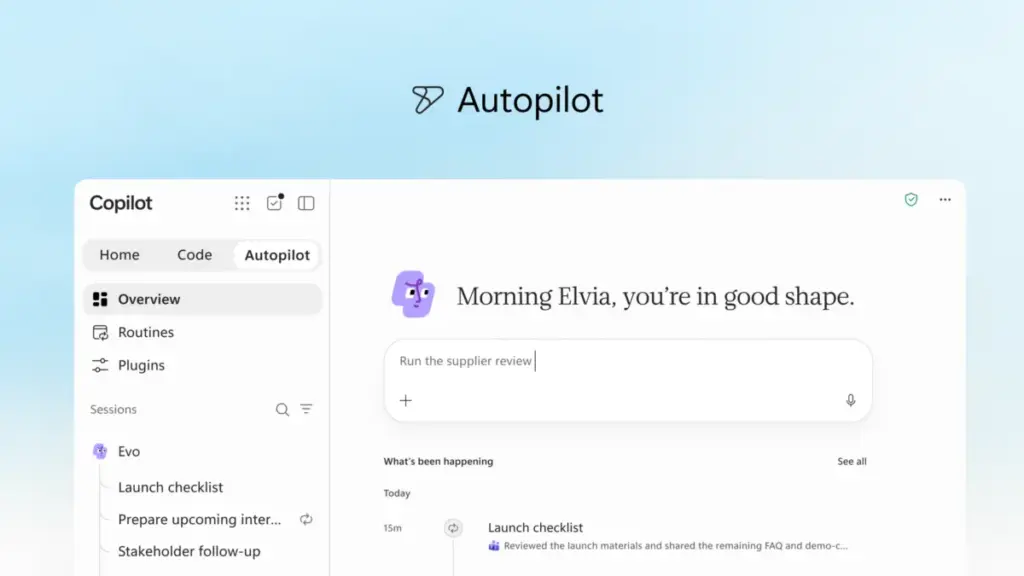
The most forward-looking element of the announcement is "Autopilot," a proactive personal agent previously known by the internal codename "Scout." Unlike traditional AI that waits for a user prompt, Autopilot is designed to work independently. Users can assign it a name, a role, and a specific goal, such as managing a supplier review process.
Once activated, Autopilot can monitor communication channels, follow up on email threads, and handle the logistical heavy lifting of a project. It can build schedules, coordinate meetings, and reach out to stakeholders for updates without constant human intervention. Because it is cloud-hosted, it continues to operate even when the user is offline.

Autopilot is built on "Microsoft IQ," a platform that provides the agent with an understanding of the organization’s specific workflows and history. It functions as a digital colleague with its own identity and memory, appearing in Teams, Outlook, and documents where it can be @mentioned like any other team member. Microsoft emphasizes that while the agent is autonomous, it operates within strict boundaries and permissions set by the user and the organization, ensuring that human oversight remains central to the process.
Expanding Business Context and Data Grounding
For AI to be truly effective in a corporate setting, it must understand the specific data and context of the business it serves. Microsoft is addressing this through "Fabric IQ," which connects Copilot to the vast amounts of data held in Power BI and other semantic models. This grounding ensures that when a user asks a question or delegates a task, the AI is pulling from trusted, real-time internal data rather than general information.
Furthermore, Microsoft is integrating data from Dynamics 365 and the Power Platform into the Copilot workflow. For example, a salesperson drafting a proposal can now have Copilot automatically incorporate deal history or active support tickets directly into the document. This deep integration is supported by a new unified plugin registry, a central catalog where IT can manage and approve Microsoft, partner, and custom-built plugins. This registry allows developers to publish a tool once and have it function across all Copilot-supported experiences, from Teams to Word.
 Productivity Software & Office Suites
Microsoft Reimagines Copilot as a Central Hub for AI-Driven Work and Autonomous Agents
In a significant shift for the future of digital productivity, Microsoft has...
 Productivity Software & Office Suites
Microsoft Announces Fifth Annual Power Platform Community Conference in Las Vegas to Bridge the Gap Between AI Innovation and Business Process
As the global enterprise landscape continues to evolve, the fundamental machinery of...
 Productivity Software & Office Suites
Microsoft Announces Microsoft 365 G7 and Agent 365 to Accelerate AI Adoption and Governance Across U.S. Government Agencies
In an era where the public sector faces the dual challenge of...







