
Managing the Economics of AI
As AI usage scales, organizations are increasingly concerned with the associated costs. Microsoft is addressing this through a new "FinOps for AI" framework, designed to help businesses manage spend while maximizing value. The company is introducing a two-tiered approach to billing: User Subscription Licenses (USL) and Usage-Based Billing (UBB).
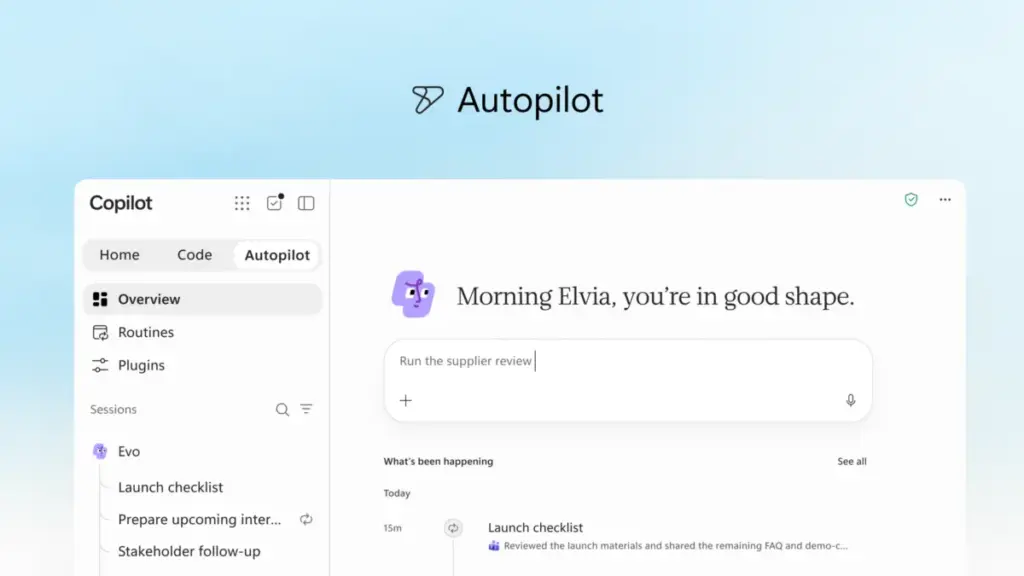
For everyday tasks like drafting emails or summarizing meetings, the USL provides a fixed-cost model. At the heart of this is a feature called "Auto," which intelligently routes requests to the model best suited for the task based on a balance of accuracy, speed, and cost. For more complex, "agentic" work—such as the long-running tasks handled by Autopilot or the custom applications built in Code—Microsoft is moving toward a usage-based model. This allows organizations to use advanced frontier models, such as Astra and Fable, while maintaining control over their budget.
New administrative tools are also being introduced to provide transparency. Admins will be able to set spending policies, manage model availability for different groups, and analyze which AI tasks are generating the highest ROI. End users will also gain visibility into their own credit usage, helping them stay within organizational guardrails while utilizing AI tools.

A Sneak Peek at the Proactive Future
Looking ahead, Microsoft offered a glimpse into upcoming features designed to make Copilot even more personalized. A new command center called "Today" is set to enter private preview in October. Today acts as a proactive assistant that scans mail, calendars, and Teams threads to surface what needs immediate attention. It doesn’t just show the work; it prepares it. For instance, it might have a draft response ready for an urgent email or a proposed schedule change for a conflicting meeting, allowing the user to simply review and send.
Additionally, the introduction of "@Copilot" in Teams will allow the AI to act as a participant in group settings with shared context. In a channel or group chat, the AI can explain the reasoning behind past decisions by pulling from previous conversations across the organization. It can also help manage the ripple effects of those decisions—such as adjusting launch timings or manufacturing schedules—and prepare cross-functional reviews to keep all stakeholders aligned.
As these features begin to roll out through the Frontier program in the coming weeks, Microsoft is positioning the new Copilot as the essential infrastructure for the future of work. By moving from reactive chat to proactive partnership, the company is betting that the "flow of human ambition" is best supported by an AI that can not only talk but also build, manage, and act. These innovations will be a major focus at the upcoming Microsoft Ignite conference in November, where the company plans to share further details on how these tools will empower organizations to reimagine their operations in an AI-first world.
 Productivity Software & Office Suites
Microsoft Announces Global Launch of Copilot Cowork, Introducing Agentic AI to the Modern Enterprise
In a move that signals a significant shift in the landscape of...
 Productivity Software & Office Suites
Microsoft Unveils Advanced AI ‘Skills’ and Data Connectors to Transform Excel for Finance Professionals
The evolution of modern computing has historically followed a predictable trajectory, moving...
 Productivity Software & Office Suites
Microsoft Announces Microsoft 365 G7 and Agent 365 to Accelerate AI Adoption and Governance Across U.S. Government Agencies
In an era where the public sector faces the dual challenge of...







